Summary
- A realistic parent handbook focused on choosing a toddler daycare in Langley with clarity, confidence, and complete peace of mind.
- Breaks down provincial licensing requirements, group sizes, and supervisory oversight enforced across the Fraser Health region.
- Explores how child-led discovery, emotional co-regulation, and intentional classroom environments support rapid toddler development.
- Outlines essential tour inspection strategies, direct questions, and subtle observations that reveal the true atmosphere of a centre.
- Delivers practical guidance on managing waitlists, navigating fee structures, and smoothing the emotional transition to group care.
Stepping into the world of early childhood care is one of the most emotional, high-stakes decisions a young family ever faces. As children transition out of infancy, their world expands rapidly. They develop budding personalities, fierce desires for independence, and boundless physical energy that requires careful guidance and positive social interaction. For local parents, choosing a toddler daycare in Langley can feel like balancing a complex puzzle of logistical convenience, licensing safety, educational philosophy, and intuitive comfort.
Reputable local centres such as Kiddie Kollege, located at 20103 53 Ave, Langley, BC V3A 3T8, Canada, demonstrate how a thoughtfully run multi-age childcare program creates an environment where little learners feel protected, challenged, and genuinely heard.
Understanding the underlying landscape of early learning in British Columbia turns what could be an overwhelming task into an empowering journey. Rather than simply settling for the nearest open slot, families can evaluate prospective centres with the discerning eye of an early learning specialist. By focusing on regulatory compliance, daily rhythm, educator stability, and classroom design, you ensure your child’s formative years are rooted in safety and joyful discovery.
Have questions about choosing the right toddler program for your child? Click the WhatsApp button below to chat instantly with our Langley team.
Licensing Standards and Provincial Regulations in British Columbia
The cornerstone of any quality evaluation begins with regulatory compliance. In British Columbia, community care facilities are legally governed by the Community Care and Assisted Living Act and the Child Care Licensing Regulation, overseen regionally by Fraser Health.
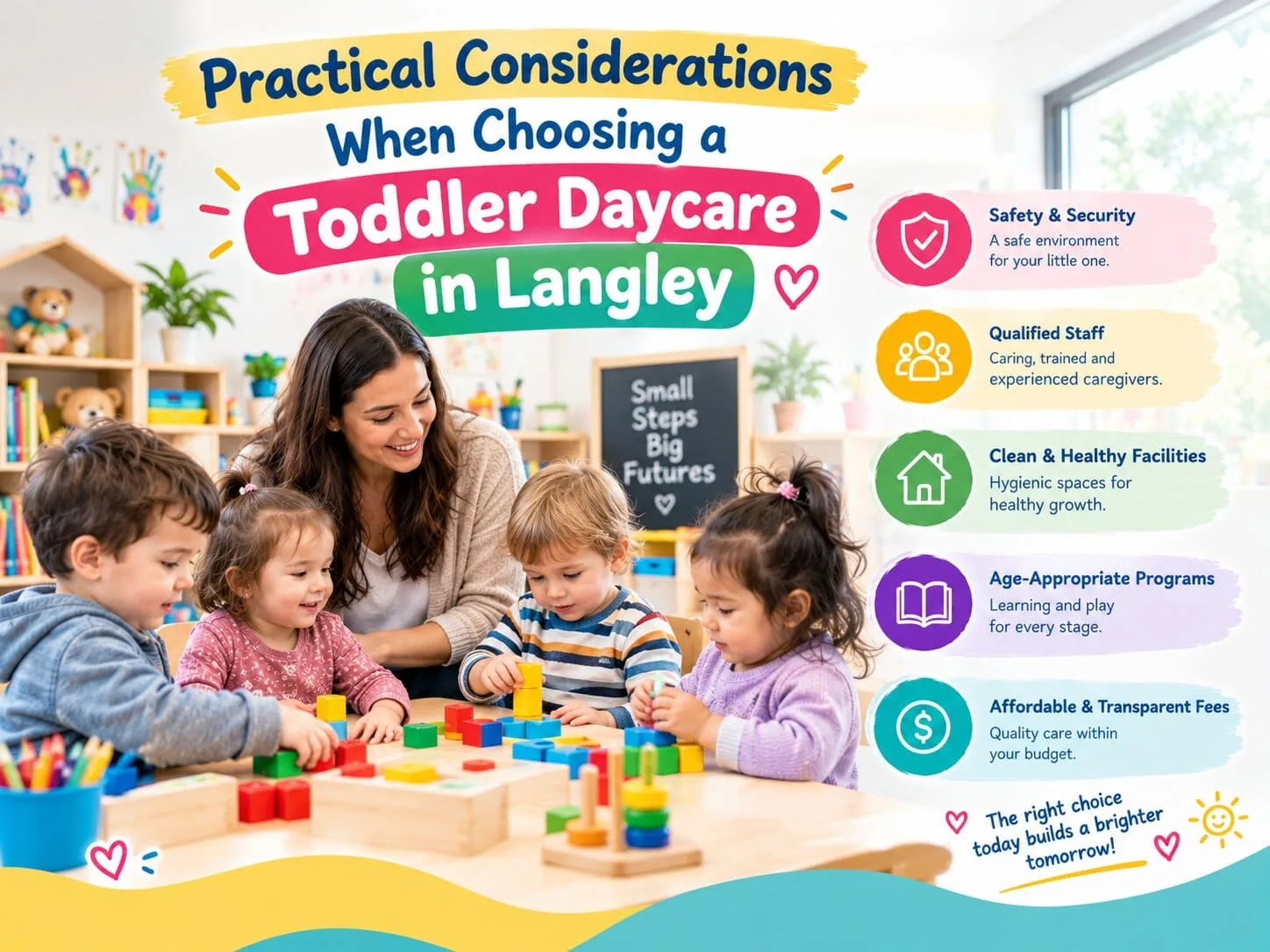
A fully accredited and licensed daycare in Langley must meet rigorous provincial requirements that casual arrangements or unlicensed babysitters cannot match. These standards cover building safety codes, adequate square footage per child, hygienic food preparation, outdoor perimeter fencing, and comprehensive background checks for all staff.
Beyond physical safeguards, provincial law strictly dictates maximum group sizes and supervision limits. When speaking with facility directors, you must verify adherence to mandated daycare staff-to-child ratios BC licensing boards require for toddler cohorts, which generally stipulate one qualified early childhood educator for every four toddlers, with maximum group capacities strictly maintained. These legal ratios ensure that during critical daily moments, such as diaper changes, feeding times, and outdoor exploration, no child is ever left without attentive, responsive supervision.
Assessing Educational Philosophy: Structured Routines Versus Play-Based Exploration
Toddlers learn fundamentally through their senses, active body movement, and tactile trial and error. Rigid academic drills, worksheets, and prolonged sedentary periods run counter to everything modern developmental science tells us about early brain growth.
Enrolling your child in an intentional play-based daycare Langley families trust means choosing an environment where learning is woven seamlessly into everyday activities. In a strong play-based classroom, you will observe distinct learning zones rather than rows of desks:
- Sensory exploration areas featuring water tables, textured kinetic sand, and non-toxic clay that build neural connections and fine motor dexterity.
- Dedicated building hubs filled with natural wood blocks and magnetic tiles that teach preliminary concepts of balance, gravity, and geometric spatial relations.
- Dramatic play kitchens, costume corners, and miniature grocery stands where toddlers practice social roles, collaborative dialogue, and early empathy.
- Quiet literacy nooks stocked with low-reach bookshelves, soft floor cushions, and textured board books that nurture a relaxed love for print.
A rich educational program provides gentle structure through a predictable daily rhythm. Toddlers thrive when they know that morning greeting circles are naturally followed by outdoor play, nourishing snacks, creative exploration, and quiet afternoon rest. This predictable flow provides psychological safety, reducing behavioral resistance and easing transitions throughout the day.
The Power of Educator Stability and Emotional Attunement
Classroom furniture and educational materials are wonderful, but the human beings interacting with your toddler are the heart and soul of any centre. At eighteen to thirty-six months of age, children navigate intense emotional waves. They experience big feelings without having the neurological maturity or expressive vocabulary to regulate those states independently.
High-quality early learning professionals act as emotional anchors. Observe how teachers speak to young children during active hours:
- Do educators bend down to eye level when listening to a frustrated or crying child?
- Do they validate feelings with calm, descriptive language like, “I see you are sad because it is time to put the red truck away,” rather than dismissing the child’s distress?
- How do they handle common toddler friction, such as toy grabbing or biting?
Compassionate educators never use isolation or punitive measures. Instead, they use calm physical redirection, positive guidance, and collaborative co-regulation. Furthermore, ask about staff retention during your evaluation. High educator turnover can disrupt a toddler’s sense of attachment and security, while a stable, long-tenured teaching staff builds lasting, trust-filled bonds that allow sensitive little learners to flourish.
Touring Facilities: What to Look for Beyond the Brochure
Visiting a facility in person is the single most informative step in your decision-making process. A glossy website or well-curated social media page cannot substitute for the sights, sounds, and smells of an active classroom.
When walking through a centre, keep your senses attuned to the physical environment:
- Hygiene and Air Quality: Is the facility tidy without smelling overwhelmingly of harsh chemical bleaches? Are diaper changing tables sanitized between uses, with handwashing sinks readily accessible within the care area?
- Natural Lighting and Space Flow: Does the room have ample natural daylight and ventilation, or does it feel dark, noisy, and cramped? Is the room divided cleanly so that active running zones do not cross paths with quiet rest or reading areas?
- Outdoor Play Infrastructure: Is the outdoor play yard fully fenced, secure, and covered to allow fresh air play during our rainy West Coast seasons? Does the ground surface use child-safe shock-absorbing materials beneath climbing structures?
Preparing a concise list of targeted questions to ask a daycare tour helps you cut through sales talk and discover how the centre operates day to day:
- What are your formal communication policies for sharing daily updates on naps, meals, and social milestones?
- How do educators support children through illness, teething discomfort, or developmental sleep regressions?
- What specific professional certifications and pediatric first-aid credentials do your classroom educators maintain?
- What are your written policies on managing food allergies, meal storage, and specialized dietary preferences?
- Can parents drop in unannounced to visit or check on their child during program hours?
Transparent, professional centres welcome these detailed inquiries and will answer them openly, viewing parent questions as a sign of mutual dedication to the child’s well-being.
Practical Logistics, Community Budgets, and Scheduling
Even the most beautiful childcare program must align with your family’s practical everyday realities. Langley is home to many working parents who commute daily toward Vancouver, Burnaby, or Surrey along major routes like Highway 1, Fraser Highway, and 200th Street.
Consider how the facility’s operating hours align with your commute. A centre that closes strictly at 5:00 PM may cause chronic stress if you encounter bridge or highway delays, whereas a centre offering extended care windows provides valuable breathing room.
Financial planning is another critical pillar. Researching affordable child care Langley options requires looking closely into provincial fee reductions. Check whether the facility participates in the provincial Child Care Fee Reduction Initiative (CCFRI), which significantly lowers monthly parent fees across British Columbia. For eligible lower-to-middle-income families, ask whether the centre’s administrative office works directly with the Affordable Child Care Benefit (ACCB) to ensure government subsidy paperwork is processed efficiently without causing administrative delays.
Continuity of Care and Developmental Transitions
Children grow with surprising speed. A facility that supports infants and toddlers must also provide a clear pathway for ongoing development as your child approaches preschool age and kindergarten.
Choosing an established multi-age care provider prevents the emotional friction of moving your child to a brand-new facility every couple of years. When a child can transition smoothly from a cozy toddler environment into a vibrant pre-kindergarten classroom within the same community building, they retain familiar physical surroundings, friendly teacher faces, and established peer groups.
Furthermore, a well-managed toddler daycare transition requires sensitive collaboration between home and school. Top-tier centres implement gentle, phased settling-in schedules rather than expecting a two-year-old to manage a ten-hour day right away. Gradual separation protocols—starting with a one-hour classroom visit alongside a parent, moving to a short morning session, and building up to naptime—allow your child’s nervous system to adapt to group care with confidence and ease.
Exploring Comprehensive Local Care Pathways
As you explore dynamic childcare programs throughout Langley, you will see how distinct early learning philosophies translate into everyday classroom practices. A progressive kiddie kollege daycare approach demonstrates that academic readiness does not require forced memorization; rather, it is born naturally through sustained curiosity, social cooperation, and physical competence.
Parents seeking a dedicated child care service want more than basic supervision while they work. They want a reliable second home where their child’s unique emotional rhythms, quirks, and achievements are celebrated every day. While compiling your shortlist, you might find yourself exploring community options near downtown Langley or searching online directories for a loving toddler daycare near me that emphasizes play-based discovery. Families planning for upcoming educational stages often combine this search with tours of an accredited pre school near me or look specifically for a fully verified licensed daycare near me close to 53rd Avenue or Murrayville to keep family morning routines simple and stress-free.
Frequently Asked Questions
What is the typical toddler daycare availability and waitlist status in Langley?
Like much of British Columbia, licensed toddler spaces in Langley experience high demand, with many centres maintaining active waitlists. It is highly recommended that families begin submitting inquiries and registering on facility waitlists six to twelve months before their intended return-to-work date to ensure space is secured without unnecessary stress.
How quickly do childcare centres in Langley typically respond to tour requests?
Reputable, customer-focused centres generally reply to online tour inquiries and enrolment requests within 24 to 48 business hours. Reaching out through direct contact forms or telephone gives families the quickest route to discussing upcoming intake openings and booking an in-person visit.
What specific neighborhoods and commuting corridors are covered by Langley centres?
Centrally located centres on 53rd Avenue primarily serve families across Langley City, Willoughby, Murrayville, Brookswood, and Walnut Grove. Due to easy access to 200th Street and Highway 10, these centres are also convenient for working parents commuting from nearby Cloverdale, Clayton Heights, and Surrey.
What happens if my child is still working on potty training when entering a toddler room?
Licensed toddler programs are specifically designed to support diapering and emerging toilet learning. Educators partner directly with parents to implement consistent, pressure-free bathroom routines, celebrating developmental progress without ever requiring toddlers to be fully trained before admission.
How do centres manage communication with working parents during the day?
Most modern early learning facilities use secure, real-time parent communication applications alongside daily face-to-face handoffs at afternoon pickup. These platforms allow educators to log diaper changes, meal intake, nap durations, and candid classroom photos, keeping parents connected throughout the business day.
Final Thoughts: Making Your Choice with Confidence
Finding the right childcare home for your little one is an exciting journey of discovery. When you look beyond simple convenience and prioritize provincial safety regulations, qualified educator relationships, and an enriching, play-based classroom design, you lay the foundation for years of joyful learning and social confidence. Trust your instincts during facility tours; the right environment will feel welcoming, clean, and filled with the happy sounds of engaged children.
If you are seeking a reliable, professional early learning community that treats your family as true partners, connect with Kiddie Kollege. Centrally located at 20103 53 Ave, Langley, BC V3A 3T8, Canada, our devoted team provides a nurturing multi-age childcare program designed to inspire curiosity and emotional resilience in every child. We invite you to schedule a tour of our classrooms, meet our caring educators, and see how our programs support your child’s developmental journey.
By taking a practical, well-researched approach to choosing a toddler daycare in Langley, you give your child a safe, encouraging space to play, explore, and build lifelong friendships.