Summary
- This practical kindergarten readiness checklist BC guide demystifies the developmental expectations children need before stepping into primary classrooms across British Columbia.
- School readiness prioritizes foundational self-help habits, physical independence, and peer communication over rote academic memorization.
- Developing social resilience and emotional flexibility prepares young learners to handle shared group spaces with minimal stress.
- Consistent fine and gross motor play throughout early childhood creates the physical coordination needed for writing and outdoor recreation.
- Aligning home routines with the provincial early learning philosophy ensures families approach registration deadlines with clarity and confidence.
Watching your child transition into big school is an incredible milestone, yet many families find themselves overwhelmed by conflicting advice regarding what a child should know on day one. Parents often worry whether their little one needs to read full sentences, write in perfect script, or perform complex mental addition. In British Columbia, early educators look at the whole child rather than isolated academic flashcards. In welcoming communities throughout the Fraser Valley, experienced childcare providers like Kiddie Kollege, located at 20103 53 Ave, Langley, BC V3A 3T8, Canada, build these vital foundational capacities early on through their dedicated Infant & Toddler Program.
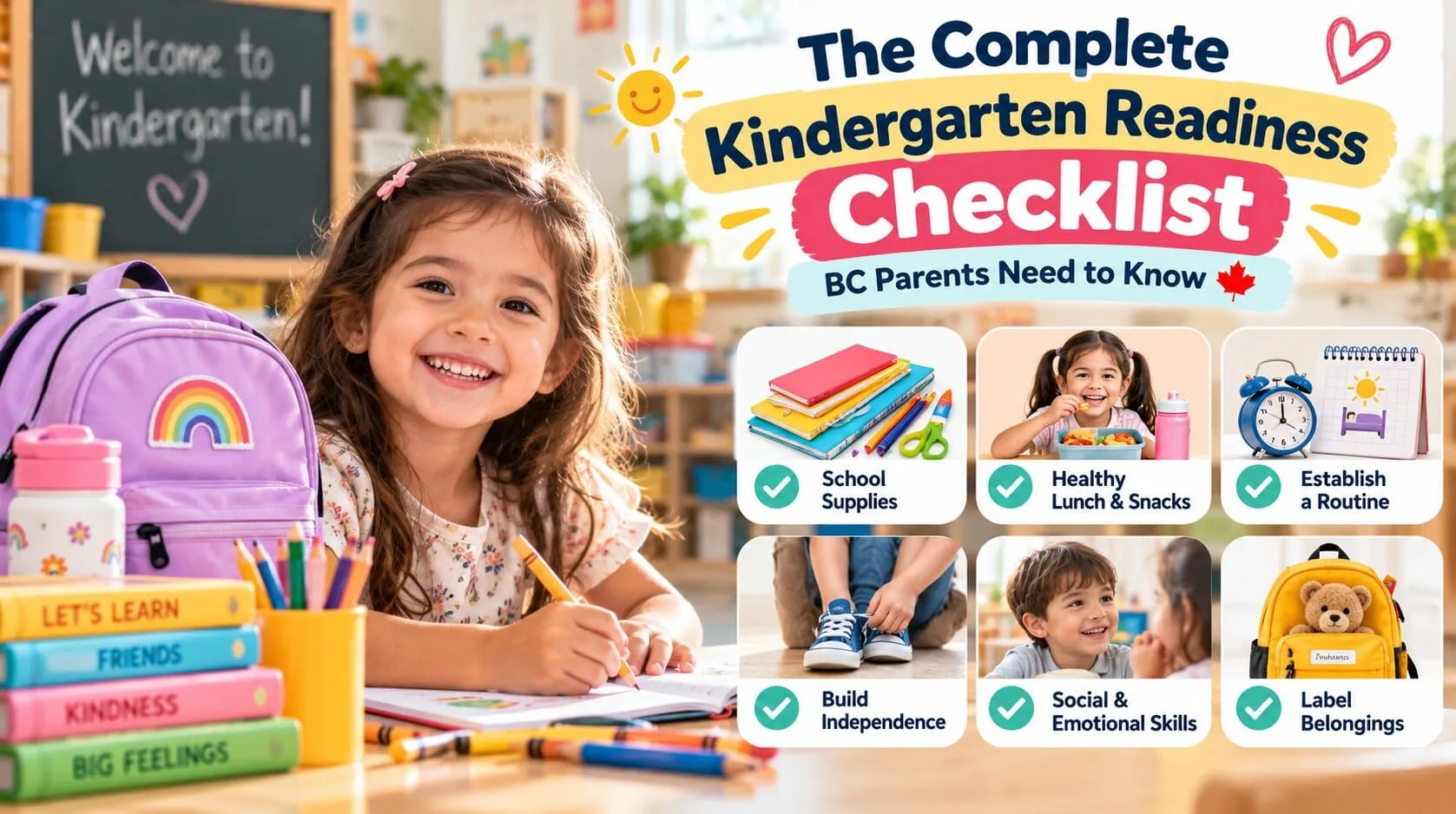
Looking closely at an authentic kindergarten readiness checklist BC educators follow shows that social confidence, practical independence, and self-advocacy matter far more than academic drilling when preparing for that first classroom bell.
The provincial approach focuses on nurturing curious, capable, and confident children who can comfortably navigate a shared social space. Elementary teachers consistently share that academic concepts like phonics and numeracy fall into place naturally once a child can independently manage their clothing, follow multi-step routines, and build positive peer relationships. Let us break down the core developmental areas that genuinely prepare young learners to flourish in kindergarten.
Understanding the True Purpose of Kindergarten Readiness
The transition to kindergarten is not an entrance exam. Rather, readiness reflects a child’s physical, emotional, and communicative ability to engage in a community learning environment. British Columbia schools do not expect five-year-olds to arrive reading chapter books or reciting complex mathematical equations.
Modern early learning pedagogy emphasizes natural curiosity and resilience. When children enter elementary classrooms with a sturdy sense of belonging, they willingly take intellectual risks, ask for assistance when challenged, and engage in cooperative activities. Shifting focus away from rote academic tests allows families to support genuine development through everyday play, tactile experimentation, and meaningful conversations.
Foundational Self-Care and Practical Life Autonomy
Classroom teachers manage between eighteen and twenty-two lively children at any given time. While educators are always available to guide and support, a child who can handle basic personal care feels significantly more empowered and relaxed throughout the school day.
A well-structured kindergarten skills checklist prioritizes these self-help capabilities:
- Managing washroom visits independently, including unbuttoning pants, thorough wiping, flushing the toilet, and washing hands with soap and water without constant reminders.
- Opening personal lunch containers, peel-away packaging, thermoses, and drink boxes without needing immediate teacher intervention.
- Zipping winter jackets, putting on outdoor splash pants, pulling on boots, and hanging backpacks onto assigned wall hooks.
- Blowing their own nose with a tissue and throwing the used tissue directly into the waste bin.
Mastering these core kindergarten self-help skills preserves your child’s emotional energy, preventing the frustration of waiting in line for help with outerwear before heading outside for recess.
Social Cooperation, Peer Play, and Conflict Resolution
A primary classroom is a bustling social ecosystem. Children must spend several hours each day navigating personal boundaries, taking turns with high-demand toys, and collaborating on shared building projects.
To thrive socially, children benefit from practicing these community interactions:
- Initiating play by approaching classmates with simple phrases like, “Can I play with you?” or offering a shared toy.
- Taking turns during simple board games or outdoor playground activities without experiencing severe emotional distress when waiting.
- Demonstrating basic empathy by checking in on a peer who looks upset or helping someone pick up dropped crayons.
- Respecting physical personal space and understanding that hands and feet must be kept to oneself during quiet circle discussions.
Experiencing regular social play environments allows children to observe social norms, mirror cooperative behaviours, and learn that compromising is part of shared play.
Emotional Co-Regulation and Separation Resilience
Being apart from family caregivers in a new, stimulating building can test a young child’s emotional stability. Schools look for children who have developed initial coping mechanisms to navigate everyday disappointments, schedule shifts, and sensory changes.
Nurturing healthy emotional regulation in preschool settings provides the foundation for classroom resilience:
- Recovering with gentle reassurance when minor playground mishaps or accidental toy drops occur.
- Transitioning away from high-interest play, like building blocks, to clean-up or quiet listening time without major resistance.
- Using words to express distress, such as stating “I do not like that” or “I feel sad,” rather than striking out or screaming.
- Maintaining focus for eight to ten minutes during an engaging story or group music presentation.
These emotional milestones allow children to absorb instruction and participate joyfully rather than spending their mornings overwhelmed by sensory fatigue.
Communication, Expressive Language, and Active Listening
Expressive and receptive communication skills form the backbone of all academic learning. Before a child can comprehend printed words on a page, they need to process spoken language comfortably and express their needs clearly to non-family members.
Key linguistic abilities to observe include:
- Speaking in clear, complete sentences of five to seven words that can be understood by adults outside the immediate family most of the time.
- Following two-to-three-step verbal directions in sequential order, such as: “Put your shoes on the rack, grab your water bottle, and sit on the carpet.”
- Asking simple questions to understand their environment, beginning with who, what, where, and why.
- Expressing personal needs clearly, including stating when they feel thirsty, unwell, or need to use the washroom.
Engaging your child in open-ended conversations throughout the day enriches their functional vocabulary and provides the verbal tools needed to articulate their feelings to educators.
Fine and Gross Motor Coordination
Physical strength and motor coordination are direct prerequisites for handwriting, cutting, and athletic games. Fine motor control develops from the shoulder and core outward to the fingertips; a child must have core balance and shoulder stability before they can comfortably hold a pencil.
Practicing dynamic movement builds these physical capabilities:
- Balancing on one foot, running with coordination, hopping, and climbing basic playground play structures safely.
- Grasping small crayons or markers using an emerging dynamic tripod grip rather than a rigid whole-fist clench.
- Snapping clothes fasteners, twisting open container caps, and squeezing plastic water bottles.
- Using blunt-tipped safety scissors to cut paper along a straight or wavy line.
Encouraging regular outdoor running, playdough modeling, and coloring provides the natural resistance young hands need to develop strong pencil endurance.
Foundational Literacy and Mathematical Curiosity
While reading is explicitly taught within the kindergarten curriculum, children benefit from foundational phonological awareness and numeric intuition gained through play.
Look for these organic pre-academic milestones:
- Holding a picture book right-side up, turning pages from front to back, and recognizing that print carries meaning from left to right.
- Identifying familiar letters, particularly the initial letter of their own first name, on street signs or labels.
- Reciting the alphabet song rhythmically and recognizing common rhyming pairs in nursery rhymes.
- Counting aloud up to ten objects accurately using one-to-one touch correspondence.
- Recognizing basic geometric shapes, such as circles, squares, and triangles, in daily household objects.
Introducing these ideas playfully through kitchen cooking, vehicle counting on errands, and bedtime stories makes learning an engaging lifestyle rather than a chore.
The British Columbia Early Learning Philosophy
British Columbia approaches early childhood education through a holistic lens rather than rigid standard testing. The BC early learning framework highlights the interconnectedness of well-being, belonging, exploration, and expression.
Rather than treating early education as a race toward testing benchmarks, educators throughout the province focus on cultivating a love of inquiry. When children spend their foundational years in environments that honour child-led play, they develop the critical thinking skills needed to interpret their world thoughtfully.
For families with little ones approaching pre kindergarten age, exploring local early education settings is an important step. Selecting a high-calibre kindergarten prep preschool Langley families recommend provides the gentle structure, peer interaction, and rich learning stations needed to bridge home and grade school.
As registration dates approach on the provincial calendar, parents should prepare the necessary documentation for official kindergarten registration BC school districts require, which typically opens each January for children turning five within that calendar year.
Connecting Home Routines to School Success
The most effective preparation for kindergarten happens right in the comfort of your living room and kitchen. Simple domestic adjustments establish confidence months before school starts:
- Practice eating out of school lunch gear: Pack a trial lunchbox and practice opening zipper pouches and thermoses together at the park.
- Standardize sleep schedules: Establish consistent evening wind-down rituals and early wake-ups that mirror school day mornings.
- Visit the neighborhood school playground: Play on the school swings and climbing equipment on weekends to familiarize your child with the physical space.
- Create a dedicated personal belongings drop-zone: Provide low wall hooks at home where your child independently hangs their coat and puts away their boots each afternoon.
Building these habits at home transforms the new expectations of elementary school into comfortable, familiar routines.
Choosing the Right Early Learning Partner in Langley
A child’s school readiness is deeply supported by the community that surrounds them during their formative infant, toddler, and preschool stages. While researching high-performing preschools in langley bc, families discover that environments balancing structure with child-led play produce exceptionally well-adjusted children.
Opting for an established kiddie daycare environment ensures your child benefits from educators who understand developmental milestones intimately. Whether families begin their search seeking a reputable licensed infant daycare near me to establish safe, responsive care from the start, or search local directories for a warm Kiddie Daycare near me to introduce social routines, partnering with qualified educators sets the stage for a wonderful school experience.
Observing how your child handles small daily responsibilities—like tidying up their toys or expressing feelings during play—will show you that they are growing more capable every single day.
Frequently Asked Questions
Does my child need to be fully potty trained before entering kindergarten in British Columbia?
Yes, school districts in British Columbia expect incoming kindergarten students to be fully independent with toilet routines, including wiping and handwashing, unless the child has an identified medical condition or unique support need. If your child is still working on toileting autonomy, educators suggest working consistently on manageable clothing and bathroom schedules during the spring and summer before school begins.
What age must a child be to register for kindergarten in BC?
In British Columbia, children are eligible to enter kindergarten in September of the calendar year they turn five years of age. For instance, if your child turns five at any point between January 1 and December 31 of a given year, they will enter kindergarten that September.
What is the typical turnaround time when submitting tour inquiries for childcare in Langley?
Established early learning facilities in Langley usually respond to tour submissions and enrolment inquiries within 24 to 48 business hours. Early outreach gives families adequate time to tour the centre, meet program supervisors, review educational philosophies, and secure a spot well before school transitions begin.
What areas do Langley early childhood facilities typically service for local commuters?
Centrally located facilities on 53rd Avenue serve families throughout Langley City, Willoughby, Murrayville, Brookswood, and Walnut Grove. Due to easy access to 200th Street and Highway 10, these centres are also convenient for working parents commuting from Surrey, Cloverdale, and the surrounding Fraser Valley.
What should parents do if their child still struggles with separation anxiety right before school starts?
Separation anxiety is completely natural. To ease this, practice short trial separations with trusted family members, maintain a brief and cheerful goodbye ritual, and read books that validate separation feelings. Sharing your child’s emotional triggers with their classroom teacher ahead of time also helps educators provide immediate comfort when drop-off occurs.
Embracing the Next Chapter with Joy and Confidence
Preparing for the first day of kindergarten is an exciting journey of growth for the entire family. When we measure readiness through the lens of emotional safety, curiosity, and everyday life skills, the pressure lifts. Your child does not need to know everything on day one; they simply need to know that they are capable, supported, and ready to explore new friendships.
If you are looking for an early learning partner that values every child’s individual pace, connect with Kiddie Kollege. Conveniently situated at 20103 53 Ave, Langley, BC V3A 3T8, Canada, our devoted team provides an enriching Infant & Toddler Program alongside early learning environments designed to nurture curiosity, resilience, and independence. We invite you to schedule a visit to our classrooms, meet our caring educators, and discover how our community prepares young learners for a smooth educational journey.
By utilizing a realistic, supportive kindergarten readiness checklist BC framework, you give your child the greatest gift of all: the confidence to step forward, hang up their backpack, and embark on a joyful educational journey.