Summary
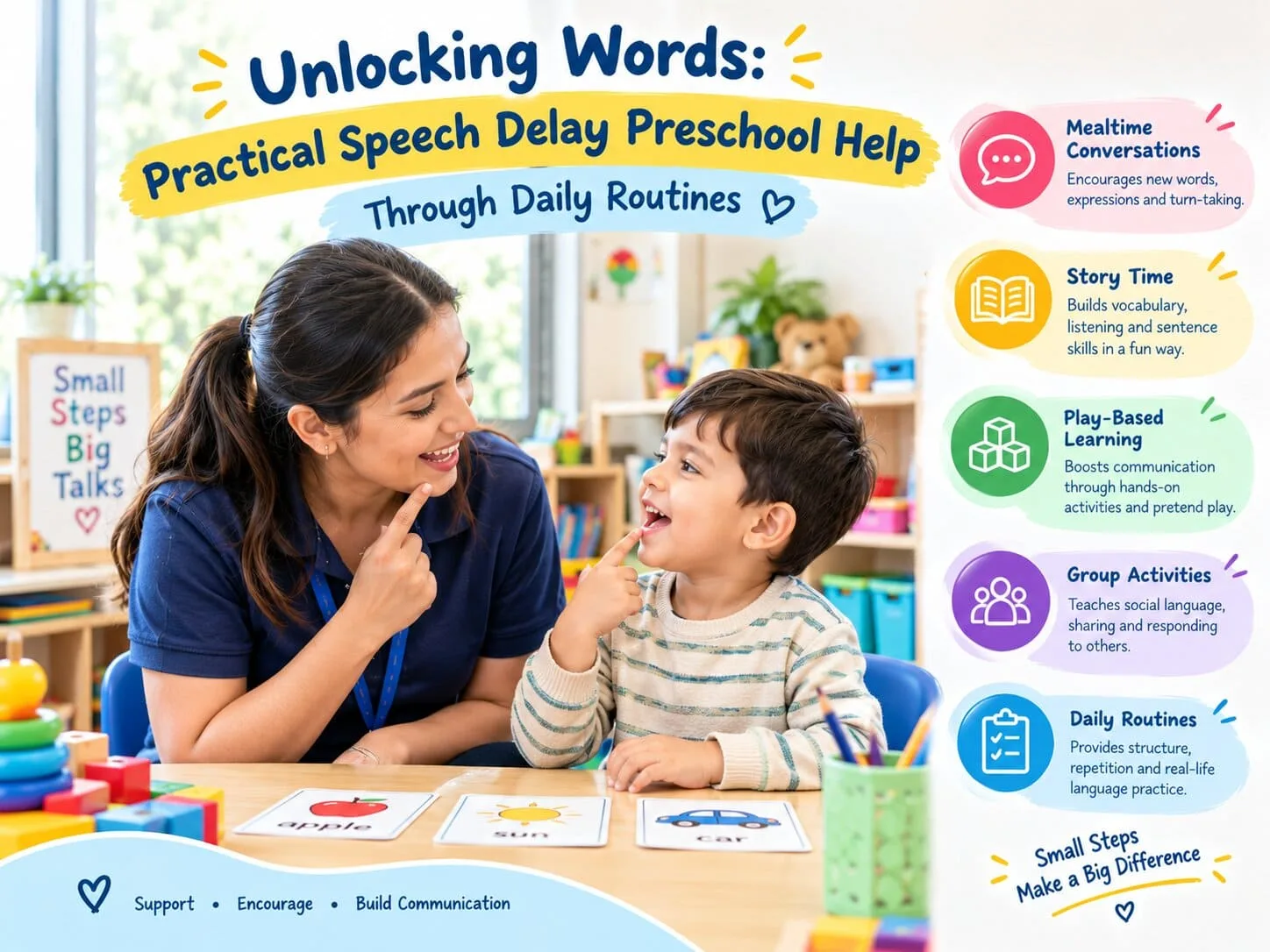
- Practical speech delay preschool help focuses on weaving natural language stimulation directly into predictable daily rhythms rather than high-pressure verbal drills.
- Early learning classrooms establish language-rich settings that alleviate communication anxiety and foster spontaneous conversation.
- Interactive social routines like snack sharing, musical games, and sensory discovery create continuous reasons for children to vocalize.
- Understanding the emotional roots of communication barriers helps parents and educators work together to soothe daily frustration.
- Early community-based guidance builds lifelong confidence, helping children transition smoothly into kindergarten with strong expressive skills.
Hearing your toddler struggle to express their wants, thoughts, or feelings can be an emotionally taxing experience for any parent. When words do not flow as expected, family life often feels filled with guesswork, hesitation, and worry about future classroom readiness. However, unlocking expressive communication rarely requires exhausting drills or stressful clinical quizzes at home. Instead, children thrive when language is seamlessly built into everyday routines where spoken words serve real, motivating purposes.
For families across the Lower Mainland, community-based centres like Kiddie Kollege, situated at 20103 53 Ave, Langley, BC V3A 3T8, Canada, provide a compassionate multi-age childcare program that seamlessly integrates this developmental support into daily care. Exploring intentional speech delay preschool help demonstrates how ordinary classroom rhythms, from morning greetings to outdoor discovery, can gently nurture a hesitant child into a confident communicator.
Communication development is deeply intertwined with a child’s sense of environmental comfort. When young children feel secure, understood, and unhurried, their nervous systems relax. This emotional safety opens up mental pathways for receptive understanding and vocal expression. Below, we examine the mechanics of how everyday classroom and household routines nurture expressive speech, offering practical approaches that early childhood educators and speech specialists utilize every day.
The Power of Social Immersion and Classroom Interaction
One of the greatest catalysts for verbal growth is immersion in a dynamic peer setting. At home, loving parents often anticipate their toddler’s every need. If your child points toward a water cup, you likely hand it to them before they need to ask. While this attentiveness comes from love, it inadvertently removes the natural urgency to vocalize.
In an early learning environment, children encounter peers who cannot read their minds. When a peer is using a coveted wooden train, pointing and grunting is rarely enough to negotiate a trade. This social dynamic creates an organic motivation to use words or clear gestures.
Furthermore, children observe their classmates talking, asking for second helpings, and singing along with educators. Utilizing peer modeling for speech delay in preschool offers children relatable speech targets. A child who feels intimidated by direct adult questioning will often imitate a classmate singing a silly phrase or requesting a toy. Seeing friends use speech to solve problems and share laughs provides a low-pressure roadmap for vocal experimentation.
Morning Welcomes and Low-Stress Rhythms
The transition from home to school presents an exceptional opportunity to practice language. In quality langley childcare centres, the morning begins with predictable, gentle conversational exchanges rather than rushed demands.
Educators structure drop-off periods with intentional verbal cues:
- Personalized morning greetings where educators greet every toddler by name, making warm eye contact at their physical height.
- Visual check-in charts where toddlers point to pictures representing their current mood, pairing non-verbal emotional cues with simple descriptive words like “happy,” “tired,” or “excited.”
- Cubby routines where teachers narrate actions: “Coats go on the hook, boots sit on the mat.”
Hearing these repetitive narrative sequences day after day establishes stable receptive language maps. The child begins to expect the words, understand their contextual meaning, and eventually reproduce them independently during transitions.
Circle Time: Melody, Rhyme, and Repetitive Rhythm
Group gathering times are often perceived simply as fun group activities, but they are also powerful language laboratories. Children with speech differences often find standard back-and-forth conversation overwhelming because it requires fast neurological processing, vocabulary retrieval, and motor coordination of the tongue and lips.
Music changes how the brain processes language. Singing utilizes both hemispheres of the brain, rhythmic cadence provides predictable timing cues, and natural repetition removes performance pressure.
Implementing engaging circle time speech activities helps bridge this gap through:
- Action rhymes where physical hand movements accompany words, such as clapping along with syllables to build phonological awareness.
- Repetitive call-and-response melodies that allow hesitant children to join in on easy, predictable refrains.
- Visual flannel storyboards that pair bright felt cutouts with spoken characters, grounding abstract words in concrete visual imagery.
In these group moments, no single child is put on the spot to answer a question. The collective chorus allows late talkers to hum, mouth the words, or belt out key syllables in a safe, celebratory setting.
Mealtime Moments and Communicative Temptations
Mealtimes are naturally rich in conversation. When children sit together around child-sized tables for morning snack or lunch, educators use a subtle technique called communicative temptation.
Instead of serving large pre-portioned plates, educators offer food in small servings and place favorite items slightly out of reach but clearly in sight. This intentional arrangement encourages children to express a desire for more.
Educators support this naturally without withholding food punitive-style:
- Offering concrete, binary choices: “Would you like apple slices or banana slices?” Holding up both items gives the child visual support while prompting them to name, approximate, or point toward their preference.
- Pausing before fulfilling a clear request: Giving a three-to-five second pause gives the child’s brain time to formulate a verbal request before an adult jumps in.
- Modeling conversational etiquette: Encouraging turn-taking in table discussions, where friends listen to each other talk about their favorite outdoor games or pets.
These small, positive mealtime exchanges transform routine nutritional breaks into meaningful communication practice.
Understanding and Managing Big Emotional Frustrations
A major challenge associated with language delay is behavioral dysregulation. When a child possesses the intelligence and desires of a three-year-old but only has the expressive verbal output of a twelve-month-old, intense frustration is inevitable.
This communication gap frequently leads to intense speech delay tantrums, hitting, or screaming. When children lack words to proclaim “That is mine,” “I am exhausted,” or “I want space,” their physical body becomes their megaphone.
Supportive early childhood educators address these moments with deep empathy and structured co-regulation:
- Validating the underlying desire before correcting the physical reaction, using calm phrases like: “You are mad. You wanted that blue truck.”
- Introducing functional baby sign language alongside spoken words for essential concepts such as “stop,” “more,” “help,” and “all done.”
- Providing visual break areas equipped with soft pillows and emotion flashcards so overwhelmed children can reset without feeling isolated.
When children realize that adults understand their struggle and will help them communicate rather than punish their frustration, emotional meltdowns decrease significantly in frequency and duration.
Hands-On Stations: Sensory Exploration and Expressive Language
Play is a child’s work, and messy exploration is often where rich descriptive language blooms. Classrooms that integrate purposeful sensory stations encourage spontaneous descriptive talking because the physical experience triggers curiosity.
Engaging children in sensory play speech delay stations unlocks vocabulary through tactile experiences:
- Water tables equipped with small cups, funnels, and floating sponges introduce positional and descriptive concepts such as “full,” “empty,” “splash,” “float,” and “sink.”
- Texture trays featuring kinetic sand, dried lentils, or smooth river stones encourage expressive adjectives like “soft,” “rough,” “sticky,” and “bumpy.”
- Playdough modeling stations where children smash, roll, and slice dough offer easy opportunities to practice action verbs like “roll,” “cut,” “push,” and “pull.”
Because sensory play is completely open-ended, there is no right or wrong way to interact with the materials. This freedom removes performance anxiety entirely, freeing children to chat naturally as they explore.
Outdoor Recess and Gross Motor Communication
Gross motor movement and linguistic growth are closely linked. Physical movement increases oxygen flow to the developing brain and stimulates the vestibular and proprioceptive systems, which regulate attention and speech readiness.
During outdoor play, language becomes active and dynamic:
- Cooperative obstacle courses prompt children to follow sequential spatial concepts: “crawl through the tunnel, then step over the log.”
- Tricycle paths require social navigation: “stop,” “go,” “beep,” and “my turn.”
- Nature discoveries in the school garden spark organic questions about crawling bugs, flying birds, and wet leaves.
Shouting words across the playground or giggling down a slide helps children discover the sheer physical pleasure of using their vocal cords, building breath control and volume awareness naturally.
Thoughtful Collaboration in the Langley Community
When parents observe persistent communication difficulties, choosing an early learning facility that values patience, communication, and inclusive methods is essential. A nurturing environment like Kiddie Kollege ensures that children facing speech delays receive attentive care tailored to their unique pace.
Experienced educators work hand in hand with speech-language pathologists, infant development consultants, and family doctors. Seeking a dedicated speech delay preschool Langley program ensures that strategies introduced in clinical therapy are consistently practiced during daily classroom play.
High-quality early childhood environments also provide reliable, professional childcare care that meets provincial health and safety standards while prioritizing relational warmth. With intentional support, early childhood routines foster long-term speech delay kindergarten readiness, ensuring that children transition into elementary school equipped with self-advocacy skills, social resilience, and functional vocabulary.
As local families evaluate specialized programs for preschoolers, they often begin by typing searches for a supportive pre school near me or looking up an accredited licensed infant daycare near me along transit routes like 53rd Avenue or the Fraser Highway. Ensuring that your chosen centre values open communication and individualized developmental pacing makes all the difference in turning early challenges into joyful childhood victories.
Frequently Asked Questions
How can parents tell the difference between a late talker and a significant speech delay?
Late talkers generally have strong receptive language skills (they understand what you say, follow directions, and use gestures like pointing and waving) but have a smaller expressive vocabulary. A broader speech or language delay often involves difficulties in both receptive understanding and expressive production, with limited gestures or limited interest in communicating. A formal screening by a certified speech-language pathologist provides clear guidance.
Do early childhood educators work alongside private speech therapists?
Yes, high-quality childcare centres frequently partner with outside specialists. With written parental consent, educators welcome speech therapy plans into the classroom, practicing targeted sounds, visual picture systems, or sign language routines during daily circle times, sensory play, and meals to provide consistent reinforcement.
What is the typical inquiry turnaround time for childcare enrollment in Langley?
Reputable childcare facilities in Langley generally review tour requests and registration inquiries within 24 to 48 business hours, contacting parents directly to discuss program options, assess family scheduling needs, and coordinate personal classroom walkthroughs.
What areas do Langley child care facilities typically service for local commuters?
Centrally situated Langley early childhood centres serve families throughout Langley City, Willoughby, Murrayville, Walnut Grove, and Brookswood. Many facilities also provide convenient access for parents commuting from Surrey neighbourhoods, including Clayton Heights and Cloverdale.
Will attending a group daycare setting make a child’s speech delay worse due to peer babble?
No. Research consistently indicates that peer environments accelerate language development. Being around children who speak at varying developmental stages creates rich modeling opportunities. While children may imitate playful sounds, the social demand to communicate with friends consistently motivates higher expressive verbal output.
Final Thoughts on Early Communication and Confidence
Watching your child navigate a speech delay can be challenging, but it is important to remember that communication develops on a unique timeline for every child. When we replace pressure with patience and embed language into comforting daily routines, children discover that using their voices is empowering and fun. By providing a warm environment where children are heard and encouraged, we give them the tools to express their thoughts and form meaningful friendships.
If you are searching for an early learning community that meets your child right where they are, look to Kiddie Kollege. Centred at 20103 53 Ave, Langley, BC V3A 3T8, Canada, our dedicated early childhood educators deliver an inclusive multi-age childcare program that prioritizes language development, emotional security, and playful exploration. We invite your family to book a private facility tour, connect with our educators, and explore how our routines can nurture your child’s natural curiosity.
Every single word gained is a celebration. By embracing compassionate, consistent speech delay preschool help, you provide your child with the foundation they need to speak up, connect with friends, and thrive with lasting confidence.