Summary
- Developing strong executive function in toddlers sets the groundwork for emotional balance, focus, and lifelong academic achievement.
- Intentional play provides young children with hands-on practice in self-control, working memory, and flexible problem-solving without formal classroom pressure.
- Simple childhood games like freeze dance, imaginative role-playing, and block building naturally strengthen neural connections in the brain’s prefrontal cortex.
- Early childhood educators act as responsive co-regulators, modeling calm problem-solving strategies when toddlers face play-based challenges.
- High-quality child care environments design predictable daily rhythms that allow children to practice self-direction, patience, and collaborative social skills.
When parents observe toddlers deeply immersed in play, it is easy to view their activities as simple amusement. A two-year-old carefully stacking wooden blocks, pretending to cook a soup made of plastic leaves, or pausing mid-step during a musical game appears to be simply passing the time. Beneath the surface, however, an extraordinary neurological transformation is occurring. During these formative years, the brain builds complex neural pathways at an unprecedented speed.
Foundational early learning centres like Kiddie Kollege, situated at 20103 53 Ave, Langley, BC V3A 3T8, Canada, offer dedicated childcare programs that harness this rapid neurological growth. By creating structured, play-centred environments, educators actively foster executive function in toddlers, providing the supportive scaffolding children need to manage their feelings, pay attention, and navigate an increasingly complex world with genuine confidence.
Executive function is often described by developmental neuroscientists as the air traffic control system of the human brain. Just as an airport tower safely coordinates dozens of arrivals and departures on busy runways, executive function processes filter distractions, prioritize tasks, regulate emotional outbursts, and sustain mental focus. These capabilities do not appear automatically; children are not born with fully realized self-regulation. Instead, they are born with the biological potential to build these skills through patient adult modeling, secure attachments, and consistent daily practice. Below, we explore the developmental mechanics of executive function and examine how purposeful, play-based early learning cultivates resilient young minds.
Want to learn more about our daycare programs? Click the WhatsApp button below for an instant chat :
Understanding the Three Core Pillars of Executive Function
To appreciate how everyday play strengthens cognitive control, it is helpful to look at the three foundational pillars that compose the executive function architecture:
- Inhibitory Control (Self-Regulation): The ability to resist impulsive reactions, delay immediate gratification, pause before acting, and sustain attention on an activity despite enticing room distractions.
- Working Memory: The mental capacity to hold, update, and manipulate pieces of information over short periods, such as remembering two-step instructions or recalling the rules of a shared game.
- Cognitive Flexibility: The capacity to switch gears, adapt to unexpected routine changes, view situations from another person’s perspective, and adjust strategies when an initial attempt fails.
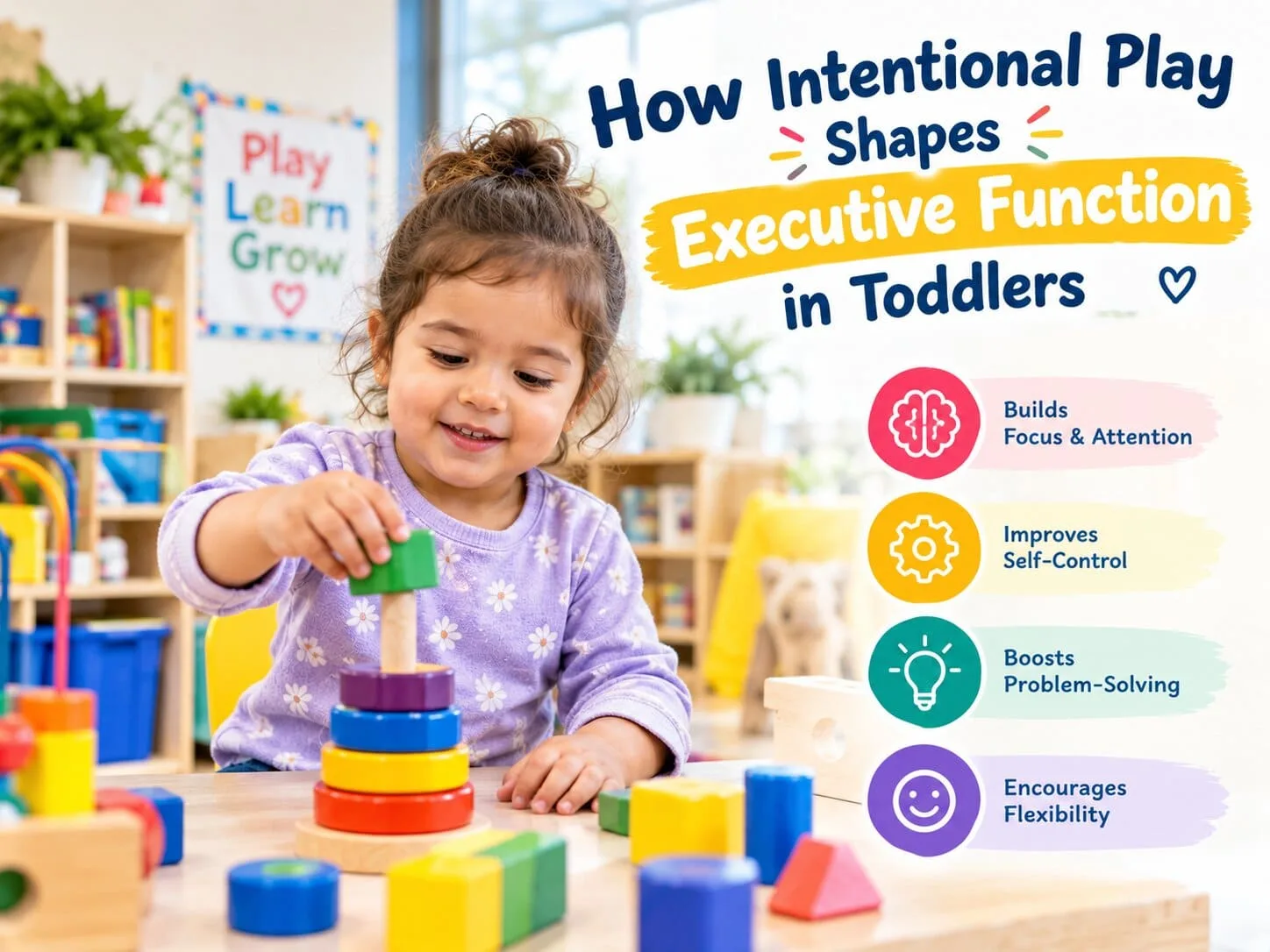
These three domains work in constant harmony. When a child attempts to build a tall tower with a peer, they must use working memory to recall which block shapes stay steady, exercise inhibitory control to place blocks gently without knocking them over, and draw upon cognitive flexibility to redesign the base when the structure suddenly topples.
The Power of Intentional Play Over Formal Academic Drilling
There is an understandable but misguided impulse in modern parenting to introduce structured academic worksheets and digital learning apps earlier and earlier. Developmental research consistently shows that rigid academic instruction in the toddler years can actually hinder long-term cognitive growth. Young minds are not designed to sit passively at desks absorbing abstract facts; they learn through whole-body movement, tactile exploration, and social experimentation.
Intentional play bridges the gap between pure spontaneous exploration and rigid instruction. In an intentional setting, early childhood educators thoughtfully curate classroom materials, set up open-ended challenges, and step in as active facilitators. By building executive function skills through play, teachers create low-stakes, joyful scenarios where children encounter manageable frustrations, test solutions, and experience the natural outcomes of their choices. In this safe space, mistakes become exciting discoveries rather than sources of stress.
Developing Inhibitory Control Through Movement and Music
For a toddler, impulse control is an immense physical and neurological challenge. The prefrontal cortex, which governs self-restraint, is in its absolute infancy. Toddlers feel an emotion or physical urge and instinctively act upon it immediately.
One of the most effective methods for strengthening these neural brakes is introducing classic toddler self-regulation games during daily group sessions:
- Stop-and-Go Music Games: Games like Freeze Dance require children to actively listen to a melody, move freely while the sound plays, and instantly freeze their bodies when the music stops. This rapid shift requires deliberate motor inhibition, teaching the brain to override physical momentum.
- Opposite Action Challenges: Asking toddlers to touch their toes when an educator says “touch your head” forces them to suppress their natural reflex and apply a conscious mental rule before moving.
- Red Light, Green Light Variations: Modified for younger toddlers with colourful visual cards, this game reinforces the mental link between sensory cues and physical stopping, building foundational focus.
Because these games are wrapped in laughter, giggles, and musical rhythm, children exercise rigorous self-control without feeling reprimanded or restricted. Over time, the ability to freeze physically translates into the mental ability to pause before grabbing a toy from a classmate.
Strengthening Recall with Hands-On Working Memory Practice
Working memory is essential for language acquisition, early numeracy, and following daily classroom expectations. A toddler with a developing working memory can listen to a sentence, retain its meaning, and formulate a relevant verbal response.
Classrooms support this cognitive muscle through interactive working memory activities for toddlers embedded within everyday routines:
- Tactile Hiding and Recovery Games: Placing three familiar objects under small cups, moving them gently, and asking children to remember which cup conceals a specific toy strengthens mental visualization and spatial tracking.
- Repetitive Storytelling Sequences: Reading predictable books where animals join a journey one by one encourages toddlers to anticipate who comes next and remember who is already part of the narrative.
- Multi-Step Classroom Helping Roles: Inviting a toddler to fetch their sun hat from their cubby and place it beside their outdoor shoes gives them real-world practice holding sequential steps in their working memory.
As children master these small mental retention exercises, their working memory capacity expands, making complex kindergarten tasks—like remembering classroom routines, following instructions, and organizing supplies—feel natural and manageable.
Fostering Adaptability: Cognitive Flexibility in Action
Life rarely goes entirely according to plan, especially in a bustling classroom filled with active children. Developing cognitive flexibility in early childhood ensures that a child can handle unexpected disruptions without falling into emotional distress.
When children engage in open-ended construction or art, they encounter unexpected physical challenges constantly. A cardboard bridge might bend under the weight of a toy truck, or blue paint might accidentally mix into yellow to create green. Rather than stepping in to fix the issue immediately, experienced educators pause and ask open-ended questions: “The bridge bent down. What can we slide underneath to make it strong again?”
This intentional pause teaches children to pivot. Instead of viewing an unexpected result as a failure, they learn to analyze the situation, brainstorm alternative approaches, and test new ideas. Cognitive flexibility is the core ingredient of human resilience; children who learn to adapt during play become adults who face life’s obstacles with calm determination.
Dramatic Play and the Rules of the Imagination
Dramatic or pretend play is perhaps the most sophisticated workout a toddler’s executive function can experience. When toddlers pick up props and declare that a corner of the room is a veterinary clinic, grocery store, or family kitchen, they enter a world governed by self-imposed rules.
To maintain the fantasy, children must remain inside their chosen character roles:
- Role Maintenance: If a toddler pretends to be a sleeping baby, they must inhibit their natural impulse to run around and instead lie quietly until the “parent” wakes them up.
- Negotiating Shared Narratives: Dramatic play requires continuous communication and compromise. Children must decide who drives the pretend bus, where the bus is travelling, and what happens when the bus runs out of fuel.
- Emotional Empathy: Stepping into another character’s shoes prompts children to imagine how someone else feels, laying early foundations for theory of mind and social perspective-taking.
Through the intricate social choreography of pretend play, children actively suppress impulses, practice complex turn-taking, and maintain shared mental scenarios, exercising all three branches of executive function simultaneously.
Purposeful Play-Based Childcare Across Langley Communities
Selecting the right early childhood provider requires looking closely at how classroom routines are structured. Families exploring options for a reliable langley bc daycare want to know that their child’s day is shaped by intentional educational philosophies rather than disorganized supervision.
Across Langley and surrounding Fraser Valley communities, families are increasingly prioritizing accredited centres that offer an authentic play-based learning daycare Langley parents can depend on. In an established daycare in langley bc, children benefit from low educator-to-child ratios, allowing certified teachers to spend dedicated time sitting on the floor, observing individual play styles, and gently introducing cognitive challenges tailored to each child’s stage of development.
Whether families are reviewing comprehensive programs for preschoolers or seeking consistent full-day care, high-calibre centres design environments where furniture, sensory materials, and daily transitions actively support self-regulation. Children learn how to tidy materials into labeled baskets, line up with classmates for outdoor play, and transition between quiet rest and energetic gross motor exploration. These daily operational habits cultivate strong executive function skills for kindergarten readiness, ensuring that when the transition to elementary school arrives, children possess the focus, social grace, and emotional resilience needed to thrive.
As local parents navigate their early childhood search along transit corridors like 200th Street, 53rd Avenue, and the Fraser Highway, many begin their journey researching a high-quality licensed infant daycare near me or looking into an accredited pre school near me to ensure their daily morning drop-offs align seamlessly with work commutes.
Frequently Asked Questions
How can parents tell if an early learning centre truly prioritizes executive function?
Look at how educators handle daily transitions, social conflicts, and play materials during your tour. A centre that fosters executive function features organized learning zones, educators who sit at eye level to guide emotional regulation, and daily schedules that allow for unhurried, child-led play rather than rigid, adult-driven worksheets.
At what age do toddlers begin showing measurable executive function skills?
Basic signs of executive function emerge around 12 months, as infants begin understanding object permanence and following simple pointing gestures. Between 18 and 36 months, executive function develops dramatically, visible when toddlers pause before touching something after being reminded, recall where their favourite shoes belong, or engage in cooperative pretend play.
What is the typical administrative response time for childcare tours in Langley?
Most established licensed centres in Langley review tour bookings and program inquiries daily, providing parents with a detailed, professional response regarding classroom availability and tour times within 24 to 48 business hours.
What geographical neighbourhoods are supported by central Langley childcare facilities?
Centrally located facilities in Langley provide convenient care for families living throughout Langley City, Willoughby, Murrayville, Walnut Grove, and Brookswood. They also serve commuter families travelling daily from nearby Cloverdale, Clayton Heights, and Aldergrove.
Can simple games at home support what children learn in daycare?
Absolutely. Consistent routines at home reinforce classroom learning. Playing hide-and-seek, singing call-and-response songs during car rides, cooking together by following simple steps, and offering toddlers gentle choices (such as picking between two shirts) all build strong executive function in daily family life.
Final Thoughts on Supporting Lifelong Cognitive Growth
Guiding a young child toward emotional maturity, sustained focus, and thoughtful decision-making is a gradual, rewarding process. Executive function is not a rigid trait that a child either has or lacks; it is a dynamic set of living capabilities that grow stronger every time a toddler pauses to think, shares a block, or giggles through a freeze dance routine. By grounding early education in intentional, joyful play, we equip children with the inner tools they need to become resilient problem solvers and compassionate friends.
When you are looking for an early learning partner that values the deep cognitive power of play, consider Kiddie Kollege. Situated at 20103 53 Ave, Langley, BC V3A 3T8, Canada, our certified early childhood educators craft thoughtful childcare programs that nurture the whole child within a safe, stimulating, and community-centred space. We invite you to tour our classrooms, observe our intentional play environments in action, and discover how our warm routines build a lasting foundation for your child’s future.
Choosing an early childhood space that honors your child’s natural curiosity ensures they receive attentive support during their formative years, unlocking the extraordinary potential of executive function in toddlers and inspiring a confident start to lifelong learning.