Summary
- Understanding how group routines foster language development in daycare toddlers gives parents clear insight into early classroom learning.
- Daily carpet sessions transform passive listening into expressive communication through rhythmic songs, repetition, and guided conversations.
- Shared reading and fingerplays help young children master essential speech rhythms, phonetics, and early sentence formation.
- Group gatherings encourage healthy social communication, teaching toddlers conversational patience, eye contact, and attentive peer listening.
- Intentional early learning environments provide predictable, low-pressure spaces where every child feels confident finding their voice.
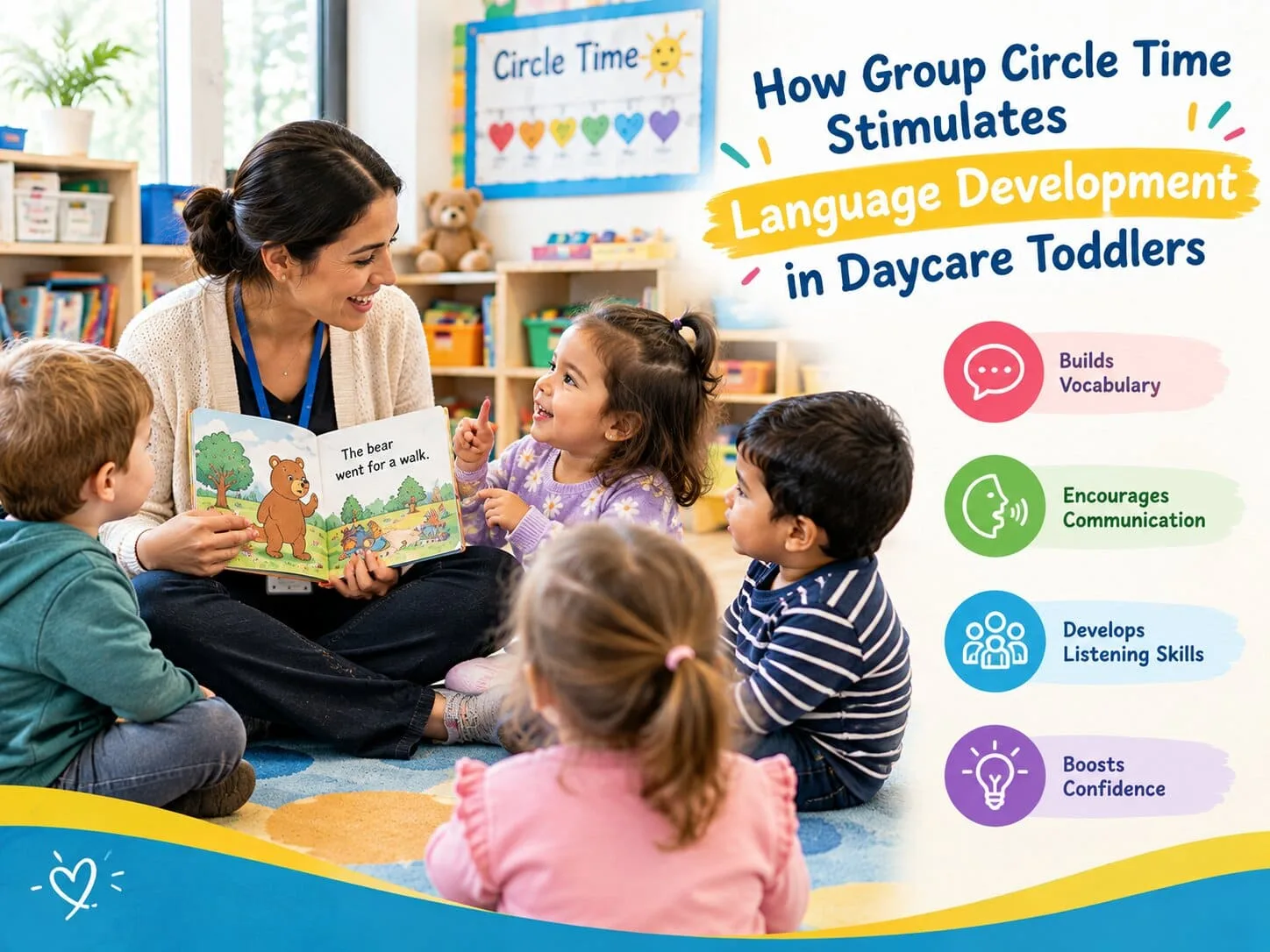
The early toddler years mark one of the most remarkable linguistic leaps in human growth. A child transitions from single-syllable babbling and pointing to speaking in vibrant phrases, posing curious questions, and expressing their inner thoughts. While everyday home conversations lay the groundwork for speech, the communal classroom setting accelerates this journey in entirely unique ways. Established neighbourhood centres like Kiddie Kollege, situated at 20103 53 Ave, Langley, BC V3A 3T8, Canada, offer comprehensive childcare programs that turn everyday group interactions into powerful speech milestones. Group gatherings, particularly the morning carpet session, play an irreplaceable role in advancing language development in daycare toddlers, giving young learners a secure, communicative environment where words, thoughts, and friendships naturally bloom.
For a toddler, stepping into a room full of peers can initially feel like an overwhelming sensory experience. The morning circle brings immediate order, emotional calm, and predictable connection to the morning. By gathering on a soft mat in a circle where everyone can see one another, educators create an inclusive space that makes spoken language fun, accessible, and social. Below, we examine the developmental science behind circle time and explore how this foundational routine turns developing toddlers into confident, expressive communicators.
The Power of the Shared Carpet: Why Visual Proximity Matters
Language acquisition in early childhood relies heavily on visual modeling and physical proximity. When a toddler sits on a carpet facing their teacher and classmates, they do not simply hear words spoken through the air. They watch how lips move to form consonant sounds, observe how facial expressions convey subtle meanings, and notice how hand gestures emphasize ideas.
In a standard classroom setting, circle time establishes clear lines of sight. Toddlers naturally study the educator’s mouth as new vocabulary words are introduced. If a teacher introduces an autumn leaf, they hold it up, describe its crinkling sound, and articulate words slowly: “crisp,” “crunchy,” and “golden.” The close seating arrangement allows children to mimic these oral motor movements in real time. Furthermore, seeing peers attempt the same vocal sounds removes the performance anxiety that sometimes occurs during direct one-on-one adult questioning. In a circle, speaking is an open invitation rather than a test.
Unlocking the True Benefits of Circle Time in Daycare
Parents often look at a circle gathering and see a lovely social songfest, but early educators recognize it as a carefully calibrated cognitive exercise. The verified benefits of circle time in daycare extend across multiple developmental domains, with expressive and receptive speech sitting squarely at the center.
Receptive language refers to a child’s capacity to understand and process instructions, while expressive language involves their ability to communicate thoughts, needs, and feelings. Circle time exercises both sides of this linguistic coin simultaneously:
- Auditory Processing: Children learn to isolate an educator’s voice amidst background room noise, training the auditory pathway to focus on phonetic subtleties.
- Instructional Comprehension: Transitioning through circle songs teaches children how to follow progressive, two-step directions, such as “stand up tall and touch your toes.”
- Sequential Understanding: The predictable routine of carpet time—starting with a greeting song, moving into weather exploration, and concluding with a story—teaches children narrative structure, helping them understand that events have a beginning, middle, and end.
By anchoring these cognitive tasks to a warm group rhythm, early learning environments build foundational communicative ease long before children ever encounter formal literacy instruction.
Rhythm, Rhyme, and Repetition: The Neural Building Blocks of Speech
Toddler brains are remarkably tuned to music, meter, and rhythmic patterns. When information is delivered through melody and rhyme, children retain words far more efficiently than when spoken in simple sentences.
During group singing, words are stretched across musical notes. This elongates vowel sounds, making it significantly easier for toddlers to hear where one word ends and the next begins. Traditional fingerplays and nursery rhymes introduce predictable phonetic cadences. When children sing classic refrains, they instinctively anticipate rhyming words, strengthening their early phonological awareness.
Moreover, regular repetition provides children with the linguistic security they crave. Hearing and singing the same welcoming song over successive weeks transforms passive vocabulary into active vocabulary. A quiet child who simply listens for the first three weeks will suddenly begin humming the cadence, eventually singing the full lyrics once their vocal confidence takes root.
Achieving Toddler Language Milestones Through Daily Interaction
Every child develops according to their own biological calendar, yet early childhood frameworks monitor consistent benchmarks throughout the toddler years. Recognizing standard toddler language milestones allows educators to gently scaffold instruction to meet individual needs:
- 12 to 18 Months: Communicating through shared gestures, imitating simple sounds, and actively using between 5 and 20 recognizable single words.
- 18 to 24 Months: A dramatic language explosion where children begin pairing two words together (such as “more milk” or “big dog”) and regularly mimic words overheard in everyday conversation.
- 24 to 36 Months: Using three-to-four-word sentences, correctly identifying familiar body parts and classroom objects, and asking simple questions to explore their environment.
Circle time serves as an organic developmental diagnostic tool. Experienced teachers can quietly observe which children eagerly join vocal chants, which toddlers rely predominantly on physical gestures, and which ones need additional support with articulation. Because group singing carries zero pressure, children working toward these milestones participate fully without feeling self-conscious.
Engaging Speech Development Activities for Toddlers on the Carpet
Certified early childhood educators do not simply sit and talk; they bring language to life through sensory-rich materials and intentional participation techniques.
A staple of carpet time includes multi-sensory speech development activities for toddlers that link physical objects to verbal expression:
- Interactive Storytelling with Felt Boards: As the teacher narrates a tale, children take turns placing felt animals, trees, or characters onto a felt board. Associating a tactile object with an oral character name anchors abstract vocabulary into concrete reality.
- Mystery Sound Boxes: Teachers pull tactile items out of a decorated container, prompting children to guess what makes a sound or describe how an object feels. This activity sparks descriptive language, inspiring words like “bumpy,” “soft,” “loud,” or “tiny.”
- Action Rhymes and Fingerplays: Songs like “The Itsy Bitsy Spider” or “Open, Shut Them” coordinate fine motor muscle control with speech timing, establishing the neural pathways that regulate physical articulation.
- Shared Echo Games: Educators model pitch variations—whispering like gentle breezes or roaring like friendly lions—encouraging children to experiment with the volume, resonance, and breath control needed for fluid speech.
These interactive moments transform passive listening into joyful physical participation, proving that learning to speak clearly is deeply rooted in active, full-body engagement.
Nurturing Social Language Skills in Toddlers
Expressive capability is only one half of communication; learning how to relate to others using language is equally crucial. Pragmatics, or the social use of language, is a complex developmental skill that requires ongoing practice in group settings.
Developing robust social language skills in toddlers starts with fundamental conversational mechanics. Circle time teaches children conversational turn-taking. When an educator passes a soft talking toy around the circle, children discover that only one person speaks while others listen with their ears and eyes. This simple routine lays the foundation for respectful dialogue, teaching little ones to wait patiently for their turn to contribute.
Furthermore, circle time models positive conflict resolution and empathetic emotional expression. When an educator reads an illustrated story about a sad bear who lost his favourite block, the teacher pauses to ask, “Look at Bear’s face. How do you think Bear is feeling right now?” Toddlers learn to associate words with emotional states, expanding their empathetic vocabulary and discovering how to articulate their own feelings when resolving play disputes later in the day.
Establishing Early Childhood Communication Skills for Lifelong Learning
The linguistic progress made on the carpet directly supports future cognitive and academic performance. Cultivating comprehensive early childhood communication skills creates a resilient bridge toward kindergarten readiness.
Long before a child learns to read printed letters, they must develop a rich spoken vocabulary and an intuitive understanding of sentence structure. A child who has spent years listening to expressive book readings, engaging in group discussions, and learning lyrical songs enters elementary school with higher reading comprehension and superior verbal confidence. They understand how stories unfold, feel comfortable speaking in front of unfamiliar groups, and possess the self-regulation required to listen attentively during academic lessons.
Local Early Childhood Excellence Across the Fraser Valley
Choosing the right early childhood environment requires evaluating how educators interact with your child on an emotional and communicative level. Across Langley and surrounding Lower Mainland communities, parents are looking for professional spaces that prioritize meaningful childhood development.
While some families begin their childcare search looking into informal home environments, a dedicated kiddie daycare or a smaller family day care arrangement, accredited group centres offer structured peer environments that are exceptionally conducive to language growth. In a high-quality preschool in langley, children are surrounded daily by peers at various stages of verbal fluency. This multi-level linguistic environment provides constant, natural peer modeling: younger toddlers observe slightly older peers speaking in complex sentences and eagerly adopt those speech patterns into their own vocabulary.
When families evaluate community options for exceptional early learning daycare programs Langley providers manage, they often look for centers that thoughtfully bridge early toddler exploration with comprehensive programs for preschoolers. A dependable child care service understands that developing confident, expressive communicators takes patience, continuous educator training, and low-ratio classrooms where every child’s voice is respected and heard.
As your search progresses toward securing care, many local parents find themselves typing searches like licensed infant daycare near me or researching an accredited pre school near me to ensure their daily morning commute along corridors like 200th Street or 53rd Avenue aligns smoothly with their family’s routine.
Frequently Asked Questions
How long does a typical toddler circle time session last?
Toddler attention spans are naturally brief and active. Most group circle sessions for children aged 18 to 36 months last between 10 and 15 minutes. Educators keep the pace brisk, alternating quickly between vocal singing, physical movement, and short picture-book storytelling to keep children engaged without causing frustration.
What happens if a toddler refuses to sit still on the carpet?
Educators never force toddlers to remain frozen in place. Children who need to move are gently guided to sit on the outer edge of the circle or given a soft sensory cushion. Toddlers absorb language through active listening even while swaying, standing, or observing from a comfortable perimeter.
What is the typical administrative response time for childcare tours in Langley?
Most established early childhood facilities in Langley process tour bookings, waitlist applications, and parent inquiries within 24 to 48 business hours, providing families with quick, transparent communication regarding classroom openings.
What local neighbourhood areas are served by centrally located Langley childcare providers?
Centrally positioned centres in Langley accommodate families living throughout Langley City, Willoughby, Murrayville, Walnut Grove, and Brookswood. They also serve commuting parents travelling from nearby Surrey, Clayton Heights, and Cloverdale.
How do educators support toddlers who are non-verbal or learning English as an additional language?
Educators utilize universal visual schedules, clear sign-language gestures, and expressive physical modeling. Songs with repetitive hand motions and tactile felt boards ensure that children who are non-verbal or learning English can participate, feel successful, and acquire language at their own organic pace.
Final Thoughts on Classroom Language Foundations
The journey toward fluent, confident communication is filled with wonder, laughter, and daily discoveries. Group circle time provides the structured warmth, joyful rhythm, and peer community that toddlers need to transform developing vocal sounds into expressive, meaningful conversations. By surrounding young children with rich melodies, interactive literature, and patient educators, early learning programs provide the firm foundation children need to express their thoughts, build deep friendships, and navigate their world with boundless curiosity.
When you are looking for an early learning partner that cherishes each child’s individual voice, consider Kiddie Kollege. Situated at 20103 53 Ave, Langley, BC V3A 3T8, Canada, our qualified early childhood educators design thoughtful childcare programs that nurture social, emotional, and linguistic growth in a safe and welcoming space. We invite you to tour our classrooms, observe our engaging morning routines in action, and see firsthand how our intentional group gatherings inspire a lasting love of learning.
Investing in intentional daily routines ensures that your child enjoys exceptional support during their formative years, unlocking the full potential of language development in daycare toddlers and setting them on an inspiring path toward lifelong success.