When parents drop their little ones off at daycare each morning, it is easy to wonder what truly happens behind classroom doors once jackets are hung in personal cubbies and morning goodbyes are exchanged. To an outside observer walking past a classroom window, the room might look like a whirl of activity, laughter, building blocks, and paint splatters. Yet behind every joyful game and busy activity table lies an intentional, evidence-based play based nursery routine designed to foster real-world cognitive, emotional, and physical capability.
At Kiddie Kollege, situated at 20103 53 Ave, Langley, BC V3A 3T8, Canada, our passionate early educators provide a nurturing infants and toddlers program that transforms natural morning curiosity into essential developmental milestones, giving children the freedom to explore, create, and thrive in an environment built around their individual rhythms.
Recognizing the educational purpose woven into morning routines helps parents see childcare through a fresh lens. Play is not merely a fun way to pass the time until lunch; it is the primary engine of early childhood learning. When children are encouraged to test ideas, interact with diverse textures, and share space with friends, their brains form complex neural pathways that set the stage for all future academic and social achievements.
Have questions about what a typical morning looks like at our centre, or want to know more about how our educators guide early milestones through play? Connect with the Kiddie Kollege Childcare team today. We’re happy to walk you through our daily toddler rhythms, transition strategies, and play-based nursery curriculum.
Summary
- Explores how an intentional play based nursery routine supports holistic childhood development through purposeful morning activities.
- Demonstrates how free-choice discovery and educator-guided centres develop cognitive problem-solving, emotional regulation, and fine motor dexterity.
- Connects active peer play and shared group interactions directly to speech clarity, listening stamina, and social confidence.
- Highlights how structured morning arrivals, circle times, and outdoor exploration create a calm, predictable environment for little learners.
- Explains how purposeful play models align with British Columbia early learning standards to build lifelong school readiness.
📋 Table of Contents
- → The Arrival Ritual: Building Emotional Security and Independence
- → Free-Choice Learning: The Brain Science of Self-Directed Play
- → Circle Time and Language Foundations
- → Sensory Tables: Science, Math, and Fine Motor Dexterity
- → Building Peer Relationships and Emotional Regulation
- → Outdoor Recess: Gross Motor Mastery and Nature Inquiry
- → The Power of Predictable Rhythm and Daily Balance
- → Integrating Child-Led Discovery into Structured Routines
- → Choosing the Right Early Care Provider in Langley
- → Frequently Asked Questions
- → Fostering a Lifelong Love for Exploration
The Arrival Ritual: Building Emotional Security and Independence
The morning transition begins the moment a child crosses the classroom threshold. For infants and toddlers, separating from family members and stepping into a shared group environment can bring forward waves of apprehension. A predictable morning arrival provides an emotional bridge that helps little ones feel grounded, valued, and safe.
Certified educators establish a calm, welcoming intake routine that honours each child’s pace. Children are gently guided to take ownership of their personal belongings by hanging up their own backpacks, placing outdoor shoes on the rack, and carrying their water bottles to their assigned spaces. These simple tasks build an early sense of agency and pride.
Once settled, children move toward quiet invitations to play—open tabletop arrangements featuring soft puzzles, textured books, or natural wooden figures. By offering engaging choices immediately upon arrival, educators help children redirect their attention from the sorrow of separation to the excitement of hands-on discovery. This smooth start ensures that early morning drop-offs remain calm, setting a peaceful tone for the learning hours ahead.
Free-Choice Learning: The Brain Science of Self-Directed Play
After the morning arrival, classrooms open into an expansive period of child-directed investigation. Rather than gathering toddlers at rigid desks for passive instruction, modern early education relies on learning centres designed to nurture autonomy and creative problem-solving.
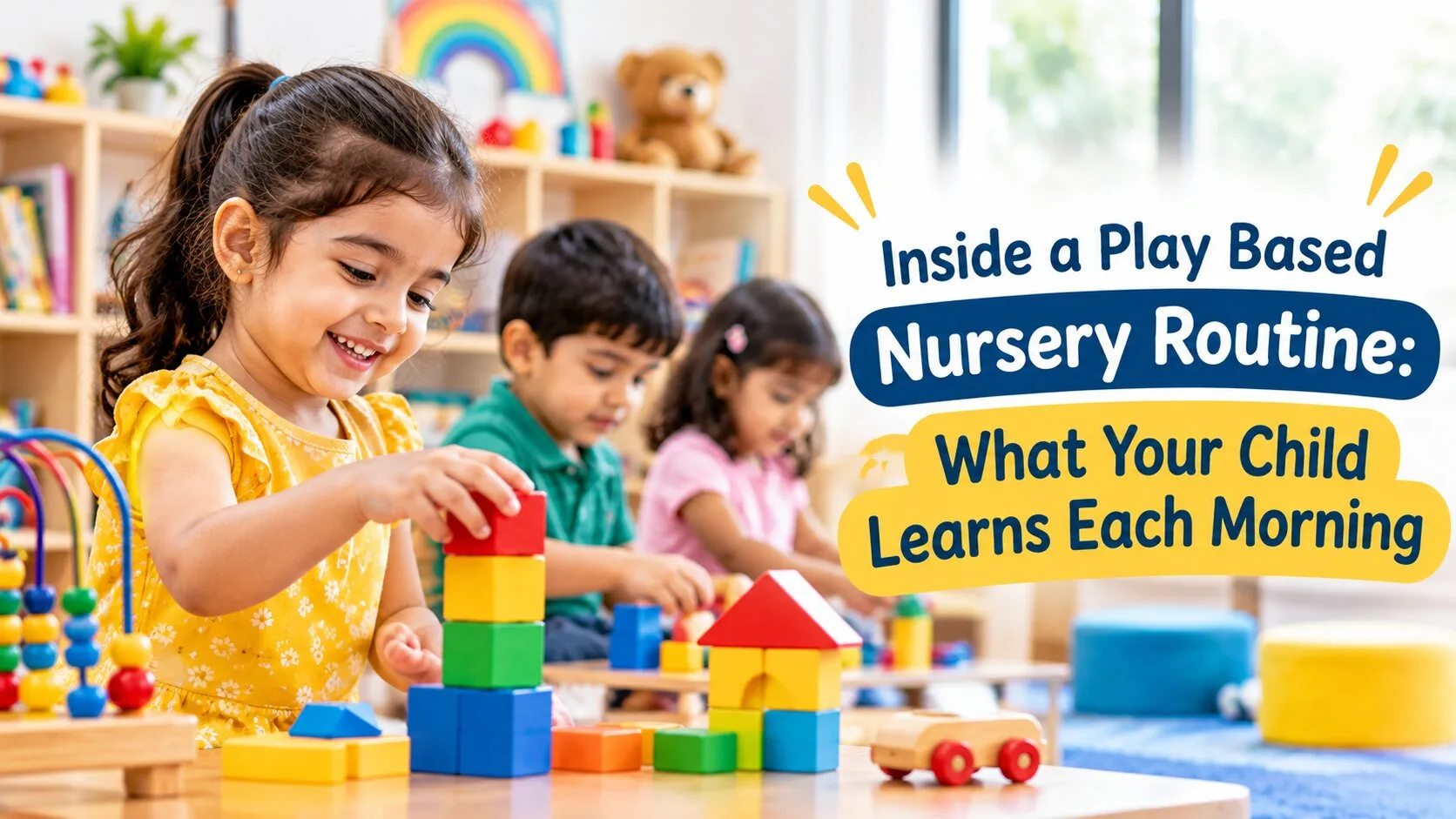
When children have the freedom to select their own activities, they become deeply invested in their learning. A toddler who chooses to spend twenty minutes balancing wooden blocks on a foam bridge is conducting real-time physics experiments. They are testing gravity, experimenting with weight distribution, and learning how to persevere when a structure collapses. This self-directed inquiry engages the brain’s frontal lobe, which governs executive function, flexible thinking, and working memory.
Educators move through the room as supportive facilitators rather than strict directors. They observe closely, asking open-ended questions like, “What do you think will happen if we add this wider block to the top?” This subtle guidance expands the child’s thinking while keeping their imagination at the centre of the experience, ensuring that learning remains an inspiring personal journey.
Circle Time and Language Foundations
Gathering on the carpet for morning circle time is a beloved highlight of the morning. While this group session is filled with smiles, fingerplays, and animated songs, its primary developmental value lies in accelerating toddler language development.
During morning circle, educators introduce vibrant vocabulary through rhythm, rhyming games, and visual storytelling. When young children sing repetitive songs accompanied by hand gestures—such as clapping to syllables or mimicking animal motions—they are developing auditory discrimination and phonological awareness. Hearing words spoken clearly in an interactive group setting encourages even the quietest toddlers to experiment with vocalisation and syllable articulation.
Circle time also introduces foundational classroom etiquette in a gentle, accessible way. Sitting together on the rug teaches toddlers how to share space, track a speaker with their eyes, and practice active listening. These shared experiences show children that their voices and contributions matter within their classroom community.
Sensory Tables: Science, Math, and Fine Motor Dexterity
Sensory exploration forms the beating heart of an effective morning program. Toddlers learn primarily through physical contact with their surroundings; they must touch, squeeze, pour, and manipulate tangible items to truly understand abstract concepts.
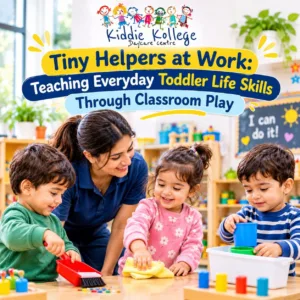
Integrating intentional fine motor activities for toddlers into sensory zones turns simple materials like water, kinetic sand, dry oats, and modeling dough into rich learning hubs. As children pinch small objects with plastic tongs, squeeze water from sponges, and roll clay between their palms, they strengthen the intrinsic hand and wrist muscles required for pencil grip and scissor control.
Sensory play also introduces foundational concepts in mathematics and science. When a toddler pours dry rice from a tall, narrow jar into a wide, shallow bowl, they are engaging with early principles of volume and conservation. Mixing paint colors introduces cause-and-effect reasoning, while sorting smooth river stones by size or colour establishes early classification and pattern recognition skills. Through these simple tactile tasks, complex academic concepts become tangible, memorable discoveries.
Building Peer Relationships and Emotional Regulation
One of the greatest gifts of a group early learning setting is the organic social practice it provides each day. At home, toddlers are accustomed to being the central focus of their caregivers’ attention. In a classroom, they learn to share space, navigate diverse temperaments, and build meaningful relationships with peers.
Early childhood classrooms serve as the ideal environment for nurturing social skills in toddlers. True cooperative play begins with parallel play, where young children sit side-by-side using similar toys while observing one another’s actions. Under the guidance of caring educators, parallel play gradually blossoms into cooperative interactions where children trade toys, collaborate on block towers, and comfort friends who appear upset.
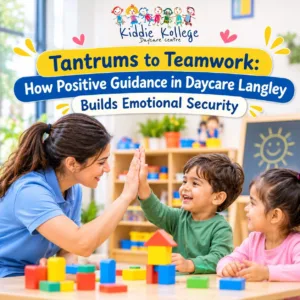
Conflict naturally arises when two toddlers desire the same yellow fire truck or sensory scoop. In progressive early childhood centres, educators treat these disagreements as teachable moments rather than infractions. Teachers model calm breathing, help children put their feelings into words, and guide them toward constructive solutions: “You both want the fire truck. Let’s set a visual timer so you can each have a turn.” This proactive coaching builds emotional resilience and gives children peaceful conflict-resolution skills that serve them throughout life.
Outdoor Recess: Gross Motor Mastery and Nature Inquiry
Morning routines typically transition into refreshing outdoor play, rain or shine. Getting outside into the fresh West Coast air is essential for physical health, mental focus, and emotional well-being.
Outdoor playgrounds provide ample room for whole-body movement that cannot be replicated indoors. Running across grass, climbing low play structures, jumping over puddles, and pedalling tricycles develop gross motor coordination, spatial balance, and cardiovascular health. These energetic outdoor sessions challenge the vestibular and proprioceptive systems, helping children develop body awareness and physical confidence.
Outdoor spaces also inspire natural curiosity. Toddlers examine earthworms after a morning rain, gather fallen maple leaves to compare colours, and inspect textured tree bark. Experiencing the outdoors connects children to their local environment, encouraging a lifelong love of nature and providing a rich sensory backdrop for spontaneous play.
The Power of Predictable Rhythm and Daily Balance
Parents often wonder how young children manage transitions between energetic outdoor play, quiet storytelling, and messy sensory stations without becoming overwhelmed. The secret lies in a carefully crafted daily daycare routine that alternates mindfully between energetic exploration and calm, restorative periods.
A dependable daycare schedule gives toddlers a deep sense of security. Because young children cannot tell time using clocks, they rely on consistent routines to understand what comes next. Knowing that handwashing follows outdoor recess, and that a nourishing snack follows handwashing, eliminates anxiety about the unknown. This predictability reduces behavioral challenges, helps children manage their energy, and creates an environment where little learners feel comfortable taking positive risks.
Integrating Child-Led Discovery into Structured Routines
High-quality early learning avoids rigid, top-down instruction while maintaining intentional classroom order. Through varied play-based learning activities, teachers organize the physical environment so that learning occurs naturally.
By championing learning through play, educators celebrate each child’s individual interests. If a group of toddlers shows fascination with neighborhood construction trucks, teachers might stock the reading corner with construction picture books, add toy excavators and pebbles to the sensory bin, and encourage children to sketch tire tracks in shaving cream. Aligning the curriculum with children’s spontaneous interests ensures high engagement and joyful learning.
Choosing the Right Early Care Provider in Langley
Selecting the ideal care environment for your child is a deeply meaningful decision. Families across the Lower Mainland want an accredited centre that combines exceptional safety standards with warmth and educational depth. Exploring options at an established preschool langley campus or touring a reputable licensed daycare in Langley helps families evaluate how educators interact with little ones during active morning play.
Families often compare multiple local programs, evaluating the average cost of daycare against the level of individual attention and developmental richness provided. Transparent centres explain how provincial fee reductions—such as the Child Care Fee Reduction Initiative (CCFRI) and Affordable Child Care Benefit (ACCB)—stack to keep licensed care accessible. Choosing an experienced community provider like kiddie kollege daycare ensures that your toddler receives attentive, licensed care in a bright, modern facility. When researching available programs, parents frequently browse directories for an inviting pre school near me to keep morning drop-offs convenient, or search for trusted childcare near me close to 53rd Avenue to give their children an enriching start in accredited childcare programs.
Frequently Asked Questions
How do educators maintain safety and hygiene during morning sensory activities?
Safety and cleanliness are maintained through proactive classroom routines. All sensory ingredients are non-toxic, age-appropriate, and taste-safe for younger toddlers. Sensory bins, water basins, and toys are cleaned and disinfected daily using child-safe sanitation products, and children participate in educator-guided handwashing before and after all activities.
What areas do Langley child care providers typically serve?
Centres located along 53rd Avenue serve families across Langley City, Murrayville, Willoughby, Brookswood, and Walnut Grove. Thanks to accessible routes near Fraser Highway and 200th Street, these facilities are also convenient for working parents commuting from Surrey, Clayton Heights, and Cloverdale.
What is the typical administrative response time for parent tour requests?
Childcare administrators understand that working parents require prompt information when planning return-to-work timelines. Most centres respond to website inquiries, waitlist applications, and phone calls within 24 to 48 business hours to arrange personalized tours and answer enrollment questions.
What should I do if my child takes longer to adjust to morning drop-offs?
Separation anxiety is a normal and healthy developmental stage. Parents can support their child by keeping morning goodbyes short, loving, and consistent. Creating a predictable ritual—such as a warm hug, a wave through the viewing window, and an upbeat reassurance of when you will return—helps children build trust and settle into their morning activities.
Fostering a Lifelong Love for Exploration
A morning spent immersed in thoughtful, play-based exploration leaves a child feeling capable, connected, and inspired. When educators view play as the foundation of early learning, simple moments—stacking wooden blocks, splashing in cool water, and sharing rhymes with friends—become meaningful steps toward kindergarten readiness and lifelong self-confidence.
If you are looking for an early learning setting where your child’s natural wonder is supported by attentive, professional educators, reach out to Kiddie Kollege. Situated at 20103 53 Ave, Langley, BC V3A 3T8, Canada, our passionate staff offers an enriching infants and toddlers program that balances engaging play spaces with loving guidance. We warmly invite you to book a personal tour of our classrooms, meet our team, and see how our approach brings out the best in every child.
Investing in a high-quality, balanced play based nursery routine provides your little one with the confidence, joy, and emotional security needed to take their first proud steps into the wider world.