Summary
- Explores how positive guidance in daycare langley classrooms transforms everyday toddler tantrums into opportunities for empathy, communication, and peer teamwork.
- Explains the developmental neuroscience behind big toddler emotions and why punitive time-outs rarely teach lasting self-control.
- Details practical educator techniques—such as co-regulation, clear boundary setting, and visual cues—that foster lasting emotional safety.
- Highlights how multi-age group settings naturally accelerate social problem-solving and conflict resolution among young children.
- Shares actionable strategies parents can use at home to reinforce calm, consistent guidance routines across Langley and the Fraser Valley.
Anyone who has spent time around a two- or three-year-old knows how swiftly a cheerful afternoon can unravel over the “wrong” coloured sippy cup or a coveted wooden train. To adults, these moments can look like sudden defiance; to developmental specialists, they are unmistakable signs of a rapidly growing brain learning to navigate overwhelming feelings without the verbal tools to express them yet. Integrating positive guidance in daycare langley classrooms turns those stormy emotional moments into stepping stones toward lifelong resilience, trust, and genuine peer cooperation.
At Kiddie Kollege, located at 20103 53 Ave, Langley, BC V3A 3T8, Canada, our experienced team leads a supportive multi-age childcare program where children are never shamed for having big feelings, but instead coached with warmth, patience, and clear boundaries until they feel safe and capable.
Understanding how modern early learning environments approach behaviour helps parents feel confident that their child’s emotional well-being is nurtured alongside their physical safety and cognitive growth. When children know that caring adults will remain steady even when their own emotions feel stormy, they develop the deep emotional security needed to explore, take healthy social risks, and build real friendships.
Understanding the Toddler Brain Behind Big Emotions
To appreciate why supportive coaching works so much better than scolding or isolation, it helps to look at what happens inside a young child’s brain during a meltdown. Between eighteen months and four years of age, the emotional centre of the brain—the amygdala—is fully active and quick to sound an alarm whenever a child feels tired, hungry, frustrated, or misunderstood. Meanwhile, the prefrontal cortex—the region responsible for impulse control, logical reasoning, and perspective-taking—is still in the earliest stages of construction.
When a toddler throws themselves onto the carpet because another child picked up the blue truck, their nervous system is genuinely flooded. Lecturing a child in that state is like trying to teach someone how to swim while they are already underwater. Supporting emotional regulation in toddlers begins with recognizing that a tantrum is not a calculated power play; it is a stress response from a child whose coping toolkit has temporarily overflowed.
What Positive Guidance Looks Like in Practice
Modern gentle discipline in early childhood is frequently misunderstood as permissive or lacking rules. In reality, positive guidance pairs deep emotional warmth with firm, predictable, and respectful boundaries. Children feel safest when they know exactly where the guardrails are and trust that the adults in charge will uphold them calmly.
In a thoughtfully run classroom, educators replace punitive reactions with proactive, skill-building responses:
- Getting Down to Eye Level: Instead of calling instructions across a noisy room, educators kneel so they are face-to-face with the child. A calm posture, warm facial expression, and steady tone immediately signal safety to an overwhelmed nervous system.
- Naming the Feeling First: Educators validate the emotion before addressing the behaviour, saying things like, “You are really frustrated because you wanted a turn on the swing right now.” Putting words to feelings helps bridge the emotional and logical parts of the brain.
- Stating What to Do Instead of What Not to Do: Young brains process concrete action words far better than negative commands. Rather than saying “Stop running,” teachers say, “Walking feet inside, please.” Instead of “Don’t hit,” they coach, “Gentle hands; tell your friend, ‘I’m using this.'”
- Offering Limited, Empowering Choices: Giving toddlers safe control over small decisions reduces power struggles dramatically. Asking, “Would you like to hop like a bunny to the handwashing sink or tiptoe like a mouse?” invites cooperation while keeping the routine moving smoothly.
Co-Regulation: The Bridge to Self-Control
Children cannot learn to calm themselves down in isolation; they learn self-regulation by borrowing the calm of a steady adult hundreds of times over. This process, known as co-regulation, is the heartbeat of effective toddler behaviour management in group care settings.
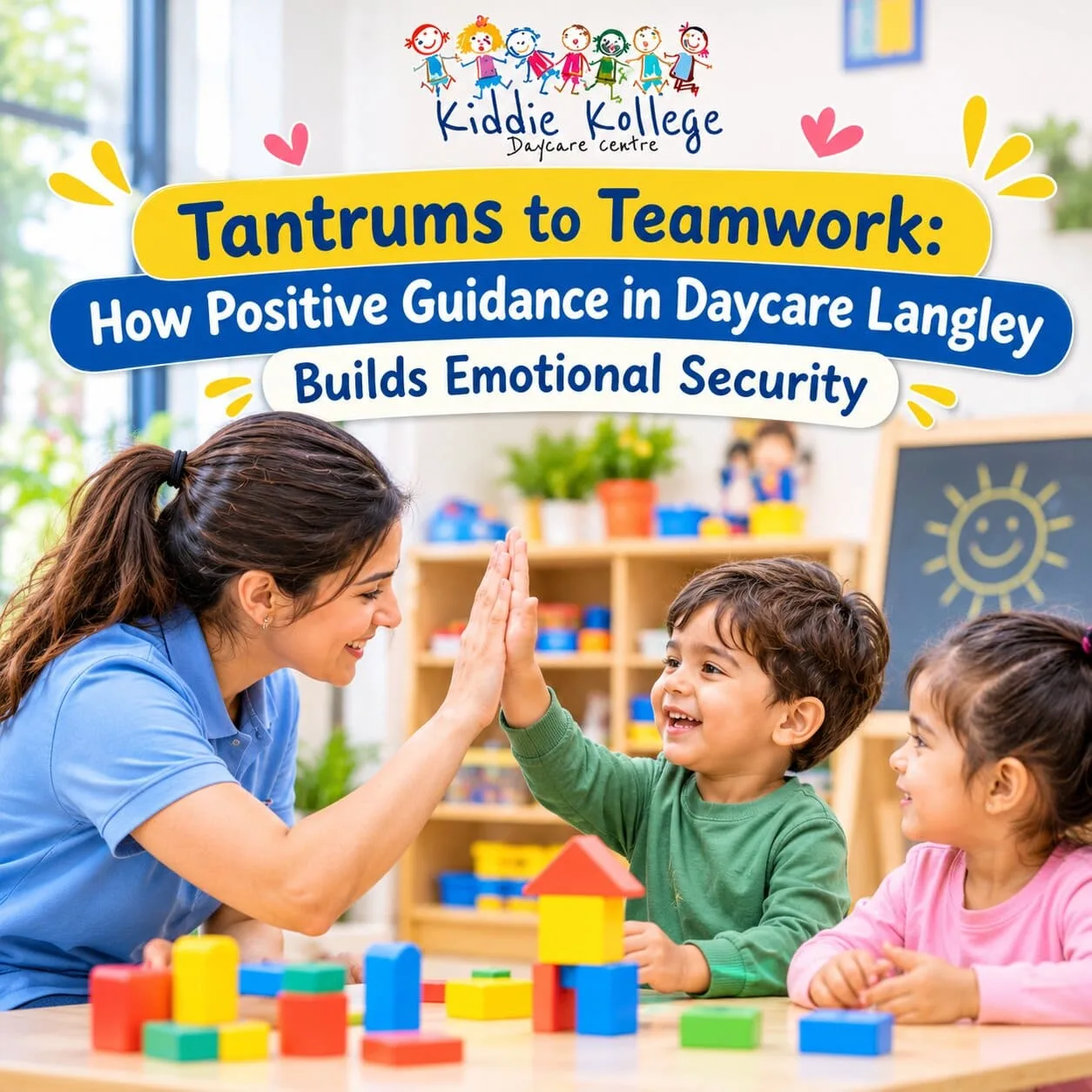
When an educator sits quietly beside an upset child, offers a comforting presence without forcing physical touch, and takes slow, audible breaths, the child’s heart rate and breathing gradually mirror that calmness. Over months of consistent co-regulation, external adult support becomes the child’s own internal voice. Parents often notice their three-year-old suddenly taking a deep breath during a frustrating puzzle at home or saying, “I need a minute to calm my body”—clear proof that those daily classroom moments have taken root.
Turning Peer Conflict into Teamwork and Empathy
Sharing space and toys with peers is challenging work for young children who are naturally wired to view the world from their own perspective. Rather than stepping in as a referee who simply confiscates a contested toy or forces an insincere “Say sorry,” skilled educators treat peer friction as a live coaching opportunity for social-emotional learning in preschool environments.
Imagine two children tugging on the same watering can at the sensory table. An educator steps in calmly, places a gentle hand on the watering can to pause the tug-of-war, and narrates what they see: “It looks like you both want to water the plants at the same time. That is a tricky problem. What can we do?”
With just a small prompt, children begin brainstorming real solutions—taking turns with a sand timer, finding a second cup to pour water, or having one child hold the funnel while the other pours. When children participate in solving the problem themselves, they experience the pride of genuine teamwork and learn that disagreements can be resolved through words rather than tears or grabbing.
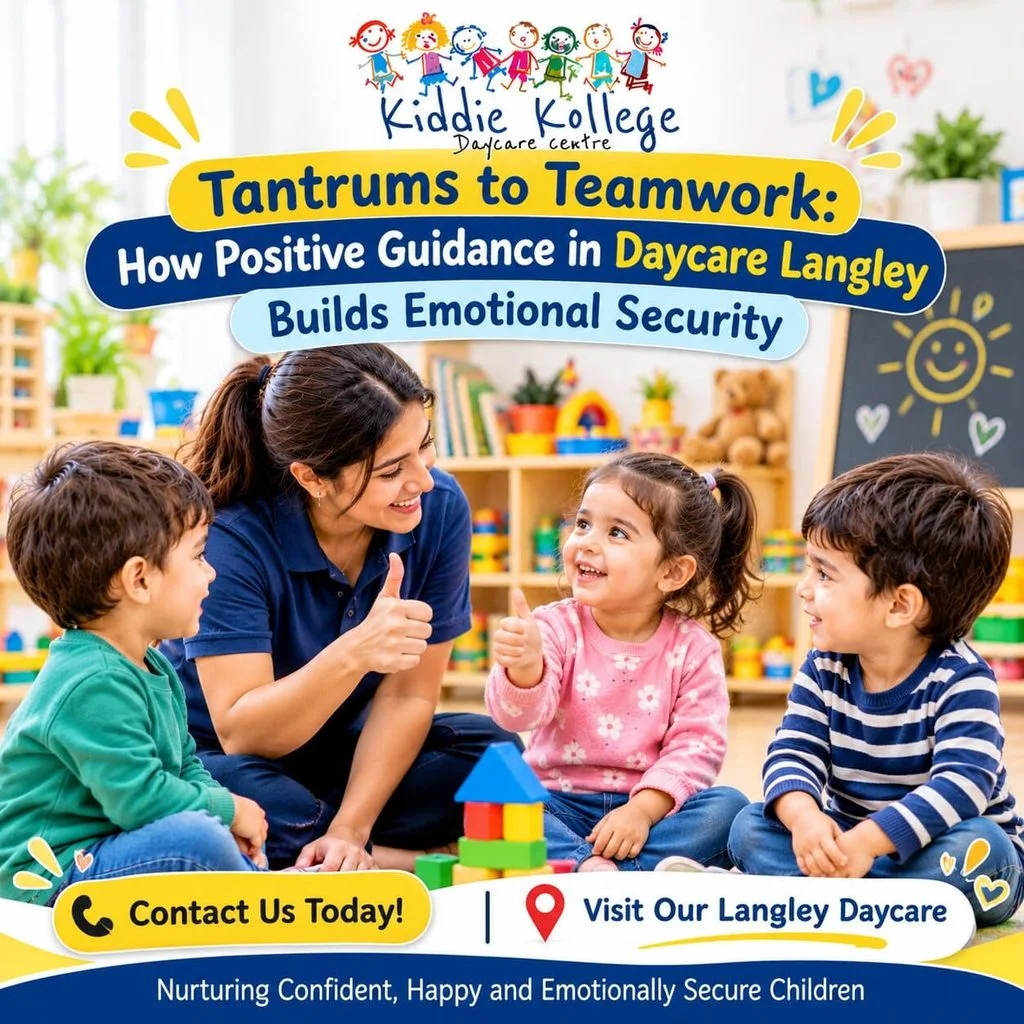
How Multi-Age Settings Accelerate Social Confidence
The composition of a classroom also plays a remarkable role in how smoothly young children develop empathy and cooperation. In mixed-age environments where toddlers and preschoolers learn alongside one another, social modelling happens organically all day long.
Younger children watch older peers wait their turn at the slide, ask politely for more apple slices at snack time, and comfort a friend who scraped a knee. Seeing peers—not just adults—practise kindness makes those behaviours feel achievable and exciting. At the same time, older three- and four-year-olds step into gentle leadership roles, discovering patience and pride as they help a younger classmate snap a block together or find their cubby. That natural peer mentorship creates a warm, family-style community where every child belongs.
Designing Classrooms That Prevent Frustration Before It Starts
A huge portion of positive guidance in daycare langley educators practise happens before children even walk through the morning door. Thoughtful classroom design eliminates many common triggers of toddler frustration:
- Duplicate Favourite Materials: Stocking several identical dump trucks, baby dolls, and paintbrushes reduces unnecessary competition among toddlers who are still learning the concept of waiting.
- Visual Schedules and Transition Warnings: Predictable routines lower anxiety. Educators use chime signals, transition songs, and picture schedules so children always know what comes next—whether tidying blocks for snack or putting on rain boots for outdoor play.
- Cozy Calm-Down Corners: Every bustling classroom benefits from a quiet retreat stocked with soft cushions, sensory bottles, and feelings books where a child can step away voluntarily when group play feels too loud.
- Balanced Energy Pacing: Alternating active gross-motor outdoor play with focused tabletop discovery and nourishing snacks keeps blood sugar steady and prevents overtired meltdowns.
Partnering with Langley Parents for Consistency at Home
Children thrive when the adults in their lives speak the same supportive emotional language. When educators and parents share observations openly at pickup time—celebrating a child’s first successful turn-taking moment or brainstorming gentle bedtime transitions—guidance feels seamless rather than confusing.
Parents looking for reputable licensed childcare in British Columbia often appreciate centres where early childhood educators langley families trust prioritize daily communication alongside strong safety standards. At kiddie kollege daycare, educators share practical insights from the day so parents can echo familiar phrases like “gentle hands” or “let’s take a deep breath together” during busy evening routines at home.
Across the Fraser Valley, families researching licensed daycare langley bc options increasingly look beyond basic supervision to find programs rooted in positive discipline and emotional warmth. Whether parents are comparing local langley childcare centres in Willoughby, Murrayville, or Walnut Grove, searching online for a trusted licensed infant daycare near me as maternity leave winds down, or exploring an inviting pre school near me along 53rd Avenue for their growing toddler, choosing an environment anchored in empathy sets the tone for years of joyful learning.
Frequently Asked Questions
How do educators handle biting or hitting safely without shaming toddlers?
Biting and hitting are common ways pre-verbal toddlers communicate frustration, overstimulation, or a need for personal space. Educators respond immediately by comforting the hurt child first, then calmly kneeling beside the child who bit or hit to set a clear boundary (“Biting hurts; teeth are for food”) while helping them express what they needed with words or gestures.
What is the typical administrative response time when inquiring about availability or tours?
Administrative teams recognize that parents balancing return-to-work dates and family schedules need timely information. Most local centres reply to online tour requests, waitlist applications, and phone inquiries within 24 to 48 business hours with current availability details.
Which neighbourhoods around Langley are covered by centres on 53rd Avenue?
A central location on 53rd Avenue provides convenient access for families living and commuting across Langley City, Murrayville, Willoughby, Brookswood, and Walnut Grove, as well as nearby routes connecting Clayton Heights, Cloverdale, and Surrey.
What service hours and age groups are typically accommodated in licensed Langley centres?
Licensed group and multi-age centres generally operate Monday through Friday from 7:00 AM to 5:30 PM or 6:00 PM to support working commuters, welcoming children from 10 months through preschool and school-age years depending on specific program licensing.
How can parents reinforce positive guidance techniques at home?
Keeping expectations simple, offering two acceptable choices during stubborn moments, naming your child’s emotions aloud before correcting behaviour, and maintaining consistent meal and sleep schedules help children feel secure and cooperative at home.
Building a Foundation of Trust, Empathy, and Teamwork
Every tantrum navigated with patience and every shared toy negotiated with gentle coaching lays another brick in your child’s emotional foundation. When young children learn early on that their feelings are understood, their boundaries are respected, and their words have power, they grow into confident, empathetic teammates both inside the classroom and throughout life.
If you are seeking a caring, dependable early learning community where emotional security and joyful discovery walk hand in hand, connect with Kiddie Kollege. Located at 20103 53 Ave, Langley, BC V3A 3T8, Canada, our dedicated educators deliver a nurturing multi-age childcare program designed to foster resilience, kindness, and genuine curiosity. We warmly invite you to schedule a visit, tour our welcoming classrooms, and meet the team supporting local families every day.
Embracing positive guidance in daycare langley classrooms ensures your child experiences early learning as a safe, encouraging partnership that turns everyday challenges into lasting confidence.