When parents peek into an early childhood classroom and see a group of three- and four-year-olds wearing oversized chef hats, taking orders on clipboards, or staging an animated puppet show behind a cardboard theatre, it is easy to smile at the sheer cuteness of the moment. Yet beneath all that giggling, negotiation, and storytelling lies some of the richest cognitive and social learning of early childhood. Incorporating dramatic play in daycare langley classrooms gives young learners a safe, joyful stage to test real-world social roles, expand their spoken vocabulary, and make sense of the busy world around them.
At Kiddie Kollege, located at 20103 53 Ave, Langley, BC V3A 3T8, Canada, our dedicated early childhood educators design welcoming childcare programs where open-ended pretend play is thoughtfully woven into daily classroom routines to build curiosity, confidence, and genuine school readiness.
Understanding why educators dedicate prime classroom space to pretend grocery stores, veterinary clinics, and puppet corners helps families appreciate the serious developmental work happening during play. When children step into someone else’s shoes, they are practising executive function, abstract thinking, and emotional empathy all at once.
Give your little explorer a classroom designed for discovery, friendship, and joyful pretend play right here in Langley, BC.
Summary
- Explores the developmental science behind dramatic play in daycare langley classrooms and why pretend cafes, puppet theatres, and dress-up corners are essential learning tools.
- Demonstrates how role-playing everyday scenarios accelerates vocabulary growth, active listening, and expressive storytelling in young children.
- Explains how stepping into imaginary roles helps preschoolers practice empathy, turn-taking, and peaceful peer negotiation.
- Reveals how acting out familiar real-world experiences builds emotional resilience and lowers anxiety around new routines.
- Offers practical ways parents can encourage imaginative storytelling at home using simple household props.
📋 Table of Contents
- → What Dramatic Play Actually Means in Early Childhood Education
- → Inside the Pretend Cafe: Maths, Literacy, and Real-World Roles
- → Puppet Shows and Storytelling: Unlocking Expressive Voice
- → Building Social Skills and Empathy Through Shared Scripts
- → Emotional Regulation and Processing Big Feelings
- → How Educators Set the Stage Without Taking Over
- → Simple Ways Parents Can Encourage Pretend Play at Home
- → Exploring Play-Based Early Learning in Langley
- → Frequently Asked Questions
- → Nurturing Imagination, Voice, and Confidence
What Dramatic Play Actually Means in Early Childhood Education
In early childhood pedagogy, dramatic play—often called socio-dramatic or symbolic play—occurs when children assign roles to themselves and others, invent scenarios, and use objects to represent something else entirely. A wooden block becomes a ringing smartphone; a scarf transforms into a superhero cape or a doctor’s sling; a cardboard box turns into a bustling neighbourhood bakery.
This symbolic leap is a major cognitive milestone. Before a child can understand that written letters on a page represent spoken sounds, or that numerals represent physical quantities, their brain must first grasp the concept that one object can stand in for another. Engaging in pretend play for toddlers lays that exact foundational wiring. When an eighteen-month-old holds a plastic banana to their ear and says “hello,” they are demonstrating early abstract thought and social observation. By preschool age, those simple gestures evolve into elaborate, multi-character storylines with rules, plot twists, and shared goals.
Inside the Pretend Cafe: Maths, Literacy, and Real-World Roles
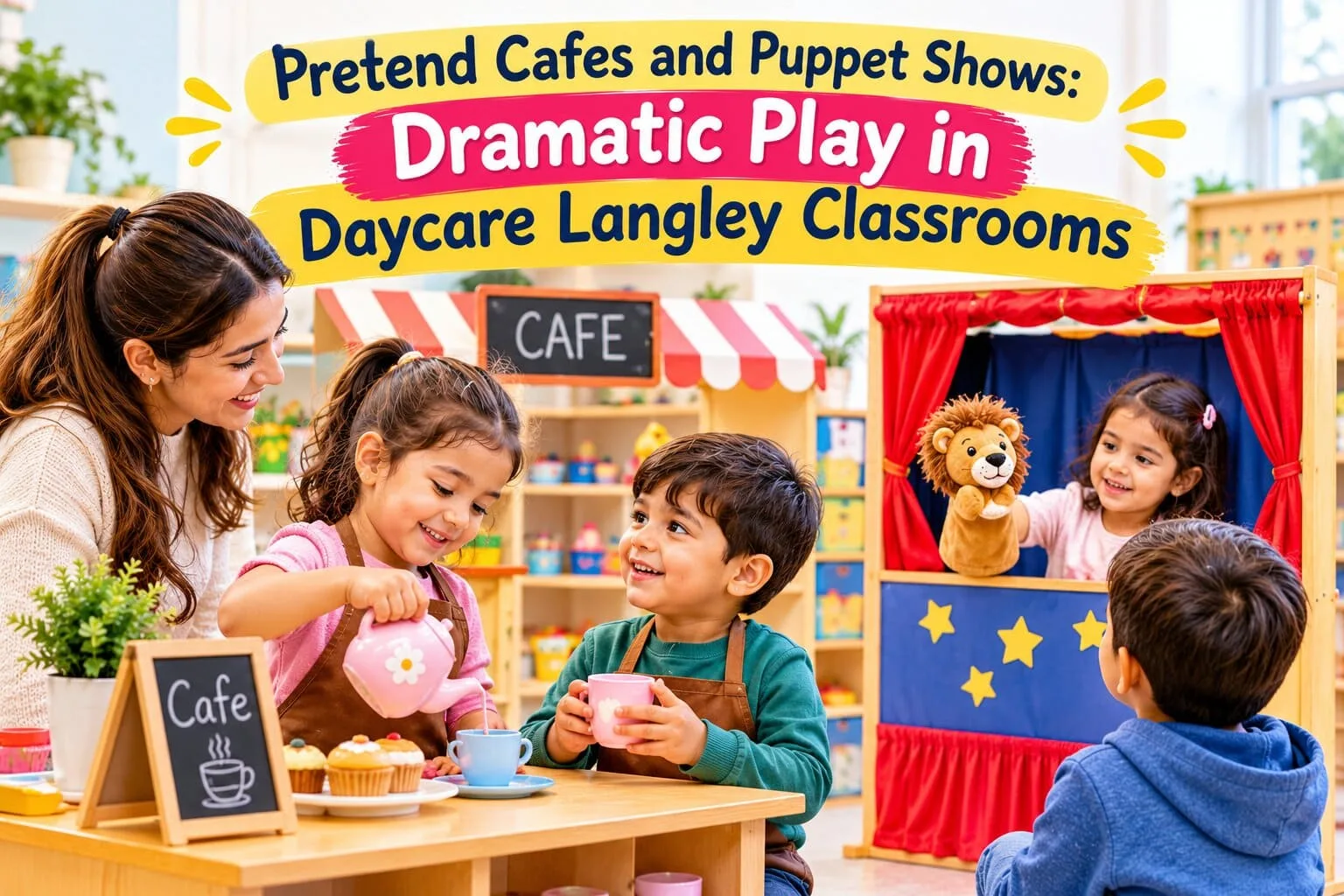
Few classroom setups capture children’s imaginations quite like a pretend neighbourhood cafe or farmer’s market. Educators frequently rotate dramatic play themes to reflect familiar community experiences across British Columbia, and food-service role-play remains a universal favourite.
Watch closely during a twenty-minute session in a classroom cafe, and you will see early academic skills blooming naturally without a single worksheet in sight:
- Emergent Literacy in Action: Children scribble squiggles and letter-like shapes onto order pads, read picture menus, and point to handwritten signs displaying daily specials. They quickly discover that printed words carry real-world meaning and help people communicate.
- Practical Numeracy and Sorting: Young servers count out three felt pancakes onto a plate, sort wooden fruits by colour into baskets, and hand over pretend coins while announcing totals. Counting becomes purposeful rather than rote memorisation.
- Fine Motor Coordination: Tongs used to pick up plush croissants, buttons on chef aprons, and zippers on dress-up vests strengthen the tiny intrinsic hand muscles children need for holding pencils and managing their own winter coats.
- Community Awareness: Rotating roles between barista, baker, customer, and delivery driver helps children appreciate how community helpers collaborate to keep a neighbourhood running smoothly.
Because children are deeply invested in keeping their cafe open for business, their attention spans stretch remarkably long, building the sustained focus they will later carry into kindergarten classrooms.
Puppet Shows and Storytelling: Unlocking Expressive Voice
While pretend cafes encourage bustling group movement, puppet theatres invite rich verbal expression, humour, and narrative sequencing. For young children who feel shy speaking up during large circle times, holding a fuzzy hand puppet or finger puppet acts as a wonderful social bridge. Suddenly, it is not the hesitant child speaking—it is the friendly bear or silly frog doing the talking.
Integrating puppetry and imaginative play activities into the classroom rhythm directly accelerates language development in toddlers and preschoolers. When children invent dialogue for puppets, they experiment with vocal inflection, descriptive adjectives, and complete sentence structures. They learn how stories work—establishing a beginning, introducing a small problem, and finding a resolution.
Educators gently enrich these puppet shows by sitting nearby as an engaged audience member or introducing a puppet of their own to ask open-ended questions. Asking a child’s puppet, “Oh dear, Mr. Owl looks worried—why is he hiding behind the curtain?” prompts the child to articulate feelings, brainstorm explanations, and expand their conversational vocabulary effortlessly.
Building Social Skills and Empathy Through Shared Scripts
Unlike solitary puzzles or individual art projects, socio-dramatic play thrives on cooperation. You cannot run a pretend veterinary clinic or fire station alone for very long before you need patients, fellow firefighters, or pet owners to join the story.
Navigating these shared scripts builds vital social skills in preschool settings. Before the story can even begin, children must negotiate roles, agree on basic rules, and compromise when two friends both want to wear the stethoscope or hold the cash register. Through gentle educator coaching, children learn to say, “You can be the veterinarian first, and I will be the nurse, then we can switch.”
Stepping into different characters also nurtures genuine empathy. When a preschooler pretends to care for a sick baby doll or comforts a stuffed puppy that is “afraid of thunder,” they are practising perspective-taking—imagining what someone else feels and needs. These moments of pretend caregiving translate directly into kinder, more patient interactions with real classmates on the playground.
Emotional Regulation and Processing Big Feelings
Young children experience intense emotions every day, yet they often lack the adult vocabulary to explain why a routine change or a trip to the dentist felt overwhelming. Dramatic play provides a safe, low-stakes outlet where children can replay unfamiliar or stressful experiences until they feel completely in control of them.
Psychologists and early educators widely recognize the link between symbolic role-play and emotional regulation in children. When a child sets up a pretend doctor’s office and uses a toy thermometer to check a teddy bear’s temperature, they are reversing roles—moving from feeling small and uncertain to feeling capable and reassuring. Similarly, acting out goodbyes and reunions with dolls helps toddlers process morning drop-off transitions. Having the freedom to explore bravery, frustration, and comfort through pretend characters lowers baseline anxiety and strengthens emotional resilience.
How Educators Set the Stage Without Taking Over
The secret to extraordinary dramatic play lies in intentional preparation paired with respectful restraint. When adults over-direct pretend play—telling children what a prop must be or dictating how the story should unfold—the magic quickly fades. Instead, skilled early childhood educators act as thoughtful stage managers and curious observers.
Rather than filling the dramatic play corner solely with single-purpose plastic toys, progressive classrooms stock shelves with open-ended loose parts: woven baskets, wooden bowls, lengths of sheer fabric, clipboards, recycled food cartons, and natural pinecones. Open-ended materials invite children to invent their own solutions rather than passively following a toy’s built-in sound effects.
By championing learning through play, educators watch for emerging classroom interests. If several children return from a weekend talking about riding the SkyTrain or visiting a local farm stand, teachers freshen up the dramatic play corner with cardboard ticket booths, steering wheels, or harvest crates to extend that curiosity throughout the week.
Simple Ways Parents Can Encourage Pretend Play at Home
Families do not need elaborate playrooms or expensive costumes to spark rich imaginative storytelling at home. Some of the most memorable pretend adventures grow out of everyday household items and unhurried time together:
- Keep a Prop Basket Handy: Fill a laundry basket with clean kitchen towels, empty spice jars, old sunglasses, scarves, and a small notepad with a chunky crayon. Rotating two or three items each week keeps curiosity fresh.
- Turn Errands into Story Starters: After visiting the library, post office, or bakery together, ask your child if they want to set up a pretend version in the living room using books, envelopes, or sofa cushions.
- Follow Your Child’s Lead: When invited to join a pretend tea party or puppet show, let your child assign your role and make the rules. Ask playful, open-ended questions like, “What is on the menu today?” rather than quizzing them on colours or numbers.
- Embrace Cardboard Boxes: A large delivery box paired with washable markers becomes a rocket ship, a submarine, a cozy reading cave, or a puppet stage with endless replay value.
Exploring Play-Based Early Learning in Langley
Choosing an early childhood setting where imagination is valued alongside safety and structure gives young learners an inspiring start. Families searching for a welcoming play-based daycare langley centre often look closely at how classrooms balance guided routines with open-ended creative discovery. While some parents browse general listings for a kiddie daycare nearby, visiting centres in person reveals the true difference that warm educator engagement and thoughtfully curated play spaces make in a child’s daily happiness.
Across Langley City, Willoughby, Murrayville, and Walnut Grove, working families seek accredited environments that honour each child’s developmental pace. Parents researching local options frequently start by looking online for an inviting pre school near me when their toddler begins showing curiosity about peers, or searching for dependable childcare near me along 53rd Avenue that nurtures creativity, speech confidence, and social warmth every single day.
Frequently Asked Questions
What age groups benefit most from dramatic play in a daycare setting?
Dramatic play evolves naturally across early childhood. Toddlers aged 18 to 30 months begin with simple imitation, such as feeding a doll or talking on a toy phone, while preschoolers aged 3 to 5 years build complex, cooperative storylines with peers. Licensed multi-age and preschool classrooms tailor props and educator prompts to match each developmental stage safely.
How do Langley centres ensure hygiene and safety in shared dress-up and pretend play corners?
Reputable licensed centres follow strict Fraser Health sanitation protocols. Hard props like play dishes, toy food, and telephones are sanitized daily using child-safe, non-toxic disinfectants, while washable dress-up fabrics, plush puppets, and cushion covers are laundered regularly on a scheduled rotation.
What is the typical administrative response time when inquiring about availability or tours?
Early learning administrators understand that parents coordinating return-to-work schedules or preschool transitions appreciate prompt communication. Most local centres respond to website inquiries, waitlist registrations, and phone messages within 24 to 48 business hours to arrange personalized classroom tours.
Which neighbourhoods around Langley are served by centres located on 53rd Avenue?
A centrally situated centre on 53rd Avenue offers convenient access for families commuting from Langley City, Murrayville, Willoughby, Brookswood, and Walnut Grove, as well as nearby routes connecting Surrey, Clayton Heights, and Cloverdale.
How does dramatic play help prepare children for kindergarten?
Kindergarten classrooms rely heavily on self-regulation, peer cooperation, active listening, and expressive communication. Through pretend play, children practice taking turns, resolving small disagreements with words, following multi-step routines, and building early literacy and numeracy concepts organically before entering elementary school.
Nurturing Imagination, Voice, and Confidence
Behind every pretend cafe order and lively puppet show sits a child learning how to collaborate, communicate, and navigate the world with curiosity and empathy. When early learning environments honour the power of imagination, children discover that their ideas matter, their voices are heard, and learning is a joyful adventure worth exploring every day.
If you are looking for a warm, supportive early learning community where creativity and whole-child growth take centre stage, connect with Kiddie Kollege. Located at 20103 53 Ave, Langley, BC V3A 3T8, Canada, our caring educators deliver engaging childcare programs designed to spark curiosity, language growth, and lasting confidence. We warmly invite your family to schedule a personal visit, tour our vibrant classrooms, and see how our educators bring purposeful play to life.
Experiencing rich dramatic play in daycare langley classrooms equips young learners with the creativity, social empathy, and expressive confidence they need to thrive in kindergarten and beyond.