Preparing a child for their very first day of primary school is one of the most emotional and significant milestones a family ever experiences. Parents across British Columbia naturally wonder whether their little one will feel confident navigating a bustling hallway, listening attentively on the carpet, or managing their own lunchbox without tears. In search of clarity, families frequently search for a comprehensive kindergarten readiness checklist to ensure their child is equipped with the practical tools necessary for academic and social growth.
The truth is that genuine readiness is far less about reciting multiplication facts or reading complete books before age five, and far more about nurturing self-regulation, curiosity, and functional independence. At Kiddie Kollege, situated at 20103 53 Ave, Langley, BC V3A 3T8, Canada, our dedicated early childhood educators deliver an enriching multi-age childcare program that treats every classroom routine as an opportunity to build real-world capability, confidence, and joyful social engagement.
Understanding the difference between academic pressure and holistic readiness can ease parental anxiety. When we examine what kindergarten teachers genuinely value in incoming students, the primary focus consistently rests on how well a child handles unexpected changes, communicates their needs, and works alongside peers.
Summary
- Outlines an actionable kindergarten readiness checklist covering academic, social, emotional, and physical indicators.
- Clarifies why practical independence and self-help skills outweigh early memorisation of flashcards.
- Demonstrates how daily early childhood structures build emotional resilience and peer collaboration.
- Explains the specific hand mechanics and fine motor coordination required for confident pencil control.
- Provides parents with actionable routines to practice at home during the months leading up to grade primary.
📋 Table of Contents
- → The Evolution of Kindergarten Expectations
- → Social-Emotional Maturity: The True Foundation
- → Physical Agility and Fine Motor Mastery
- → The Classroom Rhythm: Structure, Autonomy, and Self-Help
- → Communication and Receptive Language Milestones
- → Cognitive and Academic Fundamentals: An Inquiry Mindset
- → Your Practical Readiness Checklist
- → Selecting an Early Childhood Community in Langley
- → Frequently Asked Questions
- → Setting the Stage for a Lifetime of Confident Learning
The Evolution of Kindergarten Expectations
Modern kindergarten classrooms look markedly different from those of past decades. Today, kindergarten programs emphasize inquiry, self-directed exploration, and dynamic group collaboration. Children are invited to participate in community discussions, investigate natural loose parts, and share shared classroom supplies.
Because of this collaborative structure, children who enter school with strong foundational routines adjust significantly faster. A smooth, confident transition to kindergarten depends on an environment where a child feels emotionally grounded and physically capable. When children enter elementary school having already spent meaningful time in group settings, their focus moves easily from survival anxiety to the genuine excitement of learning new concepts.
Social-Emotional Maturity: The True Foundation
When early childhood specialists assess whether a young learner is truly prepared for a full-day elementary classroom, emotional stability and peer connection always take priority over academic drill work. Academic concepts are easily taught when a child’s nervous system is relaxed and ready to absorb information.
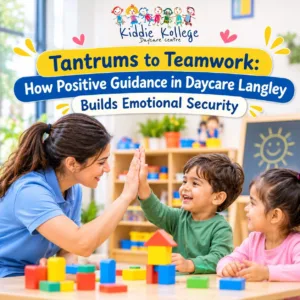
Developing age-appropriate social skills for kindergarten ensures that children know how to take turns, share sensory tools, and express their personal boundaries respectfully. In a group classroom, a child must learn to wait patiently while an educator finishes speaking with another classmate. They also need to navigate small disagreements peacefully, understanding that another friend might want the same wooden block or blue crayon.
Beyond peer collaboration, self-regulation plays a paramount role. Emotional co-regulation, modeled consistently by warm early childhood professionals, teaches children how to process frustration, disappointments, and sensory overstimulation without resorting to prolonged meltdowns. When a child learns to name their feelings and take deep, calming breaths, their classroom becomes a safe space where mistakes are viewed simply as steps in the learning process.
Physical Agility and Fine Motor Mastery
Before a five-year-old can comfortably hold a pencil, write their own name, or cut paper along a straight line, they must build substantial physical stamina in their fingers, hands, and core muscle groups. Elementary teachers frequently notice that students lacking these physical foundations tire out quickly during early drawing and writing tasks.
High-quality early learning focuses intently on fine motor skills for kindergarten through everyday play rather than repetitive worksheets. When children pinch clay, pick up small beads using plastic tweezers, string dried pasta, and roll textured dough, they are strengthening the tiny intrinsic muscles of their fingers. This physical conditioning establishes the pincer grasp required for fluid pencil control and gives children the hand strength to use safety scissors and glue sticks without muscle fatigue.
Gross motor strength matters just as much. Sitting upright on a carpet square during circle time requires solid core stability and vestibular balance. Regular outdoor play, balancing along natural logs, and pedalling trikes ensure that young bodies possess the physical endurance required for a full day of active school participation.
The Classroom Rhythm: Structure, Autonomy, and Self-Help
A major hurdle for many children entering primary school is simply managing the practical logistics of their own day. At home, loving caregivers frequently step in to zip jackets, unwrap cheese sticks, and remind little ones to use the washroom. In a primary classroom with twenty or more students, independent self-help skills are essential.
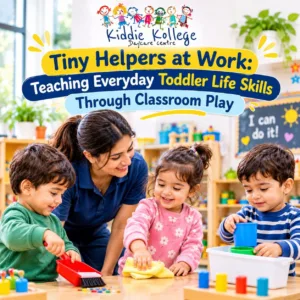
Experiencing a structured preschool classroom routine gives children the repeated practice they need to feel self-sufficient. In an intentional early learning environment, children take pride in learning how to:
- Hang their backpacks on their own assigned hooks and unpack their daily water bottles.
- Put on, zip, and button their own outdoor rain gear and coats.
- Open snap-lid containers, sandwich wrappers, and thermos lids during snack periods.
- Manage their own toileting needs from start to finish, including proper clothing adjustment and thorough handwashing.
- Clean up their immediate workspace by returning toys and art supplies to labeled bins.
When children master these basic daily chores, they enter primary school with a wonderful sense of personal pride, never feeling helpless or frustrated by simple everyday tasks.
Communication and Receptive Language Milestones
Expressive communication is the bridge that connects a child to their teachers and peers. Kindergarten educators need incoming students to be able to voice their feelings, articulate their basic physical needs, and ask for assistance when something feels challenging.
Comprehensive kindergarten readiness skills encompass far more than knowing letter names; they focus on receptive and expressive language fluency. Receptive language refers to how well a child understands spoken directions. Can they listen to a two- or three-step instruction, such as “Please take off your boots, put your folder in the bin, and sit down on the rug,” and carry it out independently?
Expressive language involves articulating thoughts clearly enough that unfamiliar adults understand them. Engaging in storytelling, listening to vibrant picture books, and participating in rich group conversations allow children to build their vocabulary, grasp narrative sequencing, and express their ideas with absolute clarity.
Cognitive and Academic Fundamentals: An Inquiry Mindset
While memorizing long lists of facts is never required for kindergarten entry, developing a natural sense of intellectual curiosity is invaluable. Rather than drilling letter flashcards, quality early childhood programs weave literacy, numeracy, and scientific exploration into daily play.
Children cultivate real mathematical understanding when they count wooden cars in a line, sort shells by shape and size, and compare which bucket holds more water. Literacy blooms naturally when children label their own block buildings, recognize their written name on their cubby, and explore print-rich classroom environments.
By prioritising learning through play, educators keep the spark of inquiry alive. A child who learns that discovery is joyful and engaging arrives at elementary school eager to investigate new ideas, ask creative questions, and explore the unknown without hesitation.
Your Practical Readiness Checklist
To help families assess their child’s overall growth, here is a functional, balanced checklist highlighting what truly supports an easy transition to primary school:
Social & Emotional Markers
- Separates from parents or primary caregivers without prolonged separation distress.
- Plays cooperatively alongside other children, engaging in sharing and taking turns.
- Expresses emotions using words rather than purely physical reactions.
- Accepts gentle corrections or redirection from adult educators.
- Demonstrates empathy by noticing when a peer is sad or hurt.
Self-Care & Independence Markers
- Uses the washroom independently, including wiping, flushing, and washing hands with soap.
- Puts on footwear and outdoor outerwear with minimal adult assistance.
- Opens lunch containers, water bottles, and snack bags unassisted.
- Cleans up their personal space after finishing a meal or craft project.
- Asks an adult for help when they feel unwell, confused, or hurt.
Language & Communication Markers
- Follows clear two- to three-step verbal directions.
- Speaks in complete four- to six-word sentences that are understood by unfamiliar adults.
- Listens attentively to a short storybook without excessive interruption.
- Expresses personal needs, choices, and preferences clearly.
- Recites their first and last name, along with their age.
Fine & Gross Motor Markers
- Holds a fat pencil, crayon, or marker using a three-finger pincer grasp.
- Cuts paper using child-safe scissors with reasonable control.
- Manipulates buttons, large zippers, and velcro closures.
- Runs, jumps, hops, and navigates stairs with alternating feet.
- Sits comfortably on the floor for ten to fifteen minutes during circle time.
Selecting an Early Childhood Community in Langley
Selecting the right early learning setting plays an enormous role in how smoothly your child adapts to group learning dynamics. Whether you have spent time reviewing regional daycare models, comparing structured options like kiddie academy, or considering daycares in langley, finding an environment that matches your family’s educational values is essential.
Parents looking for a caring, accredited child care setting often spend hours researching a reputable licensed daycare in Langley that balances play-based discovery with healthy physical habits. An exceptional centre provides a balanced daycare schedule that respects each child’s individual developmental timeline, alternating between energetic outdoor exploration, focused sensory tasks, and peaceful rest windows.
Families exploring local options can find dedicated toddler and preschool programs at kiddie kollege daycare, which supports parents across the Fraser Valley with licensed, attentive multi-age childcare. When weighing nearby options, parents often look for a welcoming pre school near me to ease their daily commute or search directories for a trusted licensed infant daycare near me along 53rd Avenue to give their children an early foundation for lifelong learning.
Frequently Asked Questions
How do early childhood programs handle variable enrollment waitlists?
Reputable childcare centres manage local waitlists transparently through online application systems. Given the high demand across British Columbia, administrators provide regular intake updates and prioritize the siblings of currently enrolled children to help keep family schedules convenient and unified.
What is the typical administrative turnaround time for parent tour requests?
Local early learning administrators understand that working parents require prompt answers when planning their return to work. Most centres respond to website inquiries, tour bookings, and telephone calls within 24 to 48 business hours to guide parents through the enrollment process.
What neighbourhoods are served by central Langley early learning centres?
Centres situated on 53rd Avenue provide convenient access for families living across Langley City, Willoughby, Murrayville, Brookswood, and Walnut Grove. Their central positioning near Fraser Highway and 200th Street makes them easily accessible for working parents commuting from Surrey, Clayton Heights, and Cloverdale.
What should I do if my child has not checked off every milestone on this list?
It is completely normal for young children to develop on different timelines. Early childhood development is rarely a straight line; some children master fine motor coordination early, while others excel in expressive speech or social cooperation. Focus on patience, gentle practice, and consistent daily routines, keeping open lines of communication with your early educators.
Setting the Stage for a Lifetime of Confident Learning
Entering primary school is an exciting step forward in a young child’s life. When we view early preparation through a lens of emotional resilience, everyday independence, and social empathy, the pressure of perfection disappears. A child who feels capable of managing their own belongings, making new friends, and asking questions is a child who is ready to thrive in any classroom setting.
If you are looking for an early childhood environment where personal growth, nurturing guidance, and kindergarten preparation are thoughtfully woven into each day, connect with Kiddie Kollege. Situated at 20103 53 Ave, Langley, BC V3A 3T8, Canada, our passionate educators provide a balanced multi-age childcare program designed to inspire curiosity and prepare little learners for the years ahead. We warmly welcome your family to tour our vibrant classrooms, meet our team, and see how our approach brings out the very best in every child.
Using a comprehensive kindergarten readiness checklist as an encouraging guide rather than a rigid test ensures your child enters primary school feeling capable, confident, and eager to discover the world.