Quick Summary
- Family-Centered Environment: Learn why multi age childcare langley programs create natural, community-style environments where children learn from peers of diverse ages.
- Peer-to-Peer Mentorship: Discover how older children build leadership and empathy while younger toddlers accelerate their speech and social confidence.
- Sibling Unity and Convenience: Explore the emotional comfort and daily logistical ease of keeping brothers and sisters together in one nurturing space.
- Developmental Pacing: Understand how mixed-age settings eliminate rigid age pressures, allowing every child to grow at their natural developmental rhythm.
- Quality Fraser Valley Childcare: Find out how licensed programs across the region balance safety, provincial standards, and enriching early learning.
Choosing the right early learning setting for your children is one of the most meaningful decisions you will make as a parent. In traditional daycare settings, children are often separated into rigid age groups: infants with infants, toddlers with toddlers, and preschoolers with preschoolers. However, real life rarely happens in isolated age brackets. Families, neighbourhood parks, and community circles are inherently multi-generational. Enrolling your child in a high-quality multi age childcare langley program embraces this natural dynamic by bringing children of varying early years together into a single, cohesive learning family.
At KiddieKollege, located at 20103 53 Ave, Langley, BC V3A 3T8, Canada, our dedicated early childhood educators understand how mixed-age dynamics enrich daily learning across our specialized Infant & Toddler Program, offering families across Langley, and surrounding Fraser Valley communities a safe, reliable, and deeply caring foundation.
What Is Multi-Age Childcare and How Does It Work?
Multi-age childcare brings infants, toddlers, and preschool-aged children together in a shared learning space led by certified Early Childhood Educators. Rather than dividing rooms strictly by birth months, a mixed-age daycare langley setting mirrors a healthy family home structure.
The Philosophy of Natural Community
In a mixed-age classroom, children interact across developmental stages throughout the entire day. Younger children observe and imitate the more advanced communication and problem-solving skills of their older peers, while older children take on roles of responsibility, kindness, and guidance. This framework follows the natural developmental philosophy championed by educational approaches worldwide, which emphasize that children thrive when they are both guided by mentors and given opportunities to lead.
Regulatory Standards and Safety
Parents often ask how safety is maintained when toddlers and older preschoolers share a classroom. In British Columbia, all licensed multi-age programs must strictly comply with fraser health multi-age childcare ratios and provincial licensing acts. These regulations establish a maximum group size of eight children per certified educator, with strict limits on the number of infants under twelve months and eighteen months in any single group. These low educator-to-child ratios ensure that every infant receives focused, responsive care while older children enjoy the freedom to explore complex group activities safely.
The Social and Emotional Power of Peer Mentorship
The social dynamic within a multi-age classroom provides profound psychological and developmental advantages that traditional single-age rooms cannot match.
Building Empathy and Leadership in Older Children
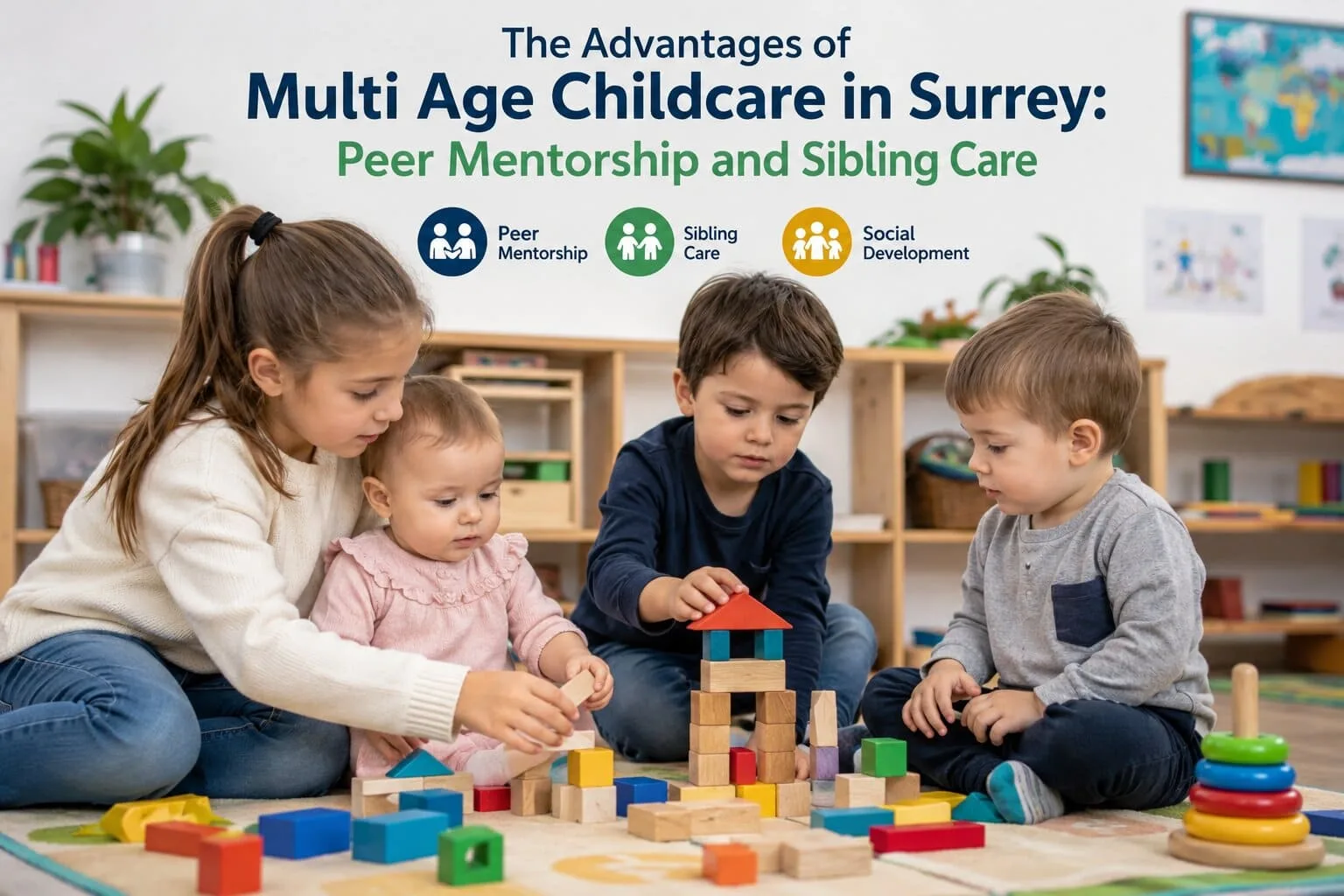
When older preschoolers share space with younger toddlers, their natural inclination to nurture and protect comes alive. They learn to adjust their physical pace, speak gently, and offer a helping hand when a younger peer struggles to open a snack container or reach a shelf.
Key leadership skills nurtured in this environment include:
- Active Empathy: Recognizing when a younger child feels upset and offering a comfort toy or gentle reassurance.
- Patience and Negotiation: Learning to wait calmly while a toddler finishes using a shared classroom tool.
- Self-Confidence through Teaching: Reinforcing their own understanding of concepts by explaining rules, colours, or block-building ideas to younger friends.
These daily interactions build intrinsic leadership habits, emotional maturity, and self-worth that stay with children long into their elementary school years.
Accelerated Social and Language Growth for Younger Children
Younger children are keen observers who absorb language, social habits, and emotional coping mechanisms from those slightly ahead of them. In a multi-age environment, toddlers are constantly exposed to advanced expressive vocabulary and complex sentence structures used by four- and five-year-olds during play.
Witnessing older peers follow classroom routines, tidy up materials, wash hands independently, and use words instead of tantrums provides toddlers with accessible, relatable role models. Because the model comes from another child rather than an adult authority figure, toddlers adopt these positive habits with natural enthusiasm.
The Distinct Benefits for Sibling Groups
For families raising multiple young children close in age, a mixed-age program offers unmatched peace of mind and emotional stability.
Preserving the Sibling Bond
Starting daycare can feel overwhelming for young children. When siblings are enrolled together in the same classroom, they carry a piece of home with them. An older sibling provides an emotional anchor for an infant or toddler during morning drop-offs, significantly reducing separation anxiety. Throughout the day, siblings can check in with each other, share hugs, and celebrate milestones together, reinforcing their lifelong bond.
Simplifying Family Daily Life
From a practical perspective, managing different drop-off schedules, multiple classrooms, and competing facility calendars creates immense stress for working parents. Having brothers and sisters at the same centre with unified communication, singular drop-off routines, and cohesive holiday schedules restores balance to family life.
Child-Led Learning and Flexible Developmental Pacing
One of the greatest benefits of mixed-age daycare is that it removes the artificial pressure of developmental comparison.
Meeting Children Where They Are
In a single-age classroom, children are often expected to master the exact same milestones at the exact same time. If a three-year-old is not yet potty trained or struggles with pencil grip, they may stand out noticeably from their peers.
In a multi-age classroom, diversity of ability is the normal baseline. Children who excel verbally can engage in conversations with older peers, while those who need extra time to master fine motor skills can work alongside younger children without feeling self-conscious. This inclusive approach respects each child’s individual developmental timetable.
Engaging in Play-Based Multi-Age Learning
Implementing rich play-based multi-age learning allows educators to design activities with multiple layers of engagement:
- Sensory Tables: An infant explores the water temperature with their hands, a toddler scoops and pours using measuring cups, and a preschooler builds a floating boat using natural materials.
- Block Construction: A younger child practices stacking two wooden blocks for balance, while an older child drafts a complex bridge design and directs the building project.
- Story Circles: Younger children enjoy the visual rhythm and repetition of illustrations, while older children answer inferential questions about character motives and plot.
This open-ended structure ensures every child remains engaged at their personal zone of proximal development without ever feeling bored or left behind.
Multi-Age Care Versus Traditional Group Daycare
When exploring daycare care options, understanding how classroom models differ helps families choose the environment best suited to their priorities.
Comparing the Classroom Experience
When evaluating multi-age daycare vs group daycare, the primary distinction lies in classroom scale and social diversity. Traditional group daycare facilities divide children into large classrooms of twelve to twenty-five children of the exact same age. While this allows for specialized age-specific toys, it can sometimes feel loud, fast-paced, and socially rigid.
Multi-age settings, by contrast, offer a smaller, quieter, home-like scale capped at eight children. This small group size minimizes illness transmission, reduces auditory overstimulation, and allows educators to build deep, multi-year relationships with each child and their parents. Rather than transitioning to a new room and teacher every twelve months, children stay with the same primary caregiver, establishing secure emotional attachment.
Evaluating Early Childhood Options Across the Fraser Valley
Finding dependable, high-quality care requires looking at safety certifications, educator warmth, and accessible program structures. Families researching affordable multi-age childcare langley options look for licensed providers that balance quality education with provincial affordability programs.
Government Affordability Support
Accredited centres across British Columbia participate in provincial initiatives like the Child Care Fee Reduction Initiative (CCFRI) and process the Affordable Child Care Benefit (ACCB). These programs significantly lower monthly tuition fees directly on parent invoices, ensuring high-standard early childhood education remains within reach for local families.
Whether you are comparing a community kiddie daycare or searching for a reputable daycare in langley, choosing a licensed centre with certified staff ensures your child receives thoughtful, safe, and enriching developmental support during these formative early years.
Frequently Asked Questions
How do early childhood educators keep infants safe around active preschoolers in a multi-age room?
Classrooms are intentionally designed with dedicated zones. While children come together for meals, story sessions, and gentle floor activities, classrooms feature protected infant-only zones with soft mats and low barriers where babies can safely crawl and rest without interference from running feet. Furthermore, low provincial ratios ensure an educator is always in close proximity.
What are your typical response times for family registration and tour inquiries?
Our administrative intake team responds to all tour requests, waitlist applications, and program inquiries within twenty-four to forty-eight business hours, ensuring parents receive timely and clear information.
How do educators ensure older preschoolers receive adequate kindergarten preparation in a mixed-age setting?
Educators provide focused small-group literacy, numeracy, and fine motor sessions for older children during the younger children’s nap periods or during quiet choice time. This ensures older children develop all necessary kindergarten readiness skills while still enjoying the social benefits of the broader group.
Which neighbourhoods and communities do your early education programs serve?
Our centrally located campus serves families across Langley and the Fraser Valley, providing accessible early childhood care for households residing in Clayton Heights and central Langley.
Does a multi-age setting work well for children with strong separation anxiety?
Yes, mixed-age environments are particularly beneficial for children experiencing separation anxiety. The smaller group size, family-like atmosphere, and consistent primary educator help children build trust quickly, making morning drop-offs smoother and less overwhelming.
Conclusion / Final Thoughts
Multi-age early learning settings provide a warm, socially rich environment that honors how children naturally grow, interact, and learn. By fostering genuine peer mentorship, keeping siblings connected, and celebrating individual developmental timelines, this collaborative model equips children with deep empathy, strong communication skills, and lifelong confidence.
If you are exploring early learning options or searching for a trusted licensed daycare near me, finding the right educational partner is the first step. Families seeking an infant daycare near me or a supportive play based preschool near me will find that high-quality programs provide the balanced, nurturing foundation their children need to flourish. At KiddieKollege, our experienced team delivers exceptional care through our accredited Infant & Toddler Program, creating a welcoming community where your children can safely learn, lead, and grow alongside their peers. We invite you to reach out to our admissions office today to schedule your private campus tour and discover how our programs support your family’s journey in multi age childcare Langley.