Quick Summary
- Physical Foundations: Discover how targeted fine motor skills activities build the small muscle strength and finger dexterity necessary for early writing.
- Play-Based Tools: Learn how simple materials like clay, tweezers, and sensory tables transform pencil control practice into engaging games.
- Developmental Stages: Explore how dexterity evolves from toddler palmar grasps to refined tripod grips in early childhood.
- Home and Classroom Integration: Access practical, low-prep ideas that blend hand-eye coordination with everyday routines.
- Expert Early Care: See how accredited early learning centres in British Columbia guide young children toward school readiness with confidence.
Long before a child sits down to write their very first letter, their hands are hard at work laying the physical groundwork. Holding a pencil, controlling its movement across paper, and maintaining a comfortable grip are complex physical tasks that require significant muscle control, joint stability, and hand-eye coordination. When young children engage in intentional fine motor skills activities, they are not just playing—they are actively conditioning the small muscles in their fingers, hands, and wrists for future academic success.
At KiddieKollege, located at 20103 53 Ave, Langley, BC V3A 3T8, Canada, our experienced educators observe daily how play-based dexterity games transform pre-writing practice into a joyful, rewarding experience for young learners across our community.
Want to learn more about our daycare programs? Click the WhatsApp button below for an instant chat :
Understanding Fine Motor Development: The Physical Pathway to Writing
Early childhood hand development follows a clear physical progression. Parents often marvel at how quickly a toddler moves from picking up objects with their entire fist to holding a crayon with precision. Understanding this progression helps caregivers provide the right support at the right time.
From Gross Movements to Fine Control
Movement control develops from the center of the body outward. Before a child can manipulate a pencil with their fingers, they need strong core stability, shoulder strength, and wrist control. Large physical movements like climbing playground ladders, crawling through tunnels, and swinging on bars build the foundational postural control that supports hand stability later on.
As large muscle control matures, the focus shifts to the hands. Early childhood fine motor development involves training the small intrinsic muscles of the hand to work in coordination with the eyes and brain. Children learn to isolate their fingers, squeeze with controlled force, and stabilize their wrists against a table surface.
The Evolution of the Pencil Grip
Children progress through distinct gripping phases as their hand strength increases:
- Palmar Grasp: Around age one or two, toddlers wrap their entire fist around a crayon, moving their whole arm from the shoulder to make marks.
- Digital Pronate Grasp: Between ages two and three, children turn their hand so their fingers point down toward the paper, utilizing the arm and wrist to guide movements.
- Static Tripod or Quadrupod Grasp: Around age three or four, children begin holding drawing tools with three or four fingers, though the movement still originates primarily from the wrist.
- Dynamic Tripod Grasp: By age five or six, children hold the pencil comfortably between the thumb and index finger, resting it on the middle finger, allowing precise movements driven purely by the fingertips.
Forcing a child into a mature pencil grip before their hand muscles are ready leads to muscle fatigue, hand cramps, and frustration. Instead, offering targeted dexterity play allows the hand to strengthen naturally.
Tactile and Resistance Play: Building Hand Strength with Sensory Materials
Building hand strength requires resistance. Squeezing, pulling, pinching, and molding materials give the fingers a rich workout while delivering satisfying sensory feedback.
The Power of Clay and Playdough
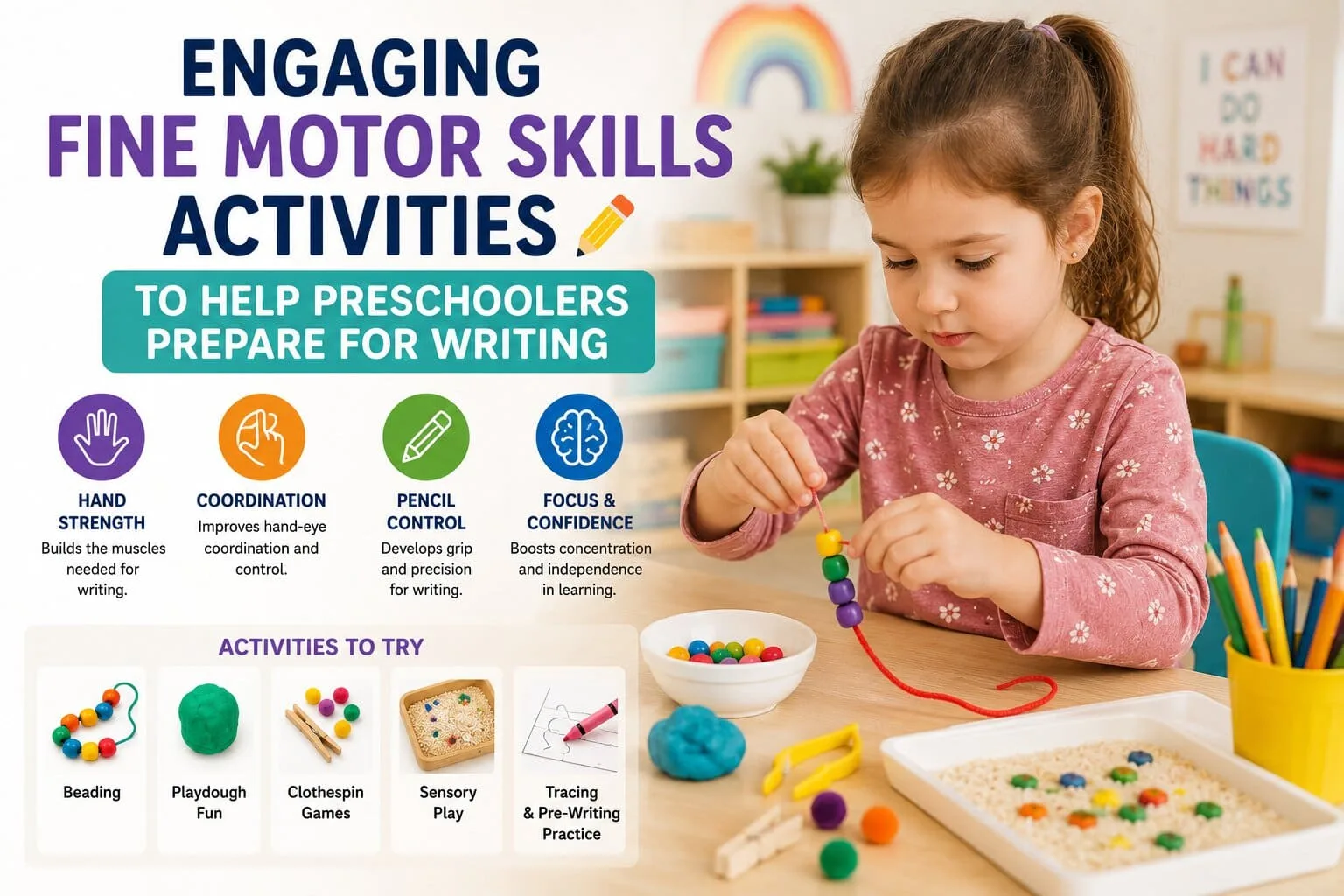
Using playdough fine motor activities is one of the most effective ways to build hand strength. Squeezing dense dough works the palm muscles, while rolling small spheres between the fingertips isolates individual finger flexors.
To turn dough play into a pre-writing workout, encourage children to hide small plastic beads or buttons inside a ball of dough and dig them out using only their thumb and index finger. Another excellent challenge involves rolling long dough “snakes” and snipping them into small pieces using child-safe safety scissors. This combination of squeezing and cutting strengthens the web space between the thumb and index finger—the exact space where a pencil rests during writing.
Sensory Bin Pinches and Drops
Sensory tables filled with dry rice, lentils, or water provide endless opportunities for physical development. Providing tools like turkey basters, eye droppers, and squeeze bottles forces children to use a rhythmic squeezing action that builds forearm and palm strength. Transferring water drop by drop using an eye dropper requires controlled finger pressure, teaching children how to calibrate the force they exert with their hands.
Precision and Coordination: Refining the Pincer Grasp
While raw strength is essential, writing also demands high levels of precision. The pincer grasp—holding an object between the tips of the thumb and index finger—is the core mechanical movement behind proper pencil manipulation.
Tongs, Tweezers, and Clothespins
Incorporating kitchen tools into daily play is a fantastic way to refine precision. Simple hand-eye coordination activities can be created using everyday household items:
- Clothespin Pinching: Squeezing wooden clothespins open to clip onto the edge of cardboard boxes or paper plates builds significant finger resistance.
- Tongs Sorting: Using mini kitchen tongs to pick up pom-poms, cotton balls, or large wooden beads and sort them into ice cube trays trains hand stability.
- Kid-Friendly Tweezers: Using blunt plastic tweezers to pick up small objects isolates the thumb, index, and middle fingers, directly mimicking the tripod grip position.
Threading and Beading Games
Threading requires a child to hold a steady target with one hand while guiding a string through a narrow opening with the other. This dual-action task enhances bilateral coordination—the ability to use both sides of the body together productively.
Start younger learners with thick wooden beads and rigid shoelaces. As dexterity improves, transition to smaller plastic pony beads, button threading, or threading pasta onto upright pipe cleaners. These precise tasks build patience, visual tracking, and steady hand control.
Pre-Writing Mechanics: Tracing, Drawing, and Spatial Control
Before children write formal letters, they need to master basic line formations: vertical lines, horizontal lines, circles, diagonal strokes, and intersecting crosses. These shapes form the structural building blocks of every letter in the alphabet.
Engaging Pre-Writing Fine Motor Activities
Traditional pencil-and-paper worksheets can feel tedious for young children. Transforming line practice into multi-sensory experiences keeps learning fresh and engaging:
- Sensory Tray Writing: Pour a thin layer of salt, cornmeal, or colored sand into a shallow tray. Children use their index finger or a small paintbrush to form lines, zigzags, and circles in the sand.
- Vertical Surface Drawing: Taping large sheets of paper to a wall, easel, or window forces children to extend their wrist upward. Working on a vertical surface automatically promotes a proper wrist position and strengthens shoulder stability.
- Sticker Line Tracing: Draw bold, wavy lines on a sheet of paper and have children place small stickers directly along the path. Peeling small stickers off a backing sheet is an incredible workout for the finger pads.
Targeted Play for Three-Year-Olds
Structuring fine motor development 3-year-olds can easily enjoy involves focusing on foundational control rather than letter perfection. At this age, activities should emphasize cause-and-effect, tactile variety, and playful exploration. Tear construction paper into small bits to make collages, push toothpicks into foam blocks, or peel painter’s tape off a tabletop. These simple actions lay a solid physical foundation without placing premature academic pressure on developing hands.
Everyday Household Routines that Support Dexterity
Parents do not need expensive specialized toys to support physical development. Everyday self-help skills offer some of the best functional finger exercises available.
Fostering Self-Reliance at Home
Encouraging children to dress and feed themselves builds hand strength while fostering personal independence:
- Dressing Challenges: Buttoning shirts, pulling up zippers, snapping fasteners, and fastening Velcro shoes practice real-world finger coordination.
- Kitchen Helper Tasks: Allowing children to tear lettuce for salads, peel banana skins, spread butter on toast with a blunt plastic knife, or snap green beans in half builds functional hand power.
- Container Manipulation: Unscrewing large bottle caps, opening plastic food containers, and squeezing toothpaste tubes train wrist rotation and grip strength.
When parents allow extra time during morning routines for toddlers to tackle these small tasks independently, physical progress happens naturally throughout the day.
Age-Appropriate Physical Milestones and Activities
Offering age-appropriate challenges ensures children stay engaged without feeling overwhelmed by tasks beyond their current physical capability.
Dynamic Fine Motor Activities for Toddlers
For children between 18 months and 3 years old, focus on large, satisfying actions that move the entire hand and arm:
- Scribbling freely on large butcher paper using thick palm-grip crayons.
- Pushing wooden pegs into soft foam boards or modeling clay.
- Stacking large wooden blocks or interlocking plastic bricks.
- Turning stiff cardboard pages in board books independently.
Refined Fine Motor Skills for Preschoolers
For children between 3 and 5 years old, introduce activities that demand finger isolation, tool usage, and precise spatial awareness:
- Cutting paper strips into confetti using child-safe loop scissors.
- Lacing yarn through hole-punched cardboard shapes.
- Building complex structures using small interlocking plastic bricks.
- Forming recognizable shapes, lines, and early letter forms in sensory materials.
Frequently Asked Questions
What are the early signs that a child may be experiencing fine motor weakness?
Signs of fine motor weakness include avoiding drawing or table tasks, showing extreme hand fatigue after a few minutes of coloring, switching hands constantly during single tasks because of fatigue, or holding drawing tools with an overly tight, white-knuckled grip. Providing supportive, low-pressure sensory play usually helps build the necessary strength over time.
What are your administrative response times for tour requests and registration inquiries?
Our administrative office prioritizes clear, prompt communication with local families. All tour bookings, registration questions, and program inquiries submitted through our website or phone lines receive a response within twenty-four to forty-eight business hours from our intake team.
How do certified educators handle children who show left-handed dominance?
Left-handedness is a natural neurological variation that typically establishes firmly around age three or four. Certified educators never attempt to force a left-handed child to use their right hand. Instead, we provide specialized left-handed scissors, demonstrate proper wrist positions for left-handed writing to prevent smudging, and ensure comfortable seating arrangements at activity tables.
Which local communities and Fraser Valley neighborhoods does your learning center serve?
Our centrally located Langley campus serves families throughout the region. We provide accessible early learning programs and child care for households residing across Willoughby, Walnut Grove, Brookswood, Murrayville, Aldergrove, and central Langley.
How can parents balance fine motor practice with gross motor play at home?
Gross motor play and fine motor development work together. A great approach is to pair large physical movements with quiet finger play. For example, after twenty minutes of running, swinging, or climbing in the backyard, transition indoors to sit at a table for ten minutes of playdough modeling or bead threading while the child’s body is rested.
Conclusion / Final Thoughts
Preparing a young child for formal writing is a journey built on play, patience, and rich sensory exploration. By replacing early worksheet pressure with tactile clay play, threading games, kitchen helper tasks, and outdoor discovery, parents give children the muscle strength and spatial control they need to hold pencils with confidence and ease.
Locating an accredited early childhood setting is simple when researching options for pre schools near me. If you are looking for a dedicated educational partner to guide your child’s early physical and cognitive development, we invite you to connect with our campus team. At KiddieKollege, we take immense pride in integrating engaging fine motor skills activities throughout our daily early learning curriculum, providing families across our community with a safe, inspiring environment where children build real confidence for life. Contact our Langley admissions office today to schedule your private tour, meet our certified educators, and explore our active classrooms.