
Quick Summary
- Safety and Regulation Standards: Learn how licensed infant child care facilities adhere to strict provincial health, fire, and safety regulations to keep babies secure.
- Low Educator-to-Infant Ratios: Understand why provincial staff-to-child ratios ensure individualized responsive feeding, safe sleep monitoring, and emotional attachment.
- Hygiene and Safe Sleep Protocols: Discover essential sanitization procedures, shoe-free policies, and crib safety measures required in professional infant rooms.
- Developmental Milestones and Play: Explore how sensory materials, tummy time, and responsive language interactions nurture infant cognitive and physical growth.
- Seamless Transitions: Gain actionable strategies to navigate emotional drop-offs, bottle feeding routines, and home-to-centre schedule alignment.
Entrusting your baby to an early learning program is a deeply personal and emotional milestone for any family. As parents begin researching early education options, questions surrounding safety protocols, health regulations, educator qualifications, and daily routines naturally arise. You want complete reassurance that your baby will be surrounded by warmth, attentive supervision, and a secure environment designed specifically for the unique physical and emotional vulnerabilities of infancy. Finding an accredited, high-quality licensed infant child care program ensures that your child is cared for under strict provincial regulatory standards that prioritize health, low educator ratios, and responsive early learning.
At KiddieKollege, situated at 20103 53 Ave, Langley, BC V3A 3T8, Canada, our dedicated educators deliver comprehensive Infant & Toddler Program and Multi-Age Childcare Program options designed to give families absolute peace of mind while creating a nurturing second home for their little ones.
Want to learn more about our daycare programs? Click the WhatsApp button below for an instant chat :
The True Value of Provincial Child Care Licensing
When touring infant facilities, the term “licensed” represents far more than a certificate on the wall. In British Columbia, licensed child care facilities are legally governed by the Community Care and Assisted Living Act and the Child Care Licensing Regulation under the oversight of regional health authorities such as Fraser Health.
Rigorous Facility Inspections
Unlike unlicensed or licence-not-required babysitting arrangements, a licensed centre undergoes rigorous initial inspections and continuous unannounced monitoring visits by environmental health officers and licensing officers. These checks inspect:
- Strict physical space allocations per child, ensuring ample room for movement, crawling, and rest without crowding.
- Comprehensive indoor air quality, natural light levels, and proper ventilation systems.
- Verified non-toxic, lead-free building materials and child-safe physical furnishings.
- Routine fire suppression checks, emergency exit planning, and child-safe perimeter security.
These thorough checks guarantee that every square metre of the environment has been evaluated specifically for infant safety.
Certified Professional Qualifications
Licensing mandates that educators working in infant classrooms hold specialized Infant and Toddler Educator (ITE) credentials in addition to standard Early Childhood Educator (ECE) certification. This advanced post-secondary training equips educators with in-depth knowledge of neurodevelopment, safe infant sleep guidelines, neonatal CPR, pediatric first aid, and responsive infant communication.
Understanding Infant-to-Caregiver Ratios and Group Sizes
One of the most vital components of exceptional infant care is the child-to-caregiver ratio. During the first eighteen months of life, babies depend entirely on adults to interpret their subtle non-verbal cues, manage feeding schedules, soothe distress, and facilitate safe motor exploration.
Provincial Staffing Standards
In British Columbia, licensed infant and toddler group care settings operate under strict maximum ratios—typically one qualified educator for every four infants, with maximum group sizes capped at twelve babies supported by three educators. These tight ratios ensure that caregivers are never stretched too thin.
Why Ratios Directly Impact Brain Architecture
Infant brain development relies on “serve-and-return” interactions. When an infant babbles, reaches out, or cries (the serve), a responsive caregiver promptly returns the interaction with eye contact, gentle touch, or soothing words. This reciprocal dance builds strong neural pathways for language acquisition and emotional resilience. Low ratios guarantee that educators have the dedicated time to hold babies while bottle feeding, engage in unhurried floor play, and respond quickly to distress signals.
Health, Sanitization, and Safe Sleep Protocols
Because infants explore their physical environment primarily through touch and taste, sanitization and safe sleep practices in an infant classroom must adhere to hospital-grade standards.
Comprehensive Infant Sleep Safety
Sudden Infant Death Syndrome (SIDS) prevention requires strict adherence to evidence-based sleep standards. In a licensed room, you should observe:
- Individual, dedicated cribs or sleep spaces for each baby, clearly labeled and never shared without complete linen sanitization.
- Firm, tight-fitting mattresses covered exclusively by fitted sheets, with zero loose blankets, plush pillows, bumpers, or stuffed toys inside the sleep space.
- Direct line-of-sight visual monitoring alongside routine, logged physical sleep checks by staff every few minutes to verify breathing and sleep posture.
- A strict “back-to-sleep” policy where all infants are placed to rest on their backs.
Sanitization Routines and Shoe-Free Zones
Since babies spend extensive time practicing tummy time, rolling, and crawling, classroom floors must remain exceptionally clean. Accredited infant rooms maintain strict shoe-free or indoor-shoe-only policies to prevent outdoor dirt and contaminants from reaching the floor.
Furthermore, toys and sensory tools are washed and sanitized with child-safe, non-toxic disinfectant solutions after every individual use, particularly if an item has been mouthed by a child. Diaper changing stations are thoroughly disinfected after each individual change using medical-grade surface cleaners, paired with mandatory educator handwashing routines.
Daily Rhythms: Balancing Predictability with Individual Infant Needs
Older children thrive on set daily group schedules, but infant care requires a balance between structured classroom flow and individualized biological timing.
Understanding the Infant Daycare Daily Schedule
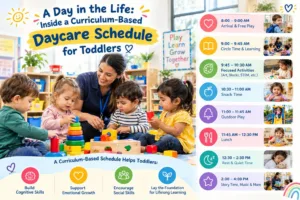
A thoughtfully structured infant daycare daily schedule adapts flexibly around each baby’s unique feeding, diapering, and nap rhythms while maintaining calm, predictable transitions:
- Morning Arrivals and Reconnection: A gentle transition period where educators greet parents, check daily log notes regarding overnight sleep and morning feeds, and settle babies into morning lap play.
- Active Floor Play and Tummy Time: Supervised floor sessions encouraging rolling, crawling, reaching for wooden grasping toys, and practicing balance.
- Outdoor Fresh Air and Stroller Walks: Weather-appropriate outdoor time to experience natural light, breeze, and environmental sounds.
- Quiet Sensory Experiences: Gentle exploration of soft fabrics, mirrors, board books, and soothing classical music.
- Individualized Naps and Feedings: Meals and rest periods provided on-demand or aligned with home routines.
Navigating Infant Sleep Schedules at Daycare
Managing infant sleep schedules at daycare requires close communication between parents and educators. Certified caregivers work closely with families to mimic nap routines established at home, whether a four-month-old requires three short naps or a twelve-month-old is transitioning to two longer rest periods. Daily digital logs or physical communication books keep parents fully updated on exact sleep times and durations.
Cognitive and Motor Milestones: The Importance of Sensory Exploration
Infant care is not passive babysitting; it is the foundation of early cognitive development. Through open-ended exploration, babies begin building spatial awareness, physical strength, and early problem-solving skills.
Intentional Infant Sensory Play in Daycare
Engaging in infant sensory play in daycare stimulates neural connections across all five senses. Educators create rich, tactile environments using child-safe materials:
- Textured Discovery Baskets: Baskets filled with natural materials like wooden rings, soft silk scarves, textured silicone balls, and metal measuring spoons for tactile contrast.
- Water and Mess-Free Paint Bags: Clear, sealed sensory pouches containing colored water, gel, or paint taped securely to the floor or low windows, allowing babies to manipulate colors and movement without mess.
- Auditory and Visual Exploration: Soft musical shakers, gentle chime bells, and unbreakable wall-mounted mirrors where babies observe their own facial expressions and movements.
Supporting Gross and Fine Motor Growth
Daily tummy time on firm, supportive mats strengthens the neck, back, and shoulder muscles required for sitting upright, crawling, and eventually walking. Low wooden balance bars, soft foam climbing ramps, and sturdy push-carts allow older infants to pull themselves up safely and explore upright mobility under watchful supervision.
Helping Your Baby (and Yourself) Navigate the Childcare Transition
Transitioning a baby into a new care setting is a major emotional step for the entire family. Approaching the baby transition to daycare with a planned, gradual phase-in makes the process gentle and positive.
The Gradual Entry Process
Rather than starting with a full nine-hour day, high-quality centres recommend a phased introduction over several days:
- Day 1: Parent and baby visit together for one hour to explore the room and meet primary educators.
- Day 2: The child attends for two hours, with the parent stepping out of the room for a short interval while remaining nearby.
- Day 3: The child stays for a morning play session, a scheduled feed, and an initial nap attempt.
- Days 4 and 5: Attendance expands to a full morning or standard day as the baby builds trust with their educators.
Bringing a familiar comfort item from home, such as a well-washed sleep sack or an unwashed swaddle blanket that carries the scent of a parent, provides grounding reassurance in the sleep area.
Finding Quality and Value: Evaluating Child Care in Langley
Navigating early learning options across the Fraser Valley involves evaluating program quality, educator warmth, and practical family logistics. When families evaluate a modern kiddie care or kiddie daycare facility, they look for transparent leadership and genuine community trust.
Affordability and Government Fee Reductions
Quality care should remain accessible. When researching affordable licensed infant care, parents should verify whether the centre participates in the British Columbia Child Care Fee Reduction Initiative (CCFRI) and accepts the Affordable Child Care Benefit (ACCB). These provincial programs significantly lower monthly out-of-pocket costs for families without compromising educator wage standards or classroom resources.
Choosing a dedicated, long-standing daycare langley facility ensures that your family joins an educational environment that treats infant safety, developmental nourishment, and parental communication with the highest level of professionalism. Whether comparing small local providers or an established kiddie club childcare center, prioritizing low ratios, certified infant educators, and clean physical spaces guarantees the best start for your baby.
Frequently Asked Questions
How do educators handle infant bottle preparation and breastmilk storage?
All infant formula and expressed breastmilk bottles must arrive clearly labeled with the child’s full name and date. Bottles are immediately stored in dedicated, temperature-monitored refrigerators. Educators warm bottles using safe water baths rather than microwaves to avoid uneven hot spots, following strict infant feeding schedules provided by parents.
What are your administrative response times for new family registration inquiries and tours?
Our administrative office prioritizes clear, prompt communication with families. All tour bookings, registration questions, and infant intake inquiries submitted through our website or phone lines receive a personalized response within twenty-four to forty-eight business hours from our intake team.
How do certified educators soothe a distressed or teething infant during the day?
Educators utilize warm, individualized soothing techniques. Caregivers offer gentle rocking, upright carrying in comfortable positions, soft singing, soothing stroller walks, or chilled, sanitized silicone teething rings provided by parents. Educators maintain close physical contact to ensure the baby feels comforted and secure.
Which local communities and Fraser Valley neighborhoods does your learning centre serve?
Our centrally located Langley campus serves families throughout the region. We provide accessible infant care, toddler programs, and preschool education for households residing across Willoughby, Walnut Grove, Brookswood, Murrayville, Aldergrove, and central Langley.
What daily communication can parents expect regarding their baby’s feeding, sleep, and diaper changes?
Educators maintain detailed daily digital logs accessible to parents. Every bottle consumed (including volume in ounces), solid food intake, diaper change, nap start and end time, and developmental milestone observation is recorded in real time throughout the day.
Conclusion / Final Thoughts
Selecting an infant care setting is one of the most significant choices you will make during your child’s early developmental years. By focusing on verified provincial licensing, low educator ratios, rigorous sleep and hygiene protocols, and responsive sensory environments, you provide your baby with a safe, enriching setting to build early confidence and motor strength.
Locating a trusted early childhood setting is simple when researching options for a licensed infant daycare near me. If you are looking for a reliable educational partner to nurture your child’s foundational months, we invite you to connect with our team. At KiddieKollege, our certified educators provide exceptional licensed infant child care through our dedicated Infant & Toddler Program, giving families across our community a warm, transparent, and safe space where young children thrive from their very first days. Contact our Langley admissions office today to schedule your private tour, meet our certified infant educators, and explore our infant classrooms.