Quick Summary
- Identifying Key Warnings: Learn how to spot critical administrative, environmental, and behavioral red flags when evaluating a potential child care service for your baby.
- Safety and Compliance Verification: Understand why unverified licensing, poor caregiver-to-infant ratios, and hidden security records pose significant risks.
- Evaluating Classroom Environments: Discover what clean, well-maintained nursery spaces look like and how to recognize chaotic or poorly supervised settings.
- Communication and Transparency: Recognize the importance of open-door policies, daily updates, and honest caregiver dialogues during drop-offs and pick-ups.
- Peace of Mind for Local Families: Gain actionable insights to confidently select a high-quality, trusted early learning provider in your community.
Handing your infant over to a new caregiver is one of the most emotional and vulnerable steps you will take as a parent. During those tender early months, babies require extraordinary attention, warm emotional co-regulation, and an environment engineered around strict health and safety parameters. While every early learning center promises exceptional care on their marketing brochures, the day-to-day reality inside a facility can sometimes tell a different story. Recognizing subtle warning signs before you enroll your baby is essential for protecting your child’s emotional well-being and physical safety.
At KiddieKollege, located at 20103 53 Ave, Langley, BC V3A 3T8, Canada, we believe that an exceptional child care service should operate with complete operational transparency, giving parents absolute confidence in every aspect of their infant’s daily care experience.
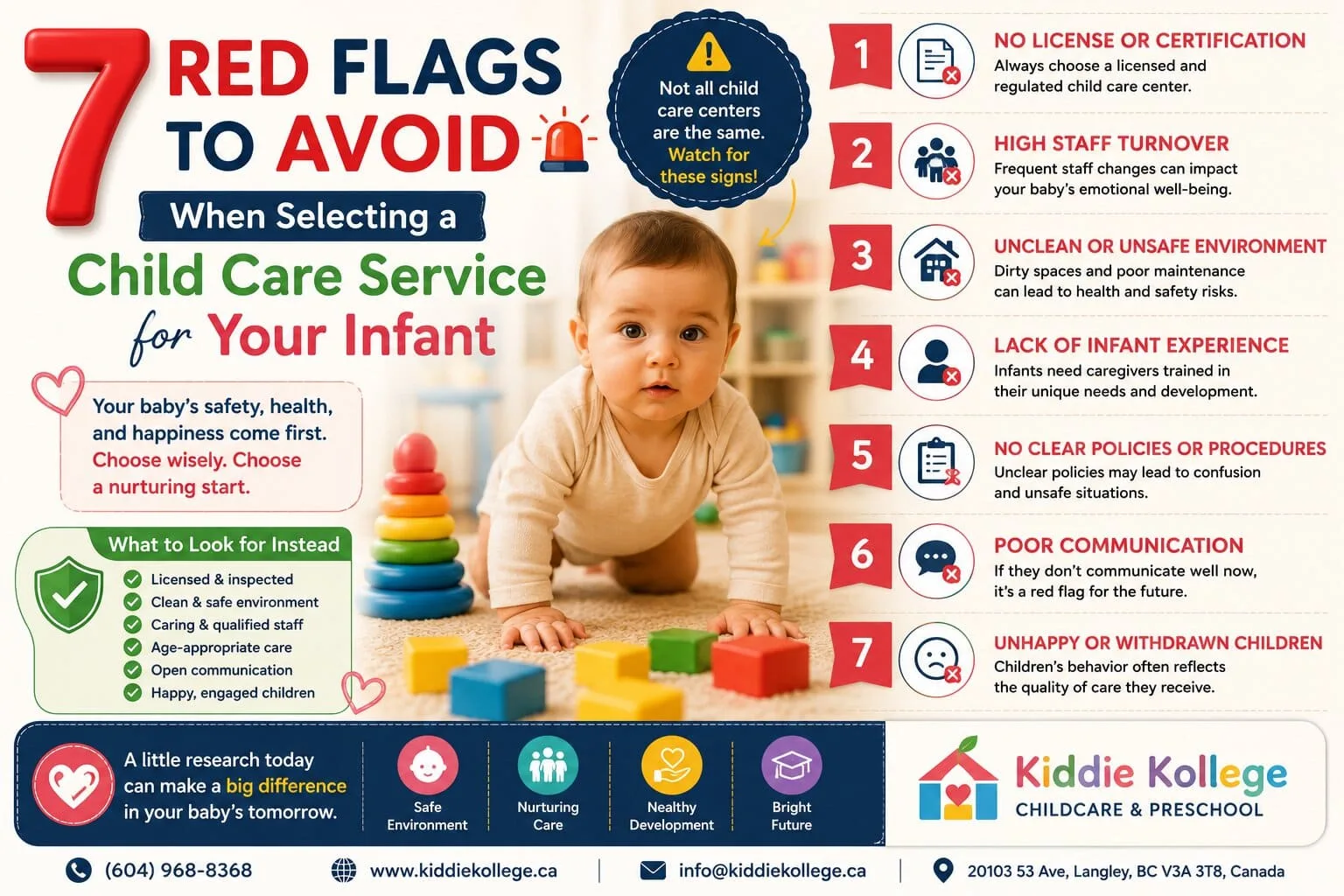
Red Flag 1: Lack of Clear Licensing and Unclear Regulatory Compliance
The foundation of any safe infant environment is strict adherence to provincial regulations and health board guidelines. In British Columbia, licensed early learning centers are governed by comprehensive community care rules that dictate everything from square footage per infant to strict emergency evacuation plans.
When visiting a facility, the provider’s active license should be clearly posted near the entrance. If a provider seems evasive when asked about their licensing status, hesitates to show official paperwork, or claims they are in the middle of a renewal process without proof, treat this as an immediate warning sign. Unregulated settings or facilities that bypass official inspections operate without independent oversight, meaning there is no external guarantee that staff background checks, safety audits, or health evaluations are being performed.
Always ask to view the provider’s recent health inspection reports. A quality center will gladly share their compliance record, showing how quickly and thoroughly any past administrative or environmental updates were resolved.
Red Flag 2: Overcrowded Nursery Rooms and High Caregiver Ratios
Infants operate on individual internal clocks and require continuous, attentive supervision. When an infant daycare classroom exceeds safe capacity limits, caregivers are forced into a reactive survival mode rather than providing proactive, nurturing care.
Provincial standards set strict maximum caregiver-to-infant ratios specifically because babies cannot communicate their needs verbally. During your site visit, pay close attention to how many adults are actively present in the room relative to the number of infants. If you notice a single educator trying to feed one baby, soothe another who is crying, and monitor two more who are awake on the floor, the room is understaffed.
Overcrowded spaces lead to missed cues for hunger, sleep, and comfort. An environment where caregivers appear visibly rushed, stressed, or detached often signals systemic staffing shortages. An exceptional nursery environment maintains low ratios so educators can form strong, one-on-one bonds with every baby in their care.
Red Flag 3: Poor Hygiene Practices and Unsafe Sleep Environments
Infants have developing immune systems and limited physical mobility, making clean surroundings and strict safe sleep protocols non-negotiable. A quick walk through a facility’s infant wing will quickly reveal their commitment to health standards.
When touring a day care center, look closely at the sleeping arrangements. Every infant should have a designated, clean crib free of loose blankets, pillows, bumper pads, or soft stuffed animals. Babies must always be placed on their backs to sleep to align with national safe sleep recommendations. If you observe cribs being used for storage, babies sleeping unsupervised in swings or car seats, or shared bedding that is not washed daily, the facility is compromising basic safety.
Sanitization protocols are equally critical. Check whether staff members wash their hands thoroughly between diaper changes and before preparing formula or meals. Look at the condition of the toys on the floor—if sensory items and teethers are shared continuously without being disinfected in a dedicated cleaning zone, illness will spread rapidly through the classroom.
Red Flag 4: High Staff Turnover and Distracted Caregivers
The quality of an infant’s day depends directly on the stability and warmth of their primary caregivers. Infants thrive when they can build a secure attachment with familiar adults who understand their unique sounds, expressions, and temperaments.
If you notice new faces every few weeks in a baby daycare setting, high staff turnover may be an issue. Frequent turnover disrupts an infant’s sense of security and often indicates low staff morale, poor management, or inadequate training programs. During your tour, observe how educators interact with the children. Are they down on the floor at eye level, singing, reading, and offering warm eye contact? Or are they standing above the children, checking their personal phones, or talking exclusively among themselves?
Caregivers who seem disengaged or indifferent to crying infants create an environment where emotional needs are overlooked. You want an enthusiastic team that views early childhood education as a meaningful career rather than just a job.
Red Flag 5: Resistance to Open-Door Policies and Restricted Viewing
Transparency is the hallmark of a safe, customer-focused early learning center. Parents should always feel welcome to drop in unannounced to observe their child or check on their daily routine.
A major warning sign is any facility that insists on rigid drop-off boundaries that prevent parents from entering the classroom spaces or requires advance notice for simple visits. While security gates and keycard entries are essential for keeping unauthorized visitors out, they should never be used to keep enrolled parents out.
In a professional center day care environment, management encourages open dialogue and invites parents to witness classroom activities firsthand. If a provider uses excuses about disturbing the children’s routine to keep you from viewing the main play areas during operational hours, ask yourself what they might be trying to hide.
Red Flag 6: Inconsistent Communication and Lack of Daily Tracking
Because infants cannot tell you how their day went, you rely entirely on caregivers to bridge the gap between home and care. Detailed, transparent communication is essential for maintaining your baby’s physical health and routine consistency.
A reliable facility provides structured daily logs—either through a secure digital app or a detailed paper chart—documenting exact times for bottle feedings, food intake, diaper changes, nap durations, and mood observations. If a provider offers vague verbal summaries at pickup like “they did fine today” without specific details, it indicates a lack of organized tracking.
Furthermore, pay attention to how management handles minor incidents. A safe licensed daycare will report any small bump, scratch, or unusual behavior promptly with a clear, written incident report. If you notice unexplained marks on your child or feel your questions are being brushed off by staff, it indicates a breakdown in professional communication.
Red Flag 7: Chaotic Room Layouts and Unmonitored Access Points
The physical layout of a building reflects an operator’s commitment to safety and child development. A well-designed facility balances warm, engaging play spaces with secure structural boundaries.
When evaluating a family day daycare or commercial center, inspect the entryway security. Is the front door unlocked and unattended, allowing anyone to walk in off the street? Are emergency exits clearly marked, unblocked, and secured from the outside? A lack of secure access control puts every child in the facility at risk.
Indoors, observe the room flow. Infant areas should be physically separated from mobile toddler zones to prevent smaller babies from being accidentally bumped or stepped on during high-energy play. Play materials should be in good repair, age-appropriate, and free of small parts that pose choking hazards. If a center feels cluttered, dimly lit, or unorganized, it reflects a broader lack of attention to detail that can impact daily care quality.
The Value of Finding the Right Early Learning Partner
Navigating through these potential red flags can feel daunting, but knowing what to look for empowers you to find an exceptional care environment where your baby will truly flourish. Quality childcare services go far beyond basic supervision—they offer an enriching, loving second home where your infant’s physical, emotional, and cognitive development is supported every single day.

When you find a center that meets all safety standards, maintains low ratios, communicates openly, and employs passionate educators, the stress of returning to work melts away. Utilizing a regional day care finder or seeking recommendations from local parenting groups can help narrow down your search to highly rated, accredited facilities in your immediate area.
Taking the time to conduct thorough site visits, ask detailed questions, and trust your parental instincts ensures that you choose a setting that treats your child with the utmost care, dignity, and respect.
Frequently Asked Questions
How do I verify if an infant facility has any past licensing violations?
Parents in British Columbia can access public inspection records through regional health authority portals, such as Fraser Health. These online databases display past inspection reports, identified non-compliance items, and proof of corrective actions taken by the center management.
What is the typical enrollment inquiry response time for local families?
Our administrative office prioritizes prompt communication with parents. All tour bookings, waitlist status checks, and enrollment questions submitted through our website or phone lines are answered within a twenty-four to forty-eight business hour window by our intake coordinators.
What measures are taken if an infant becomes unwell during the day?
Facilities maintain dedicated, clean isolation areas where a sick child can rest comfortably under direct adult supervision while parents are notified. In accordance with health regulations, children with fevers, vomitting, or contagious symptoms must be picked up promptly and remain home until symptom-free for twenty-four hours.
Which local communities and neighborhoods do your care cohorts serve?
Our centrally located campus serves families throughout the region. We provide accessible early learning options for households located across Willoughby, Walnut Grove, Brookswood, Murrayville, Aldergrove, and the central Langley area.
What should I do if my infant has specific dietary needs or medical allergies?
Licensed facilities create detailed individual care plans for children with allergies or dietary restrictions. Emergency medication like EpiPens must be properly labeled and stored securely, while staff receive specialized training to manage dietary needs safely without cross-contamination risks.
Conclusion / Final Thoughts
Selecting an early childhood environment for your baby is one of the most significant decisions you will make during your child’s early years. By actively watching for these seven critical red flags—such as poor licensing transparency, unsafe sleep setups, high staff turnover, and restricted parental access—you can effectively protect your infant and ensure they receive the highest standard of care.
Finding a warm, accredited care environment is easy when researching options for a private daycare near me. If you are seeking a supportive, community-trusted partner to care for your baby, we invite you to visit our campus. At KiddieKollege, we are deeply committed to serving as a premier child care service, offering families across our community a safe, transparent, and loving foundation for their children.
Contact our Langley admissions office today to book your private tour, meet our certified infant educators, and discover how our dedicated care standards offer the peace of mind your family deserves.