Summary
- A high-quality learn and play preschool prioritizes organic brain development over rigid, repetitive tracing worksheets.
- Play-based education systematically fosters executive functions, such as cognitive flexibility, working memory, and emotional self-regulation.
- Early mathematics, spatial awareness, and structural physics are naturally integrated when children engage in open-ended, child-led construction activities.
- Immersive language skills and narrative comprehension are rapidly accelerated through collaborative peer interaction and dramatic roleplaying.
- A thoughtfully designed early learning program bridges the gap between home environments and the formal K-12 school curriculum seamlessly.
When parents begin exploring early education options in British Columbia, they often look for tangible benchmarks of progress. It is entirely natural to feel a sense of pride when a three-year-old brings home a perfectly traced letter “A” or a neatly colored worksheet. However, modern neuroscientific research challenges the traditional notion that desk-bound, rote memorization is the most effective pathway to intellectual development. In fact, forcing young children into rigid academic drills too early can inadvertently suppress their natural curiosity and critical thinking skills.
The human brain during early childhood is fundamentally hardwired to absorb information through movement, physical manipulation, and sensory discovery. Choosing a specialized learn and play preschool allows children to build advanced neural pathways while maintaining a joyful, natural relationship with education. For families looking for an exceptional foundation in British Columbia, KiddieKollege offers a premier, expertly designed learn & play preschool in Ave, Langley, Canada, where daily play is treated as a rigorous, scientifically backed framework for long-term cognitive success.
Want to learn more about our childcare programs? Let’s chat! Click below to message us instantly on WhatsApp.
The Neurological Blueprint: How the Toddler Brain Truly Learns
To appreciate why play is superior to paper-based drilling, it helps to look closely at early brain development. During the first five years of life, a child’s brain undergoes a massive burst of synaptic formation. These neural connections are reinforced through active engagement, physical movement, and real-world problem-solving.
When a young child sits at a desk to complete a repetitive worksheet, only a highly isolated, superficial part of the brain is engaged. The child is primarily mimicking lines rather than understanding concepts. Conversely, when a child engages in a dynamic, play-centered curriculum, multiple areas of the brain fire simultaneously. They are balancing spatial reasoning, fine motor coordination, social negotiation, and creative hypothesis testing all at once. This multi-system neurological activation builds a stronger, more resilient intellectual architecture, ensuring that the child is capable of deep conceptual understanding rather than shallow performance tracking.
Pillar 1: Developing Robust Executive Function Natively
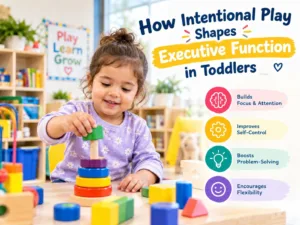
Executive function is frequently described by child psychologists as the “air traffic control system of the brain.” It encompasses a critical suite of mental skills, including working memory, cognitive flexibility, and inhibitory control. A child with strong executive function can focus their attention, filter out classroom distractions, switch between distinct tasks easily, and manage emotional frustration constructively.
These foundational mental capacities cannot be taught through passive lectures or worksheets; they must be actively practiced in real-time social scenarios. Within an authentic play based preschool environment, children are constantly placed in situations that demand high-level executive regulation.
When a group of children collaborates to build a miniature city or orchestrates an elaborate dramatic game, they are practicing cognitive control. They must remember their chosen roles, negotiate rules with their peers, inhibit the urge to take all the materials for themselves, and modify their creative strategies when things do not go according to plan. This continuous mental workout builds self-regulation skills that are directly predictive of lifelong academic achievement.
Pillar 2: The Hidden Mathematics of Spatial Play
Early mathematical competency is about far more than just reciting numbers in a specific sequence. True mathematical fluency requires a deep, intuitive comprehension of volume, weight, geometry, estimation, and spatial relationships.
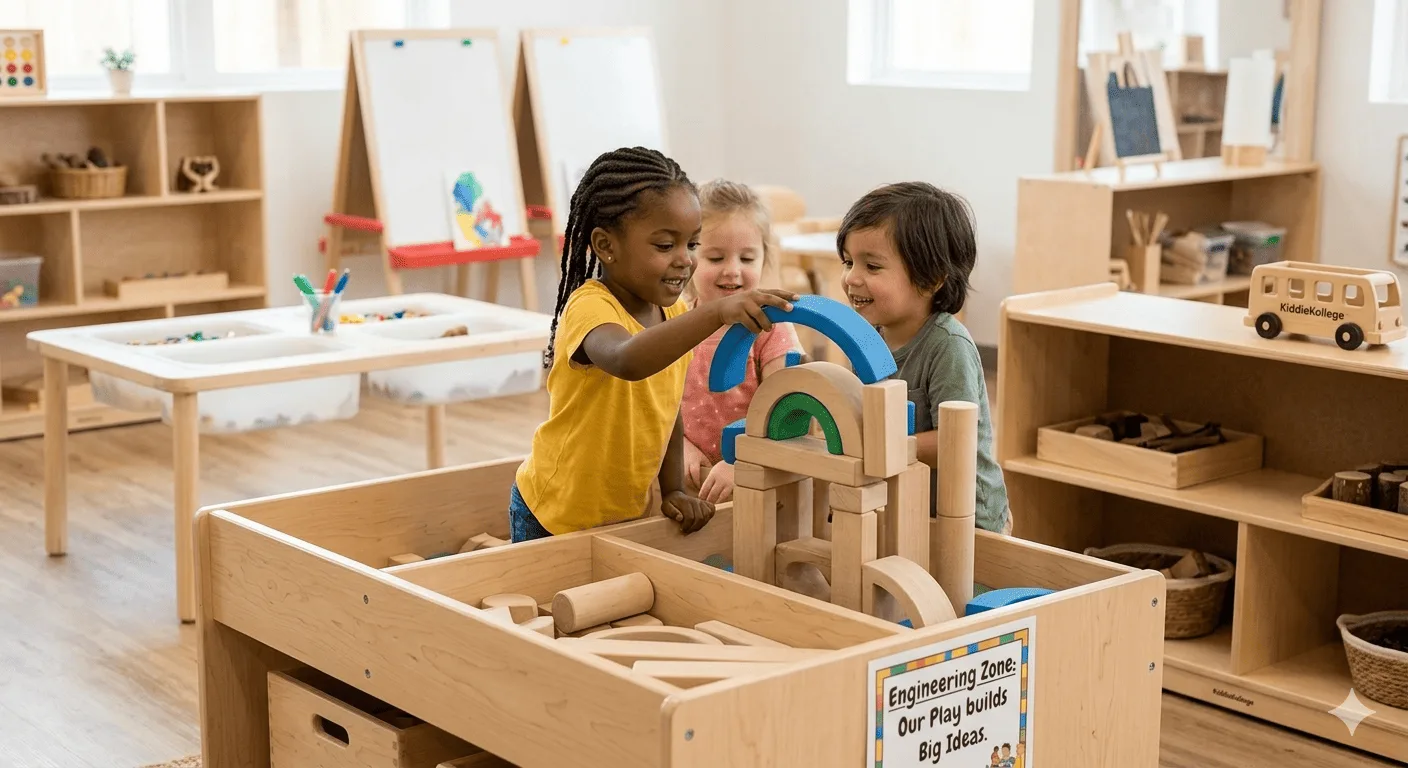
Watch a group of preschoolers playing with blocks and you are witnessing a highly sophisticated foundational mathematics lab in action. When a child selects a triangular block to place atop two rectangular prisms, they are executing real-time geometric assessments. They are measuring symmetry, testing weight distribution, and evaluating balance.
If the structure topples over, the child does not encounter a discouraging red mark like they might on an uninspired math sheet. Instead, they receive immediate, non-judgmental physical feedback from the environment. They are prompted to re-evaluate their design, adjust their baseline stability, and attempt a brand-new approach. This interactive iteration fosters a natural mathematical mindset rooted in active exploration, resilience, and logical deduction.
Pillar 3: Linguistic Expansion and Narrative Architecture
Language acquisition flourishes best in an environment rich with authentic social interaction. While worksheets focus on isolated letter identification, true literacy requires vocabulary depth, contextual understanding, and narrative comprehension.
An elite early childhood center leverages an immersive playing preschool methodology to accelerate communication milestones. During child-led play, the vocabulary utilized by both children and educators is highly sophisticated and context-driven. For example, rather than simply labeling colors, an educator guiding a sensory station might introduce words like translucent, viscous, opaque, or buoyant as the children interact with different materials.
Furthermore, dramatic play areas allow young learners to experiment with narrative architecture. When children take on distinct roles—such as a veterinarian treating an animal or an astronaut launching a rocket—they must formulate complete plotlines, use diverse language structures, and interpret the verbal and non-verbal cues of their peers. This rich conversational environment builds a deep love for language and communication that forms the true basis of advanced reading and writing.
Pillar 4: Cultivating Lifelong Curiosity and Scientific Inquiry
At its core, science is not a collection of static facts to be memorized from a page; it is a systematic method of asking questions, testing theories, and observing outcomes. Young children are natural scientists, possessed of an intense drive to figure out how their world operates.
By choosing a dedicated play to learn preschool framework, you keep that internal scientific drive alive. When a classroom features dedicated discovery zones filled with open-ended materials—such as magnifying glasses, natural items, magnets, and loose parts—children are empowered to launch their own investigations.
They observe how water moves down a series of tubes, how light refracts through a prism, or how different textures interact under pressure. Because they are driving the inquiry themselves, they develop deep critical thinking and a profound cognitive curiosity. They learn to view obstacles not as final failures, but as fascinating data points that help guide their next steps toward discovery.
Aligning Play-Based Frameworks with Provincial Standards
Parents in Western Canada often wonder how a play-centric philosophy prepares children for the structured environment of the public school system. British Columbia’s official Early Learning Framework places immense emphasis on holistic development, critical thinking, and social-emotional security. The provincial curriculum recognizes that a child who is emotionally regulated, socially confident, and highly curious will learn academic skills effortlessly once they enter a kindergarten classroom.
A modern learn and play preschool academy intentionalizes every single activity to align with these provincial developmental goals. Educators observe each child’s play patterns closely, taking detailed notes on their milestone progression, and subtly modifying the environment to offer deeper, more complex challenges as the child grows. This sophisticated pedagogical approach ensures that your child is meeting and exceeding all provincial readiness standards without sacrificing their emotional well-being.
Establishing this optimal developmental trajectory early in a child’s life sets a predictable, calm path for the whole family. If you are a parent mapping out your back-to-work transition and seeking a trusted, licensed facility close to home, searching for a reputable pre school near me can help you uncover neighborhood-focused programs that blend seamlessly into your family’s daily commute, ensuring your little one grows up alongside familiar faces in their own local community.
FAQs Section
Do children learn how to recognize letters and numbers in a play-based curriculum?
Yes, absolutely. The primary difference lies in the method of delivery. Rather than using repetitive tracing paper, alphabetic and numeric concepts are woven into the physical environment. Children might measure ingredients for a baking project, count wooden arches during block play, or trace letters into smooth sand trays. This contextual exposure ensures they learn the meaning behind the symbols, resulting in deeper comprehension.
How quickly does your administrative team respond to registration and enrollment inquiries?
We understand that planning for childcare and early education requires timely communication. Our Langley administrative office monitors all online inquiry forms, tour requests, and waitlist applications daily. Our goal is to provide families with a thorough, professional, and personalized response within 24 to 48 business hours.
What specific geographical areas are covered by your early learning programs?
Our campus is centrally situated in Langley, allowing us to serve families from Langley City, Willoughby, Walnut Grove, Brookswood, and Murrayville. Due to our proximity to major regional transit routes, we are also a highly accessible option for commuting parents residing in Surrey, Cloverdale, and Clayton Heights.
What are the main benefits of keeping a child in a continuous learning academy?
Continuity of care is deeply beneficial for a child’s emotional safety. When a child remains within a single, trusted academy as they move from toddlerhood to preschool ages, they are spared the anxiety of routine shock. They remain familiar with the building layouts, the core staff, and their established peer group, allowing them to focus all their cognitive energy on learning rather than constantly adapting to new environments.
Final Thoughts: Designing an Elite Educational Journey
The choice of an early learning environment serves as the true baseline for your child’s long-term relationship with education. While traditional worksheets offer a temporary illusion of progress, an authentic, play-based curriculum constructs the deep cognitive, emotional, and social foundations required for true, lifelong intellectual mastery. By honoring the natural way children learn, you give them the confidence to explore, the resilience to problem-solve, and a genuine love for discovery.
At KiddieKollege, we are intensely passionate about delivering an exceptional, professional learn and play preschool in Ave, Langley, Canada, designed to turn early childhood curiosity into lasting academic success. We warmly invite you to reach out to our dedicated admissions team, tour our state-of-the-art facility, and discover how our community-centered approach can elevate your child’s educational journey today.