
Summary
- The Foundation for School Success: Discover how enrolling your child in a high-quality daycare in Langley bridges the gap between early childhood and structured elementary schooling.
- Social and Emotional Development: Learn how early learning settings cultivate critical interpersonal skills, empathy, and resilience necessary for the modern kindergarten classroom.
- Cognitive and Language Milestones: Explore the play-based frameworks that boost early literacy, problem-solving abilities, and communication skills under expert guidance.
- A Local Solution for Busy Families: See how a consistent, structured routine sets a lifelong foundation for young learners while supporting parents throughout the Fraser Valley.
The transition from the comforting, predictable rhythms of home life to the structured environment of kindergarten is one of the most significant milestones in a young child’s life. For many families, this transition can feel daunting, filled with questions about whether a child is socially, emotionally, and academically equipped to handle the demands of a modern classroom. Fortunately, preparing tomorrow’s students does not mean enforcing rigid academic drills at home; instead, it is about cultivating a deep sense of curiosity, emotional resilience, and social competence.
At KiddieKollege, a reliable and professional service provider located at 20103 53 Ave, Langley, BC V3A 3T8, Canada, early childhood educators purposefully design environments that turn everyday interactions into meaningful learning opportunities. Enrolling your child in a premier daycare in Langley ensures they receive a balanced, play-based education that builds a rock-solid foundation for future academic and life success.
The Evolution of Early Learning and Kindergarten Readiness
Years ago, kindergarten readiness was often measured by a child’s ability to memorize the alphabet, count to twenty, or write their name. While these cognitive milestones are still incredibly valuable, the modern educational landscape has shifted its focus. Today, elementary school educators look for structural readiness—specifically, social-emotional maturity, self-regulation, and executive functioning skills.
When children enter kindergarten today, they are expected to share physical spaces with up to twenty peers, follow multi-step directions from a new authority figure, manage their own personal belongings, and navigate complex social conflicts during recess. A child who can recite the entire alphabet but struggles to sit in a circle or cope with minor frustrations will face distinct challenges. Early learning programs act as a gentle training ground, allowing toddlers and preschoolers to practice these vital life skills in a safe, nurturing environment.
Socialization: Learning the Art of Community
One of the greatest gifts a high-quality program provides is a diverse community of peers. At a dedicated play and learn childcare centre, children step out of their family dynamic and learn to find their place within a broader social structure.
Mastering Conflict Resolution
When toddlers play side-by-side, conflict is entirely natural. Two children wanting the same blue fire truck is not a behavioral failure; it is a golden educational moment. Under the guidance of experienced professionals, children learn to navigate these moments without resorting to pushing or crying. They learn the vocabulary of negotiation, practicing simple yet powerful phrases like, “May I have that when you are done?” or “Let’s build this together.”
Cultivating Empathy and Collaboration
Working on a group art project or building a massive block tower requires cooperation. Through these collaborative efforts, children begin to realize that their peers have feelings, perspectives, and ideas that might differ from their own. Seeing a classmate drop their crayons and instinctively leaning down to help pick them up is a direct result of the empathy fostered within structured group care.
Emotional Resilience and Self-Regulation
Self-regulation is the ability to monitor and manage your energy states, emotions, thoughts, and behaviors in ways that are acceptable and produce positive results. It is the ultimate predictor of long-term academic satisfaction.
Adapting to Predictable Routines
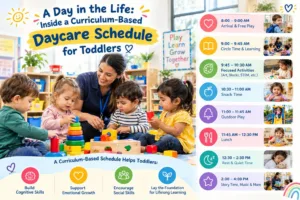
Toddlers and young children find immense comfort in predictability. Early childhood programs establish a balanced daily schedule that alternates between high-energy outdoor play and calm, focused indoor activities. Learning to transition smoothly from a favorite activity to lunch or naptime helps train a child’s brain to handle shifts in routine. This adaptability is exactly what makes the first few weeks of elementary school feel seamless rather than overwhelming.
The Role of Independent Care
In a home setting, parents naturally anticipate a child’s every need. In a professional care center, children are gently encouraged to take ownership of their physical needs.
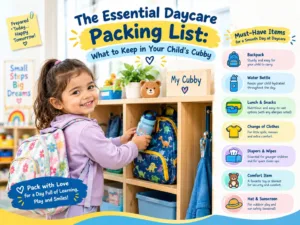
- Hanging up their own coat on a designated cubby hook.
- Opening their lunchbox containers independently.
- Washing their hands thoroughly before eating.
- Gathering their indoor shoes at the end of the day.
These seemingly small habits build a profound sense of personal autonomy and competence. When a child arrives at kindergarten knowing they can manage their own backpack and jacket, their anxiety levels drop significantly, allowing them to focus entirely on learning and making friends.
Cognitive and Language Growth Through Play-Based Frameworks
There is a common misconception that play-based learning lacks academic rigor. In reality, play is the primary vehicle through which young children make sense of the world. High-quality childcare langley spaces leverage intentional play to introduce foundational mathematical, scientific, and linguistic concepts.
Language-Rich Environments
From morning circle time to afternoon storytelling, early learning spaces are saturated with language. Educators expand vocabulary naturally by narrating activities, asking open-ended questions, and introducing rich descriptive terms. Instead of saying, “Look at that bug,” an educator might say, “Observe how that tiny green caterpillar crawls slowly across the surface of the leaf.” This constant exposure to articulate speech builds robust comprehension and expressive language skills, preparing children to become confident readers.
Early Math and Scientific Inquiry
When a child fills different-sized cups with water at a sensory table, they are experiencing early lessons in volume and physics. Sorting colorful buttons by size or pattern lays the groundwork for algebraic thinking. Building a wooden block structure that does not fall over introduces spatial awareness and structural engineering. When these concepts are discovered naturally through exploration, the knowledge sticks permanently, making later abstract math and science lessons far easier to grasp.
| Skill Bracket | Everyday Learning Activity | Future Academic Impact |
| Fine Motor Control | Threading beads, playing with clay, using safety scissors | Pencil grip, handwriting stamina, keyboarding skills |
| Gross Motor Coordination | Climbing playground structures, balancing on logs | Concentration at a desk, spatial awareness in gym class |
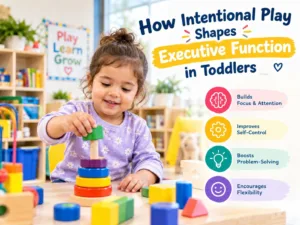
| Executive Functioning | Waiting for a turn during a group game | Sustained attention, listening to teacher instructions |
| Language & Literacy | Singing rhyming songs, participating in show-and-tell | Reading comprehension, phonics, public speaking comfort |
Partnering with Families for a Smooth Transition
Preparation is a collaborative effort that requires alignment between early learning professionals and the home environment. Trustworthy centers prioritize transparent partnerships with parents, offering regular assessments and actionable insights regarding a child’s unique development.
Educators can provide tailored guidance on how to mirror supportive routines at home. Whether it is recommending specific independent self-care goals or sharing positive boundary-setting strategies, this unified front gives children a consistent roadmap for behavior and expectations, reducing behavioral friction across the board.
Frequently Asked Questions
What age should a child start attending a care center to prepare for school?
While every child develops at their own unique pace, entering a consistent group care environment around age two or three provides excellent long-term benefits. This timeframe allows children ample opportunity to adjust to group dynamics, build peer socialization skills, and get used to learning from adults outside their immediate family before entering kindergarten.
How do play-based programs prepare children for reading and writing?
Play-based programs build pre-literacy skills through fine motor practice and language exposure. Activities like squeezing clay, painting, and using tweezers strengthen the exact hand muscles needed for proper pencil grip. Storytelling, rhyming games, and labeling classroom objects build phonemic awareness and print recognition without forcing children to complete dry worksheets.
Are licensed early childhood programs widely accessible throughout the entire Langley region?
Yes, premium licensed programs are accessible across the entire Fraser Valley region. For families seeking reliable daycare langley bc options, high-quality care spaces exist to serve distinct neighborhood pockets, including the downtown core, Willoughby, Walnut Grove, Brookswood, and Aldergrove, making drop-off and pickup routines simple for working parents.
What is the typical communication turnaround time for families enrolled in your care?
Maintaining close contact with parents is essential for peace of mind. Daily updates concerning meals, sleep, activities, and social interactions are typically shared at pickup or via dedicated parent communication applications. For more detailed inquiries or behavioral observations, centers generally maintain a swift response time, answering emails or phone calls within a single business day.
Do local early learning facilities offer specialized programming for pre-kindergarten children?
Many centers provide dedicated pre-kindergarten curriculum components for older three and four-year-olds within their broader classrooms. Choosing a comprehensive preschool langley bc option ensures your older toddler participates in specialized group projects, deeper literacy exercises, and advanced independence challenges explicitly curated for smooth public or private school integration.
Final Thoughts
The journey toward formal education is not a race to see how quickly a child can memorize facts; it is a steady marathon aimed at building a resilient, joyful, and confident mind. When we prioritize emotional maturity, self-regulation, and collaborative social skills, we give our children tools that will serve them far beyond their elementary school years. By securing a space in a structured, loving, and locally respected daycare in Langley, parents give their children the absolute best head start possible, ensuring they enter their first elementary classroom with their heads held high and a genuine love for learning.
Let’s Build a Bright Future Together
If you are looking for a reliable, nurturing environment that balances play-based discovery with professional care, we invite you to connect with us. If you are a parent exploring options for an exceptional great beginnings daycare langley experience, or if you are specifically looking for a supportive baby daycare near me to start your child’s educational journey early, our dedicated staff is here to help.
At KiddieKollege, our goal is to partner with you to turn those vital early years into a stepping stone for lifelong happiness and academic achievement. Reach out to our Langley campus today to schedule a private tour, explore our curriculum, or learn more about our upcoming intake openings.