
Summary
- A childcare development center serves as a critical foundation for neurological and social-emotional growth during the first five years of life.
- The “Educare” philosophy combines high-quality supervision with intentional learning to maximize early brain development.
- Intentional play, structured environments, and qualified mentorship are the pillars of a successful program.
- This article explores how specialized centres like KiddieKollege implement evidence-based strategies to prepare children for lifelong success.
- Understanding the mechanics of early learning helps parents choose a facility that offers more than just basic supervision.
The first five years of a child’s life are often described as a period of “extraordinary plasticity.” During this window, the brain is forming upwards of one million new neural connections every single second. For parents in British Columbia, this reality shifts the perspective on childcare from one of simple convenience to one of profound developmental opportunity. Choosing a childcare development center is no longer just about finding a safe place for your child while you are at work; it is about selecting an environment that actively participates in the construction of their cognitive and emotional architecture.
At KiddieKollege, we have built our reputation as a premier childcare development center in Ave, Langley, Canada, by focusing on the “Educare” model—a philosophy that recognizes that care and education are not separate services, but two sides of the same coin.
Want to learn more about our daycare programs? Click the WhatsApp button below for an instant chat :
Understanding the “Educare” Philosophy
The term “Educare” was born from a need to bridge the gap between traditional babysitting and academic-heavy preschools. In a high-quality childcare development center, every diaper change, snack time, and playground interaction is viewed as a “teachable moment.” This approach prioritizes the relationship between the caregiver and the child as the primary vehicle for learning.
When a child feels safe, secure, and emotionally supported, their brain is in an optimal state for exploration. Conversely, in environments that lack intentionality, children may stay “safe,” but they miss the critical sensory and social inputs required to spark complex brain development. By choosing the early childhood education center model, parents are ensuring that their children are exposed to a “prepared environment” designed to meet their specific developmental milestones.
The Biological Impact of Intentional Environments
To understand why a childcare development center matters so much, we have to look at the biology of the brain. Early experiences determine which neural pathways are reinforced and which are “pruned” away. This is often referred to as the “use it or lose it” principle of brain development.
Sensory Stimulation and Synaptic Pruning
In a professional setting, educators use sensory play—involving sand, water, textiles, and sound—to stimulate the brain’s various regions. These activities aren’t just for fun; they are building the complex networks that will later handle logical reasoning and mathematical concepts. When children engage in these activities within a structured early childhood education center, they are practicing problem-solving and cause-and-effect in real-time.
Language Acquisition and “Serve and Return”
One of the most vital functions of a development centre is language immersion. High-quality educators engage in “serve and return” interactions. When a child babbles or asks a question (the serve), the educator responds with meaningful eye contact and verbal expansion (the return). This process is fundamental to building the language centres of the brain, which are the precursors to literacy and social confidence.
The 5 Pillars of Brain-Focused Development
A truly effective childcare development center operates on five key pillars that ensure a child is moving toward their full potential.
1. Social-Emotional Regulation
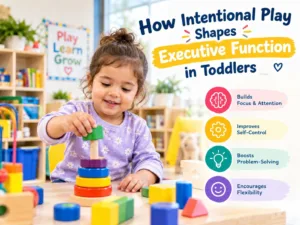
Before a child can learn to read, they must learn to manage their emotions. The brain’s executive function—located in the prefrontal cortex—is responsible for self-regulation. In a development centre, children learn how to name their feelings, wait their turn, and resolve conflicts through guided peer interaction. This “soft skill” development is the single greatest predictor of success in the K-12 school system.
2. Physical and Motor Skill Refinement
Brain growth is inextricably linked to physical movement. Gross motor skills (running, jumping, balancing) build the cerebellum, while fine motor skills (holding a crayon, using safety scissors, manipulating blocks) develop the pathways required for writing. A professional childcare centre development plan ensures that indoor and outdoor environments are balanced to challenge both types of motor skills daily.
3. Cognitive Curiosity and Inquiry
High-quality centres move away from rote memorization and toward inquiry-based learning. Instead of telling a child “the sky is blue,” educators ask, “Why do you think the sky changes colour at sunset?” This sparks the scientific method in the child’s mind, encouraging them to form hypotheses and test them through observation.
4. Nutrition and the “Brain-Gut” Connection
We cannot talk about brain growth without talking about fuel. The developing brain consumes a massive amount of the body’s energy. A quality centre adheres to the Canada Food Guide, providing balanced meals rich in healthy fats and proteins that support the myelin sheathing of nerves—the process that allows brain signals to travel faster.
5. Secure Attachments with Mentors
The “Care” in Educare is about attachment. When children have a consistent, loving caregiver at their centre, their cortisol (stress) levels remain low. High cortisol can actually inhibit brain growth. By fostering secure attachments, professional educators create a “secure base” from which the child feels brave enough to explore more challenging tasks.
Navigating the Search in Langley
As the Township of Langley continues to grow, the options for families have expanded. However, this growth has also made it more difficult to distinguish between centres that are simply “holding spaces” and those that are true development hubs. When searching for a childcare development center near me, it is important to look beyond the shiny toys and focus on the staff.
- Ask about ECE Qualifications: Are the teachers licensed Early Childhood Educators in BC?
- Observe the Ratios: Does the centre maintain low ratios to allow for those vital one-on-one interactions?
- Check for Licensing: Ensure the centre is fully licensed and in good standing with Fraser Health.
At KiddieKollege, we pride ourselves on being a transparent partner for families. We understand that parents aren’t just looking for a service; they are looking for a community that shares their values and their commitment to their child’s future.
FAQs
1. What is the difference between a regular daycare and a childcare development center? The main difference is the focus on developmental outcomes. While a daycare provides supervision and safety, a development centre follows a structured curriculum designed to support cognitive, social, and physical milestones through intentional “Educare” strategies.
2. How do I know if my child is benefiting from the program?
You should see progress in “soft skills,” such as increased independence, better emotional regulation, and a burgeoning curiosity about the world. Professional centres also provide regular updates or daily reports on your child’s activities and milestones.
3. Is KiddieKollege currently accepting new students in the Langley area?
Enrollment varies by age group and season. We encourage parents to contact our administration in Ave, Langley, as early as possible, as our infant and toddler spots tend to fill up quickly due to high demand in the Fraser Valley.
4. What is the local response time for tours and inquiries?
We understand that parents are often on a tight schedule. Our team typically responds to initial inquiries within 24 to 48 business hours to schedule a tour and discuss your family’s specific needs.
5. Does the center help with the BC Childcare Subsidy (ACCB)?
Yes, as a licensed facility, we support families in navigating the provincial subsidy programs. We can provide the necessary Child Care Arrangement forms to help make premium care more affordable for your household.
Final Thoughts on Early Learning
The decision of where to enroll your child is one of the most impactful choices you will make in their early years. By prioritizing a childcare development center that understands the mechanics of early brain growth, you are giving your child a head start that will echo throughout their academic and personal life. The “Educare Advantage” is not about pushing children to grow up faster; it is about providing them with the rich, supportive soil they need to blossom at their own natural pace.
At KiddieKollege, our mission is to be the most trusted childcare development center in Ave, Langley, Canada, providing a professional and nurturing environment where every child feels seen and supported. We invite you to visit us, meet our passionate educators, and see firsthand how our commitment to excellence can benefit your family. Choosing a childcare development center is an investment in your child’s future—let’s make it a great one together.