Quick Summary
- Foundational Life Skill: Explore how teaching self regulation in toddlers helps children manage emotional impulses, tolerate frustration, and build lasting patience.
- The Power of Group Play: Discover why structured peer activities, cooperative games, and turn-taking routines strengthen executive function more effectively than isolated instruction.
- Practical Calming Tools: Learn evidence-based de-escalation methods to navigate daily tantrums and emotional overstimulation with calm confidence.
- Classroom vs Home Environments: Understand how licensed group care settings provide natural daily opportunities for emotional co-regulation and social resilience.
- Community Early Learning: See how high-quality programs across British Columbia support families with warm, accredited developmental guidance.
Watching a two-year-old navigate a wave of big feelings is one of the most common yet challenging experiences for any parent. Whether it is struggling to share a favorite toy, coping with a sudden schedule transition, or waiting their turn for a snack, toddlers experience the world with great intensity. Their emotional responses are immediate, raw, and often overwhelming because their developing brains have not yet mastered emotional control. Approaching the journey of teaching self regulation in toddlers through guided, structured group interactions turns everyday emotional challenges into lifelong social strengths.
At KiddieKollege, located at 20103 53 Ave, Langley, BC V3A 3T8, Canada, our dedicated educators deliver comprehensive Infant & Toddler Program and Multi-Age Childcare Program options that create safe, predictable environments where young children across our local community learn to understand their emotions, build patience, and thrive alongside their peers.
Want to learn more about our daycare programs? Click the WhatsApp button below for an instant chat :
What Is Self-Regulation and Why Is It Essential in the Early Years?
Self-regulation refers to the ability to monitor, manage, and adapt our emotional states, attention spans, and physical behaviors to meet the demands of a situation. It is the internal mechanism that enables an individual to resist an immediate impulse, maintain focus despite background distractions, and recover from emotional frustration.
The Developing Toddler Brain
In toddlerhood, the prefrontal cortex—the command center for logical reasoning, impulse control, and executive functioning—is in its earliest stages of formation. Meanwhile, the limbic system, which drives instinctual emotional reactions like fear, excitement, and anger, is fully active.
This neurological dynamic explains why a toddler cannot simply “listen to reason” during an emotional storm. They genuinely lack the internal neurological wiring to pause, reflect, and calm themselves down without adult support. Self-regulation is not an innate personality trait that children either have or lack; it is a complex set of developmental skills that must be modeled, practiced, and reinforced over time.
Self-Regulation Versus Simple Compliance
Parents often confuse self-regulation with strict obedience. Obedience occurs when a child stops an action because an external authority figure tells them to, often driven by a desire for approval or a fear of consequences. Self-regulation, by contrast, comes from within. It occurs when a child feels the urge to grab a toy or scream in frustration, recognizes that feeling, and chooses a constructive coping mechanism instead. Fostering true internal regulation builds independent, confident learners who make positive choices even when an adult is not watching.
The Role of Structured Group Play in Fostering Patience
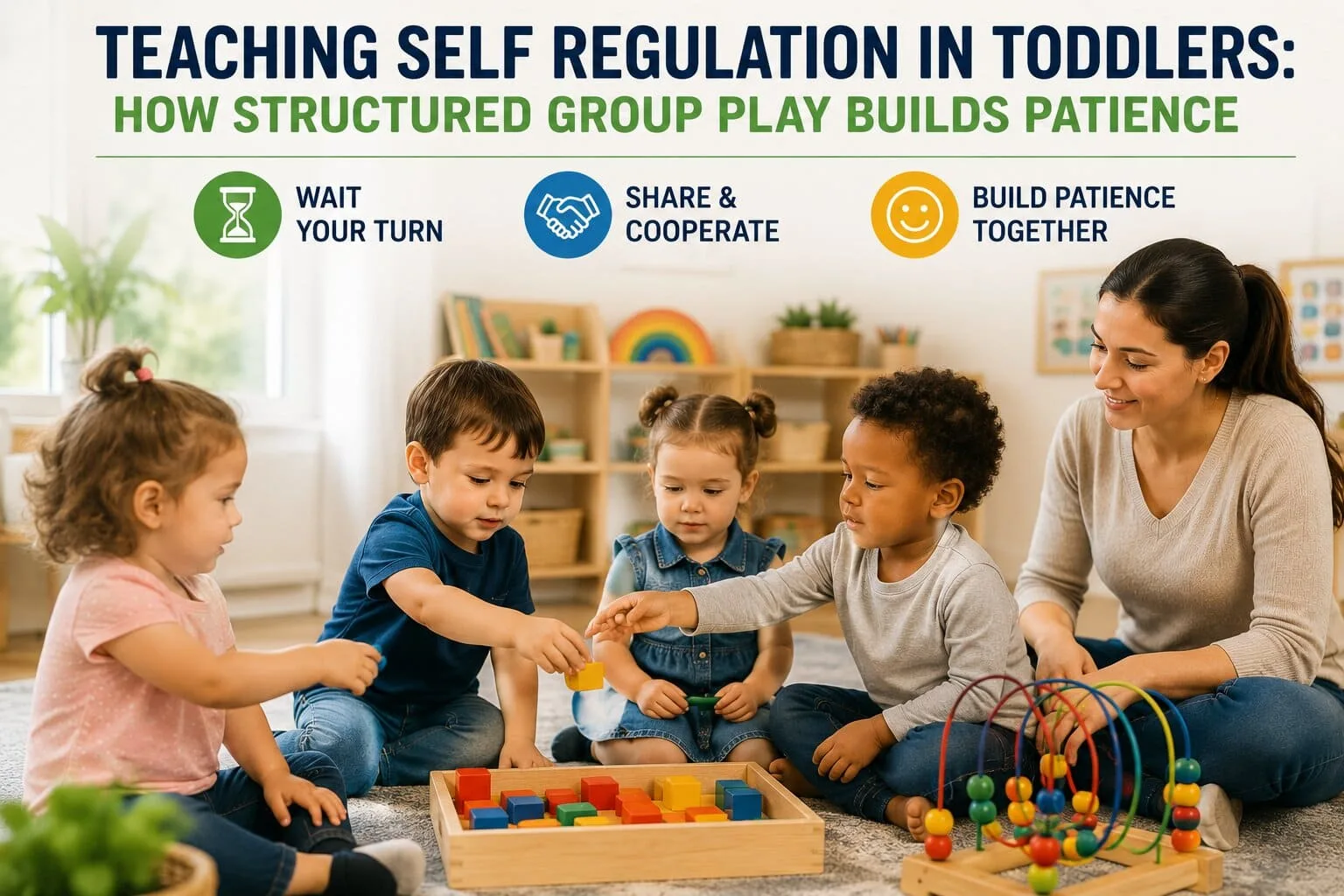
While one-on-one time with parents at home is essential for emotional attachment, structured group environments provide unique developmental opportunities that cannot be replicated in isolation. When young children play together under the guidance of certified educators, they are immersed in a dynamic social laboratory.
Experiencing Natural Social Boundaries
In a group setting, toddlers quickly realize that the classroom world does not revolve entirely around their individual preferences. If four children want to paint at the classroom easel, but only two spaces are available, an immediate lesson in patience arises.
Certified educators guide children through these moments not by punishing impatience, but by offering supportive structure. A timer might be set, or a visual waiting list might be created. When children see that waiting has a clear, predictable end and that their turn will reliably come, the anxiety surrounding waiting diminishes.
Practicing Turn-Taking and Cooperative Goals
Engaging in play based self regulation learning helps children practice impulse inhibition through joyful, active participation. Games that involve stop-and-go mechanics—such as freeze dancing, musical movement circles, or passing a ball around a circle—require children to actively listen, process rules, and halt physical movement on cue.
These playful activities stimulate the brain’s inhibitory pathways. Each time a toddler freezes during a game or waits for the music to resume, they strengthen the neural pathways responsible for impulse control. Over time, this physical practice translates into behavioral patience in everyday situations, such as standing in line or waiting for lunch to be served.
Observing Peer Modeling
Toddlers learn by watching other children. When an unsettled child observes a peer take a deep breath, hand over a toy peacefully, or ask an educator for help, it provides a powerful, relatable model of emotional management. Group environments normalize the reality that everyone has to wait, share resources, and navigate boundaries, making patience feel like a natural part of daily community life.
Moving Beyond Outbursts: Practical Strategies for Parents and Educators
Tantrums and meltdowns are a standard part of early childhood development, but having the right tools makes navigating them manageable for both caregiver and child. Understanding how to help a toddler self regulate begins with recognizing what triggers their emotional distress.
Understanding the Anatomy of a Meltdown
A meltdown is distinct from a calculated behavioral test. A meltdown happens when a child’s nervous system experiences sensory, emotional, or cognitive overload. When this threshold is crossed, the child loses conscious control over their behavior.
Successfully managing toddler meltdowns and tantrums requires adults to shift their mindset from punishment to de-escalation. Shouting, lecturing, or sending an overwhelmed toddler to isolated time-out often elevates stress hormones, lengthening the emotional storm.
Implementing Practical Calming Tools
Equipping young children with concrete, accessible coping tools allows them to participate in their own calming process:
- Sensory Grounding: Providing a heavy blanket, a soft plush toy, or a smooth wooden stone gives the hands a tactile focus that helps regulate an elevated nervous system.
- Visual Breathing Cues: Abstract commands like “take a deep breath” are difficult for toddlers to grasp. Instead, use playful visuals such as “smell the flower, blow out the birthday candle” or tracing the outline of their fingers while breathing in and out.
- Quiet Rest Areas: Establishing a comfortable, low-stimulation nook with soft pillows and picture books provides a dedicated sanctuary where children can step away from group noise to recharge.
Integrating these reliable calming strategies for toddlers into daily routines helps children recognize the early physical sensations of anger or fatigue before an emotional escalation takes place.
The Power of Co-Regulation: How Adults Shape Child Regulation
Children do not learn to regulate their nervous systems in isolation; they learn through co-regulation with calm, attuned adults. Co-regulation is the supportive process wherein a caregiver uses their own grounded presence, tone of voice, and body language to help an upset child feel safe.
The Mirroring Effect
Young children possess sensitive mirror neurons that absorb the emotional state of the adults around them. If a parent or educator responds to a toddler’s screaming with tension, raised voices, and anger, the child’s nervous system mirrors that distress, escalating the conflict.
Conversely, when an adult maintains an unhurried posture, lowers their vocal pitch, and sits down at the child’s eye level, they send biological safety cues to the child’s brain. By remaining calm during chaos, the adult acts as an external emotional anchor until the child’s prefrontal cortex comes back online.
Validating Emotions While Maintaining Limits
Co-regulation does not mean giving in to every demand. It means offering emotional validation while keeping behavioral boundaries firm and steady.
A helpful approach follows this pattern:
- Acknowledge the Feeling: “You are feeling disappointed because we have to pack up the building blocks.”
- State the Boundary Clearly: “It is time to wash our hands for snack.”
- Offer Connection and Support: “I can sit with you while you take a breath, or we can walk to the sink together.”
This approach teaches children that all emotions are valid and accepted, even if certain behaviors, like throwing toys or hitting, are not permitted.
Early Social Development in Group Learning Environments
Quality early learning spaces do far more than prepare children for academics; they lay the social-emotional bedrock for life. When looking for reliable childcare langley families consistently look for programs that prioritize emotional literacy alongside play-based exploration.
Developing Empathy and Communication
Fostering strong social skills in infant toddler daycare environments begins by helping children name their feelings and recognize emotional cues in others. When an educator points out, “Look at your friend’s face; they look sad because the block tower fell down,” children begin to connect facial expressions with internal states.
Learning to express needs verbally rather than physically is a major milestone in early childhood. Educators actively coach children to use simple verbal phrases, such as “My turn please” or “I am playing with this,” turning potential physical conflicts into moments of cooperative communication.
Predictable Daily Rhythms
In a professional langley bc daycare setting, daily schedules are designed with intention. Predictable sequences of circle time, outdoor exploration, nutritious snacks, and restful quiet periods give young children an intuitive sense of order. When children know exactly what to expect throughout their day, their baseline anxiety drops, freeing up cognitive energy for exploration, creative problem-solving, and positive peer play.
Choosing a dedicated daycare langley parents trust ensures their children spend their early years in environments that treat social and emotional development with the same importance as cognitive growth.
Frequently Asked Questions
How do early childhood educators help a toddler who struggles with sharing during group play?
Educators reframe sharing as “turn-taking.” Rather than forcing a child to immediately surrender a toy they are actively engaged with, teachers introduce visual timers or offer an engaging secondary toy to the waiting peer. Once the first child finishes their play cycle, they are gently supported in passing the toy along. This approach respects individual focus while teaching cooperative waiting.
What are your administrative response times for new family tours and registration inquiries?
Our administrative team values prompt, helpful communication with prospective families. All tour bookings, registration questions, and general intake inquiries submitted through our website or phone lines receive a personalized response within twenty-four to forty-eight business hours from our intake staff.
How does a full-day early learning schedule support children who become easily overstimulated?
Our daily schedule incorporates balanced energy rhythms throughout the day. Active gross motor sessions and outdoor exploration are intentionally balanced with quiet story corners, sensory play trays, and scheduled rest periods. Educators actively observe children for subtle signs of fatigue, guiding them to quieter, low-stimulation spaces before sensory overload turns into a meltdown.
What specific regional communities and neighborhoods do your early education programs serve?
Our centrally located Langley campus serves families throughout the Fraser Valley. We provide accessible early learning and child care programs for households residing across Willoughby, Walnut Grove, Brookswood, Murrayville, Aldergrove, and central Langley.
What is the typical age range when children begin demonstrating noticeable self-regulation skills?
While the foundations of co-regulation begin in infancy, noticeable independent self-regulation skills typically begin emerging between ages two and a half and four. During this stage, children begin showing early signs of verbalizing their frustrations, following simple multi-step classroom rules, and waiting for short periods with minimal adult prompting.
Conclusion / Final Thoughts
Navigating early childhood emotional growth requires patience, empathy, and a strong understanding of how young minds develop. By replacing punishment with co-regulation, providing structured group play opportunities, and teaching concrete emotional coping tools, parents and educators empower young children to transform big feelings into lasting emotional intelligence, patience, and social confidence.
If you are exploring local options for a supportive kiddie daycare or searching for a trusted toddler daycare near me, partnering with a licensed learning community makes all the difference. At KiddieKollege, our certified educators specialize in teaching self regulation in toddlers through balanced play-based programs that nurture the whole child. We invite you to contact our Langley campus today to book a private tour, meet our warm educators, and see how our classrooms support your family’s early learning journey.