Summary
- Defining True Readiness: Understand why social and emotional growth has overtaken rote academics as the primary indicator of a child’s kindergarten readiness.
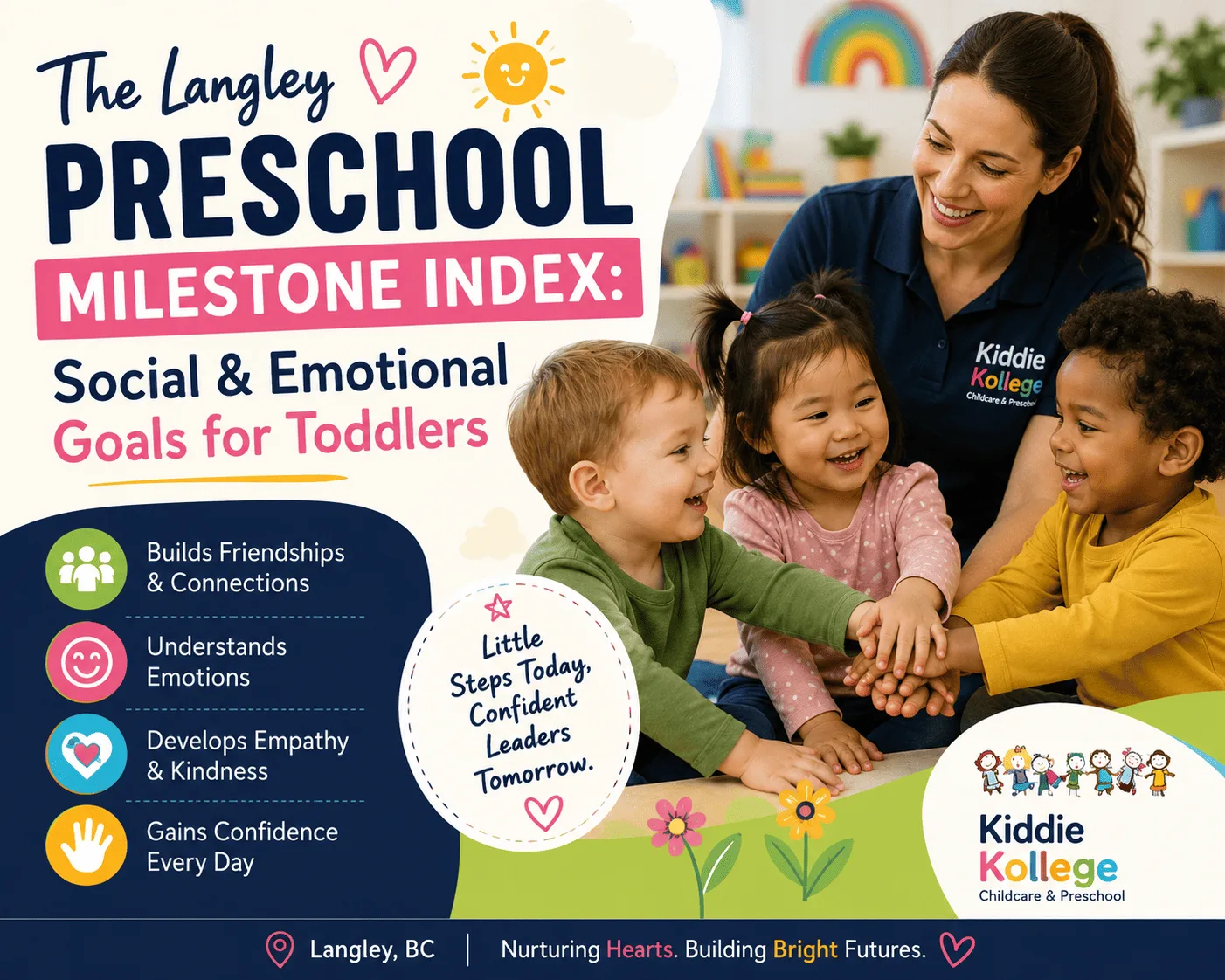
- The Milestone Index: Explore an actionable, step-by-step breakdown of core interpersonal skills designed specifically for children attending a langley preschool.
- Cooperative and Play Dynamics: Discover how young learners transition from solo play to collaborative group tasks, establishing long-term conflict resolution skills.
- Managing Big Feelings: Learn about proactive strategies, including emotional labeling and classroom coregulation routines, that effectively minimize everyday toddler meltdowns.
- A Local Framework for Families: Find out how professional community care providers seamlessly bridge the gap between home environments and formal early schooling.
When parents sit down to evaluate early childhood programs throughout the Fraser Valley, their minds often drift toward academic milestones. It is incredibly common to wonder if your child is learning their letters quickly enough, or if they can count to twenty before their peers. However, if you speak with kindergarten teachers in our local school districts, they will tell you a completely different story. True school readiness has very little to do with flashcards and everything to do with a child’s emotional architecture and social competence.
At KiddieKollege, located at 20103 53 Ave, Langley, BC V3A 3T8, Canada, our certified early childhood educators recognize that emotional intelligence is the true foundation of all future academic success. By utilizing a structured milestone guide like this langley preschool index, families can transition away from academic anxiety and focus on nurturing the deep resilience, self-regulation, and interpersonal skills their toddlers need to confidently step into the world.
The Modern Shift: Why Emotional Architecture Matters Most
For decades, early learning spaces operated under a traditional academic model. Success was measured by compliance and memory retention. Today, neurodevelopmental science has thoroughly debunked this outdated approach. We now know that a child’s brain cannot absorb logical concepts—like math equations or phonics systems—if their emotional brain is chronically dysregulated or overwhelmed by social anxieties.
When a young child enters a classroom group dynamic, they are stepping out of their family circle and entering a mini-society. This shift requires immense psychological energy. A toddler must learn to feel secure when separated from their primary caregivers, share highly coveted physical resources, and interpret the intricate facial expressions and vocal tones of their classmates.
Early childhood programs serve as a gentle, low-stakes practice arena. By focusing heavily on social-emotional architecture, specialized educators help young children build robust neural pathways in the prefrontal cortex—the exact brain region responsible for empathy, focus, problem-solving, and impulse control.
The Langley Preschool Milestone Index: A Structural Guide
To help local families track and support these complex internal changes, we have organized the primary social-emotional goals of toddlerhood into an accessible, practical Index. These benchmarks are not rigid rules; rather, they are a fluid map designed to monitor how a child learns to navigate themselves and their community.
1. Emotional Literacy and Labeling Feel States
Before a toddler can manage an intense emotion, they must be able to name it. In the earliest stages of development, a child experiences frustration or sadness as a confusing, overwhelming physical sensation. This often results in a sudden physical outburst.
- The Goal: Moving from reactive physical behavior to basic verbal expression.
- What it looks like: A child experiencing a boundary adjustment might cry, but with guidance, they can eventually use simple language: “I am mad” or “That makes me sad.”
- Classroom Support: High-quality daycare in langley bc classrooms utilize visual emotion charts, storybooks detailing diverse expressions, and responsive narration from teachers to give children a rich vocabulary for their internal worlds.
2. Parallel Play to Active Cooperative Play
If you observe two-year-olds playing, you will notice they rarely play with each other; instead, they engage in parallel play, working side-by-side with similar toys without active interaction. By age three and four, a massive social shift occurs as children attempt cooperative play.
- The Goal: Designing shared play narratives and working toward common classroom goals.
- What it looks like: Collaboratively constructing a wooden train track layout, taking assigned roles in a dramatic play kitchen, or organizing a simple group game.
- Classroom Support: Educators minimize structured toy sets that encourage single-user behavior, prioritizing open-ended materials like building blocks, loose parts, and large sensory tables that naturally require peer communication and teamwork.
3. Emerging Impulse Control and Resource Sharing
True sharing is an incredibly advanced cognitive skill. It requires a child to suppress their immediate, instinctual desires and recognize the invisible, internal wants of another person.
- The Goal: Accepting delayed gratification and practicing waiting turn structures safely.
- What it looks like: Relinquishing a toy when a timer sounds, waiting patiently in line for the outdoor playground slide, or accepting an alternative toy while a peer finishes their turn.
- Classroom Support: Professional daycare langley spaces never force a child to abruptly hand over a toy they are actively using, as this breeds scarcity anxiety. Instead, they teach the art of negotiation, using sand timers and verbal agreements to make the waiting process highly visual, predictable, and fair.
4. Basic Coregulation and Self-Soothing Techniques
Self-regulation does not mean a child never loses control; it means they possess the foundational tools to return to a calm state after an upsetting event. Toddlers cannot achieve this alone; they require an adult to serve as an emotional anchor through a process called coregulation.
- The Goal: Identifying individual overwhelm and utilizing comforting strategies to slow their heart rate down.
- What it looks like: Walking over to a quiet reading corner when an activity gets too loud, taking deep “belly breaths” alongside a teacher, or seeking out a comfort item during transitions.
- Classroom Support: Dedicated centers incorporate quiet, cozy nooks filled with plush pillows, books, and sensory calming jars where children can safely retreat to regulate their nervous systems without feeling punished or isolated.
Navigating Social Hurdles: Biting, Kicking, and Resource Defiance
When children are placed in social environments, behavioral speedbumps are a completely natural aspect of development. Aggression in toddlers is rarely a sign of a behavioral issue; it is almost always an indicators of temporary communication frustration.
De-escalating Physical Altercations Accurately
When a child resorts to biting, pushing, or hitting over a toy, the adult response must be immediate, highly predictable, and entirely calm.
- The Physical Block: Place your body between the children to ensure immediate physical safety.
- The Neutral Boundary: Avoid long, emotional lectures. Use clear, direct language: “I will not let you push. Pushing hurts friends.”
- The Empathy Shift: Turn your immediate attention to the child who was hurt. This prevents the aggressive child from receiving instant social attention for negative behavior, while modeling compassionate care in real time.
- The Alternate Skill: Once the environment settles, return to the child who struck out. Teach the missing verbal skill: “Next time you want that car, say ‘My turn please’ or tap my arm for help.”
| Common Social Challenge | Traditional Reactionary Approach | Authoritative Guidance Approach |
| Grabbing a peer’s toy | Direct isolation via a timeout chair, forcing an immediate insincere apology. | Validating the desire: “You wanted that doll so much.” Setting the rule: “It is still Sarah’s turn. Let’s find a book while you wait.” |
| Meltdown during transition | Threatening the loss of a future privilege: “Stop crying or we are skipping the park.” | Providing a physical anchor: “Moving our bodies can be hard. Let’s hold hands and walk to the line like giant bears.” |
| Refusal to tidy up blocks | Doing the cleaning yourself while scolding the child for laziness. | Breaking down the task into micro-choices: “Do you want to clean up the red blocks or the blue blocks first? You choose.” |
Environmental Design: The Silent Early Childhood Educator
The physical setup of an early learning classroom plays a massive role in guiding toddler behavior. A poorly organized space with wide-open, runway-like corridors naturally invites running, shouting, and chaotic overstimulation. Conversely, a thoughtfully arranged space functions as a comforting, intuitive guide for young minds.
When evaluating local langley daycares, pay close attention to how the physical floor plan is mapped out. A premium learning environment is broken down into intentional, micro-environments or “learning centers.” There should be an obvious reading library for quiet reflection, an enclosed block construction zone that protects building projects from foot traffic, and a distinct artistic exploration space.
Furthermore, access to reliable outdoor nature spaces is non-negotiable for healthy development. In our beautiful, damp West Coast climate, having safe access to a covered outdoor playground allows children to burn off excess energy, practice gross motor balance, and clear their minds through year-round fresh air play.
Bridging the Gap: Maintaining Consistency Between Care and Home
The true benefits of a social-emotional curriculum are unlocked when there is a unified strategy connecting a child’s care facility and their home life. Children thrive inside predictability; when they experience the exact same boundary structures, redirection language, and transition routines at home that they do at their kiddie kollege daycare campus, their anxiety drops significantly.
Parents can easily adopt these supportive classroom strategies within their daily home routines:
- Avoid Emotional Dismissal: When your child is upset over a minor issue, resist the urge to say, “It’s not a big deal.” To their developing brain, it feels monumental. Acknowledge it: “You are disappointed that your block tower fell over. It is okay to feel upset.”
- Provide Choice Architecture: Give your child structured, acceptable options to satisfy their natural craving for autonomy. “Do you want to brush your teeth before or after we put on your pajamas?”
- Keep Transitions Visual: Use clear cues before altering your routine. A simple sand timer or a specific transition song gives the toddler brain the processing time it needs to change tasks peacefully.
Frequently Asked Questions
How do educators help a child who is struggling with separation anxiety during morning drop-off?
Separation anxiety is a completely normal developmental milestone. Educators manage this by establishing a comforting, highly consistent drop-off routine. We encourage parents to create a short, loving goodbye ritual (like a special handshake or a quick hug) and then confidently exit. Teachers immediately step in to offer warm physical coregulation, guiding the child toward an engaging sensory activity to help them transition smoothly.
What are the operational coverage areas and availability schedules for your programs?
Our licensed programs are fully operational throughout the year, serving families across Langley City, Willoughby, Walnut Grove, Murrayville, and neighboring Brookswood pockets. We maintain convenient child care hours designed to accommodate commuting parents, and our administrative office operates with a rapid local response time, answering enrollment and scheduling queries within 24 business hours.
Does a play-based curriculum still prepare my child for early academic expectations?
Absolutely. Play-based learning is highly intentional. When children sort natural materials by pattern, they are practicing early algebra. When they listen to stories and sing rhyming songs, they are mastering phonemic awareness. This approach builds a deep, genuine love for learning while developing the precise fine motor finger strength needed for proper pencil grip later on.
How do centers communicate behavioral or developmental milestones with parents?
We believe in absolute transparency and continuous parent partnership. Daily insights regarding social interactions, emotional shifts, and general routines are communicated directly through secure, real-time parent applications or face-to-face updates at pickup. For comprehensive developmental reviews, dedicated parent-teacher meetings can be easily scheduled throughout the academic term.
Final Thoughts
Watching a toddler transform from a reactive child into an empathetic, communicative, and socially confident individual is one of the most beautiful experiences in early parenting. By shifting our attention away from rigid academic pressure and embracing a holistic focus on emotional regulation, cooperation, and community awareness, we set our children up for a lifetime of authentic fulfillment. Securing a spot in a high-quality, locally respected langley preschool ensures that your child is surrounded by the specialized guidance, loving patience, and structured consistency required to navigate these vital formative years.
Partner with Us for Your Child’s Journey
If you are searching for a warm, customer-focused early childhood team that treats every behavioral challenge as a valuable teaching opportunity, we invite you to connect with us. Whether you are actively looking for a supportive daycare near me to begin your child’s journey early, or simply want to explore how our specialized curriculum supports kindergarten readiness, our campus door is always open. At KiddieKollege, we are incredibly proud to serve our local community as a trustworthy foundation for early childhood growth. Reach out to our Langley administration team today to book your private tour, meet our passionate educators, and discover how we can champion your child’s milestones together.