Quick Summary
- Foundational Thinking: Discover how hands-on stem activities for preschoolers nurture curiosity, creative problem-solving, and scientific inquiry from an early age.
- Child-Led Exploration: Learn why play-based inquiry allows young minds to grasp cause-and-effect concepts without formal drills or worksheets.
- Integrated Subjects: Understand how everyday activities blend science, technology, engineering, and mathematics into meaningful, joyful routines.
- Social and Motor Benefits: Explore how collaborative construction and sensory experiments build fine motor control, patience, and peer communication.
- Community Early Learning: See how quality child care centres across British Columbia create safe, stimulating environments that inspire lifelong discovery.
When parents hear the acronym STEM (Science, Technology, Engineering, and Math), they often picture high school chemistry labs, complex robotics kits, or advanced mathematics equations. In the realm of early childhood education, however, STEM looks completely different. It is found in the joy of splashing water to see what floats, stacking wooden blocks until they wobble and fall, sorting colorful autumn leaves by size, and watching ice cubes slowly melt in warm sunlight. Young children are instinctive scientists who explore their physical surroundings through touch, trial, error, and wonder. Thoughtfully integrating stem activities for preschoolers into daily child care routines turns natural curiosity into foundational critical-thinking skills.
At KiddieKollege, located at 20103 53 Ave, Langley, BC V3A 3T8, Canada, our dedicated educators provide nurturing care through our Infant & Toddler Program, creating a welcoming and rich environment where infants and toddlers build early problem-solving skills, social confidence, and a lasting love for discovery.
Want to learn more about our daycare programs? Click the WhatsApp button below for an instant chat :
The True Essence of STEM in Early Childhood
In early learning, STEM is not about rote memorization or formal academic instruction. Instead, it represents a mindset of active exploration, creative hypothesis testing, and hands-on discovery.
Fostering Natural Scientific Inquiry
Children are born with an innate drive to investigate how things work. When a toddler drops a spoon from a highchair, they are testing gravity and sound. When a preschooler combines red and yellow paint, they are experimenting with chemistry and color theory.
Modern early learning classrooms embrace this natural drive through inquiry-based guidance. Rather than simply giving children answers, certified educators ask open-ended questions like:
- “What do you think will happen if we add one more block to the top?”
- “Why do you think the wooden boat floats while the stone sinks?”
- “How can we make this ramp steeper to help the car travel faster?”
These conversational prompts encourage children to observe, predict, test, and reflect—the exact four stages of the formal scientific method, experienced entirely through joyful play.
Deconstructing the Pillars: Science, Technology, Engineering, and Math
To understand how early discovery takes shape, it helps to examine how each individual STEM discipline translates into an early childhood classroom environment.
Science: Exploring the Natural World
Early science is rooted in sensory observation and living systems. Children explore:
- States of Matter: Melting ice cubes, mixing cornstarch with water to create sensory slime, or watching baking soda bubble when combined with lemon juice.
- Living Biology: Planting sunflower seeds in small paper cups, observing earthworms in soil trays, or examining tree bark patterns using handheld magnifying glasses.
- Physical Principles: Exploring light and shadows using flashlights on translucent materials, or discovering magnetic attraction by testing everyday objects against magnetic wands.
Technology: Tools for Discovery
In a preschool setting, technology extends far beyond digital screens and tablets. In early education, technology refers to any human-made tool that helps solve a problem or accomplish a task. Preschoolers engage with technology when using:
- Simple balance scales to compare weights
- Child-safe scissors, hole punchers, and tape dispensers
- Water droppers and pipettes for fine motor transfer
- Pulleys, gears, wheels, and levers integrated into wooden toys
Using these physical tools teaches children that tools serve functional purposes, laying the groundwork for digital and mechanical literacy.
Engineering: Designing and Building Structures
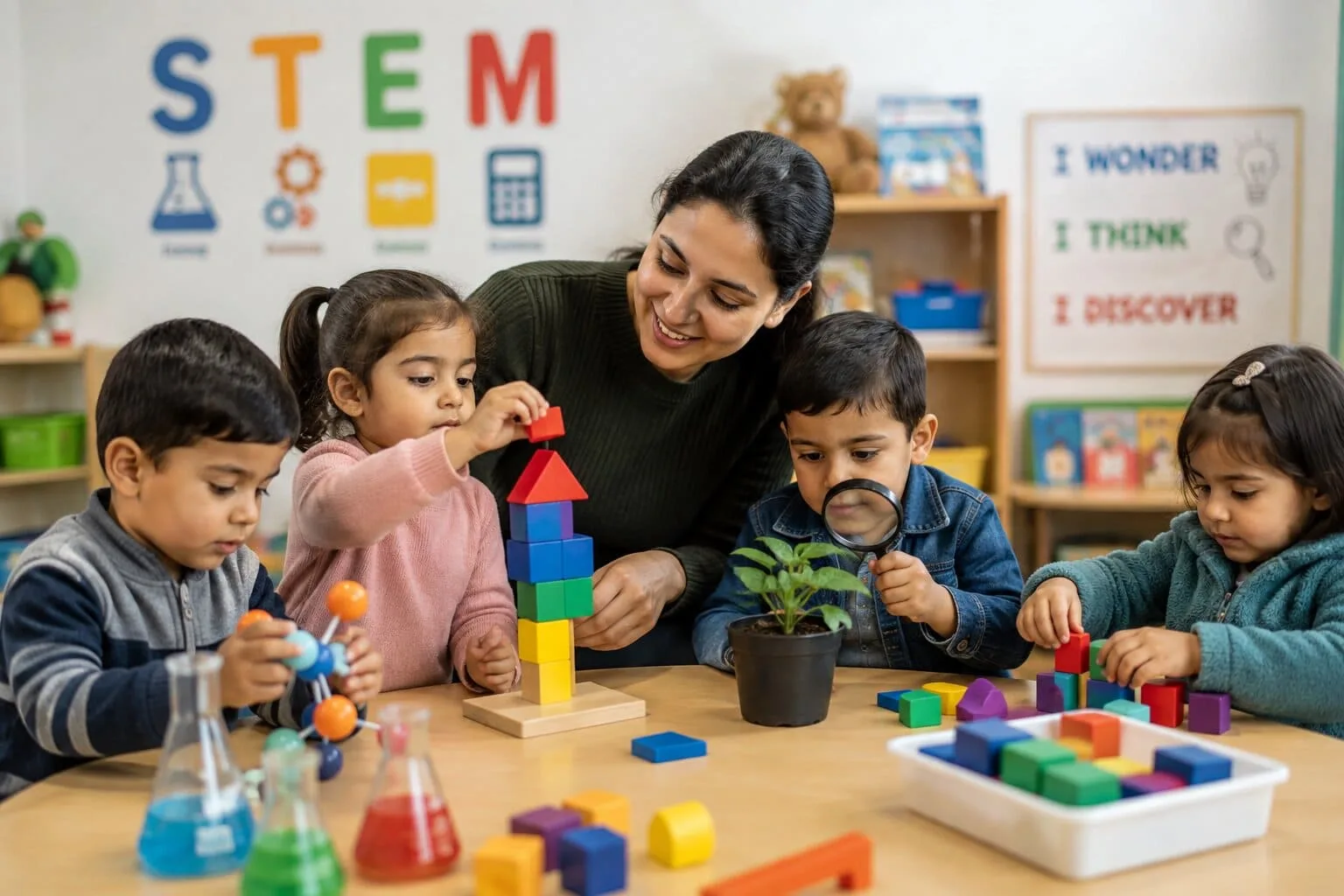
Engineering in preschool is visible in every block center and construction corner. When children build a bridge for toy cars or construct a tall tower that stays upright, they explore structural balance, weight distribution, and spatial relationships.
If a block tower collapses, educators support children in analyzing the outcome: Was the base wide enough? Were the heavy blocks placed at the top or the bottom? This process teaches resilience, spatial awareness, and iterative design—the foundational mindset of every engineer.
Mathematics: Patterns, Measurements, and Numbers
Math in early learning is tactile, visual, and rhythmic. Rather than completing paper worksheets, children engage with hands-on math activities for preschool through tangible classroom materials. They count out snack crackers, organize buttons by color or size, trace geometrical patterns with wooden blocks, and measure classroom rugs using their own footsteps. These active experiences give mathematical concepts real-world meaning.
Sensory Exploration and Early Discovery
Sensory stimulation forms the gateway to early cognitive processing. When young children engage multiple senses simultaneously, neural pathways in the brain develop rapidly.
The Magic of Sensory Bins
Introducing sensory stem activities allows toddlers and preschoolers to explore physical textures, densities, and volumes safely. Classroom sensory tables filled with dry lentils, sand, water, shredded paper, or smooth river stones provide rich learning opportunities.
By scooping, pouring, filtering, and funneling materials between containers of varying shapes, children gain an intuitive understanding of volume, conservation of mass, and spatial capacity.
Active Discovery with Infant and Toddler STEAM
Even the youngest children benefit from discovery-focused play. Integrating simple steam activities for toddlers involves tactile experiences like feeling the difference between warm and cold wet washcloths, exploring squishy sensory bags taped securely to low windows, or listening to the different sounds produced by tapping wooden, metal, and plastic bowls. These simple explorations introduce basic physics and sensory processing in safe, developmentally appropriate ways.
The Benefits of a Play-Based STEM Curriculum
When early learning facilities implement a comprehensive play-based stem curriculum, the developmental benefits extend far beyond science and mathematics.
Cultivating Executive Function and Problem-Solving
STEM play challenges children to plan, adapt, and focus. When an initial design fails to work, children learn to pause, adjust their approach, and try again. This iterative process strengthens executive functioning, impulse control, and cognitive flexibility, providing essential tools for lifelong learning.
Enhancing Language and Collaborative Skills
Working together on a construction challenge or scientific experiment requires peer communication. Children learn rich descriptive vocabulary—words such as heavy, buoyant, transparent, fragile, balance, incline, and predict.
They also practice negotiating roles, sharing specialized tools, and celebrating joint successes. This social-emotional growth transforms early discovery into an inclusive group achievement.
Why Quality Early Childhood Education Matters
A child’s early developmental window from infancy to age five represents the most rapid period of brain development in the human lifespan. Investing in early childhood stem learning during these formative years builds confidence in approaching unfamiliar problems.
Families exploring early education look for environments that balance warm caregiving with stimulating educational spaces. When comparing programs such as a kiddies academy or an established kiddies daycare centre, parents value facilities that offer transparent communication, certified educators, and child-centred classrooms.
Across British Columbia, quality centres like krt kiddies kollege prioritize environments where children are encouraged to question, experiment, and collaborate. When researching experienced daycares in langley, finding a centre that integrates inquiry-based exploration into everyday routines ensures your child receives well-rounded developmental support. Choosing an accredited langley bc daycare gives families confidence that their child is spending their days in a safe, licensed setting that treats learning as a joyful journey.
Practical Ways Parents Can Encourage STEM Thinking at Home
You do not need specialized equipment to nurture scientific thinking at home. Daily household routines offer countless opportunities for playful exploration:
- Kitchen Science: Involve your child in baking by having them pour ingredients, observe liquids turning into solids in the oven, and count out measuring spoons.
- Bath-Time Physics: Provide cups, funnels, and household sponges during bath time to explore water flow, displacement, and suction.
- Nature Scavenger Hunts: Walk through your local park and encourage your child to collect smooth stones, rough pinecones, and colorful leaves, sorting them by texture, shape, or weight when you return home.
- Cardboard Box Engineering: Give your child clean cardboard boxes, paper towel tubes, and masking tape to design miniature houses, ramps, or tunnels for toy cars.
These simple, everyday moments reinforce the idea that discovery happens everywhere, not just inside a classroom.
Frequently Asked Questions
How do early childhood educators introduce STEM concepts to very young toddlers safely?
Educators use large, non-toxic, child-safe materials designed specifically for early motor stages. Toddlers explore concepts like gravity, balance, and texture using soft foam blocks, sealed sensory liquid pouches, large wooden sorting pegs, and unbreakable mirrors, ensuring safe discovery without small-part hazards.
What are your administrative response times for new family registration and tour inquiries?
Our administrative office values prompt, clear communication with prospective parents. All tour bookings, registration requests, and program inquiries submitted through our website or phone lines receive a personalized response within twenty-four to forty-eight business hours from our intake staff.
How does a play-based STEM approach differ from traditional academic instruction?
Traditional instruction often relies on direct teaching, repetition, and worksheets to convey specific facts. In contrast, play-based STEM is inquiry-led; children actively manipulate physical objects, test hypotheses, and solve real-time challenges through hands-on exploration, building deeper comprehension and genuine enthusiasm for learning.
Which local communities and Fraser Valley neighborhoods does your learning centre serve?
Our centrally located Langley campus proudly serves families across the Fraser Valley region. We provide accessible infant care, toddler programs, and early learning services for families residing in Willoughby, Walnut Grove, Brookswood, Murrayville, Aldergrove, and central Langley.
What should parents look for in a preschool’s science and discovery learning area?
Parents should look for accessible, open-ended materials such as natural wooden loose parts, magnifying glasses, sensory bins, balance scales, light tables, and construction blocks. A well-designed discovery area encourages child-led selection, inviting children to touch, experiment, and create freely.
Conclusion / Final Thoughts
Early childhood is a golden window of wonder, imagination, and discovery. By introducing hands-on science experiments, sensory bins, tool manipulation, and collaborative building challenges, educators empower young children to view the world with curiosity and resilience. These early experiences lay the cognitive, social, and motor foundations that make future academic transitions smooth and joyful.
If you are currently researching early learning options or searching for a trusted kindergarten school near me, choosing a licensed centre dedicated to inquiry-based learning makes all the difference. At KiddieKollege, our passionate educators incorporate rich, age-appropriate stem activities for preschoolers within our supportive Infant & Toddler Program, giving young learners the freedom to discover, build, and grow every single day. We invite you to contact our Langley admissions team today to book a private tour, visit our bright classrooms, and see how our early learning programs support your child’s developmental journey.