Quick Summary
- British Columbia childcare licensing regulations generally allow children to enter preschool programs starting at thirty months old.
- Understanding what age do kids start preschool helps parents choose the right balance between developmental timing and household schedules.
- Developmental readiness, including emotional regulation, basic communication, and growing independence, matters far more than chronological birthdates.
- Licensed early childhood programs offer structured routines that bridge the developmental space between toddler discovery and formal primary schooling.
- Planning enrolment six to twelve months in advance ensures families secure their preferred schedule in local Fraser Valley classrooms.
Watching your toddler transition from simple babbling and unsteady steps to imaginative storytelling is one of the most exciting phases of early parenthood. As their curiosity expands, parents inevitably begin contemplating the next major educational milestone. Deciding what age do kids start preschool across British Columbia involves balancing provincial licensing rules with your child’s distinct personality and social maturity. Reputable community organizations such as Kiddies Daycare Centre, situated at 20103 53 Ave, Langley, BC V3A 3T8, Canada, provide dedicated Childcare Programs designed to support young learners right when they are ready to explore beyond the home. When parents understand how regulatory baselines blend with practical developmental indicators, choosing the right enrolment moment becomes an exciting, confident family milestone.
Many parents wonder whether their child should begin classroom learning the exact moment they become eligible or wait another season until social skills mature. While provincial guidelines establish minimum age brackets, readiness is rarely defined solely by a date on a birth certificate. The real goal is ensuring your child feels confident, emotionally secure, and genuinely curious about entering a group setting.
Wondering if your child is ready for preschool? Chat with our educators on WhatsApp to check age eligibility and openings at Kiddie Daycare.
Understanding the Official Preschool Start Age in BC
In British Columbia, early childhood learning centres operate under the clear regulatory oversight of the Community Care and Assisted Living Act and the Child Care Licensing Regulation. These frameworks set strict structural rules for facility sizes, safety standards, and educator-to-child ratios.
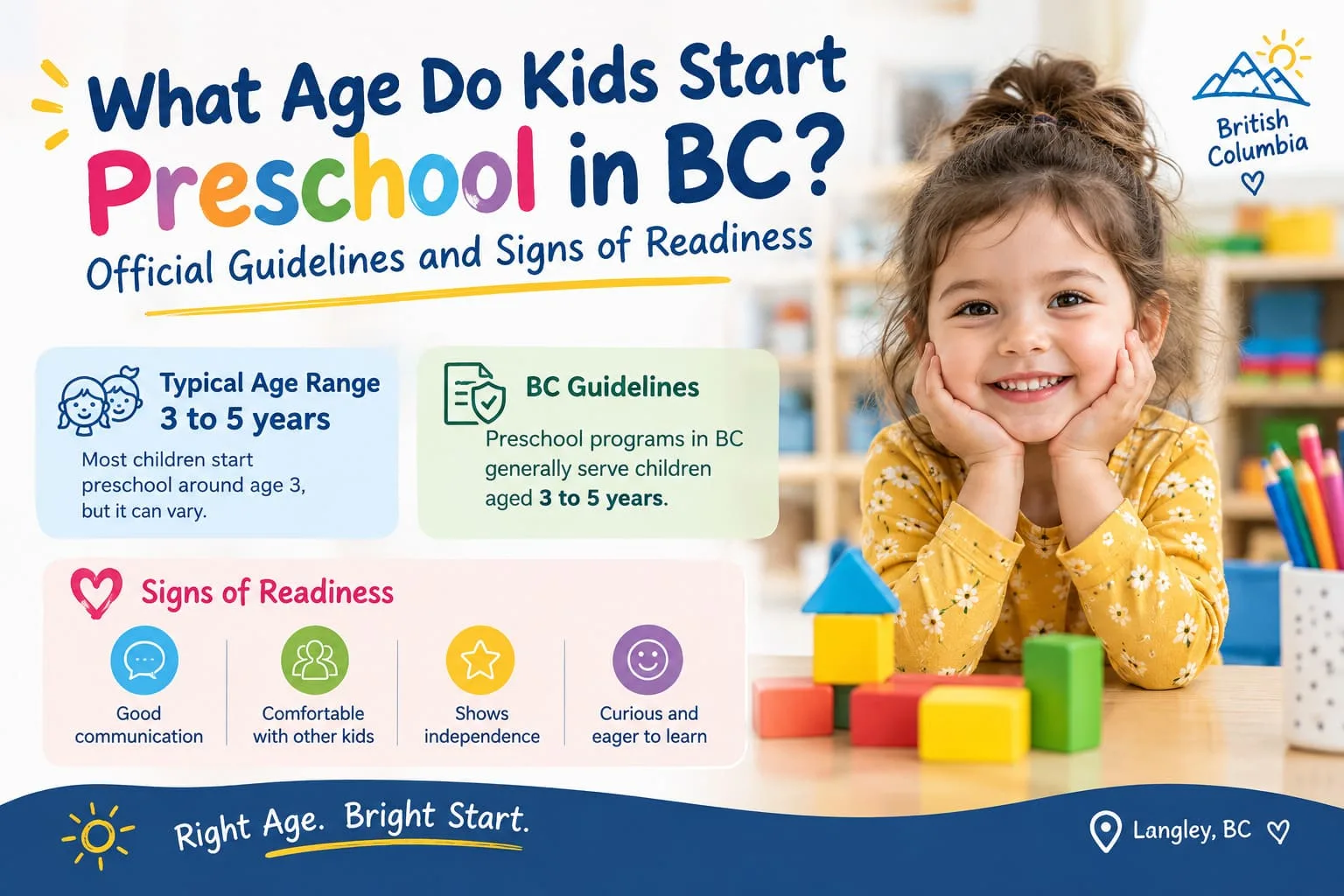
Under provincial legislation, the standard preschool start age in BC begins at thirty months (two and a half years old). Licensed preschool facilities are legally permitted to welcome children between the ages of thirty months and school entry age, which is generally five years old. However, individual centres structure their classroom configurations depending on their specific licence and facility design.
Some facilities offer dedicated junior preschool groups beginning at thirty months, while others reserve their classrooms exclusively for children who have turned three years old by December thirty-first of the enrolment year. In group preschool settings for children aged thirty months to school entry, provincial standards require a maximum educator-to-child ratio of one certified educator to ten children, with a maximum group capacity of twenty children when two qualified teachers are present. These ratios ensure that even the youngest preschool participants receive attentive guidance, emotional support, and active supervision throughout their daily routines.
Age Benchmarks: Breaking Down the Stages
Navigating the early educational continuum requires understanding how different programs serve distinct age brackets. While terms are often used interchangeably in everyday conversation, distinct developmental expectations exist across each tier.
Between eighteen and thirty-six months, toddlers experience significant physical and linguistic expansion. When comparing preschool vs toddler care age, the major distinction lies in routine structure, self-regulation demands, and independence expectations. Toddler programs focus heavily on gross motor mobility, fundamental language acquisition, sensory play, and personal care routines like diapering and assisted handwashing.
As children reach thirty to thirty-six months, their peer engagement shifts. They move from parallel play—where they simply play side by side without interacting—into early cooperative play, where they share materials and work toward joint ideas. This transition marks the entry into the true preschool age, where daily activities incorporate group circle times, collaborative art projects, early phonemic awareness, and problem-solving games that build kindergarten readiness.
Developmental Indicators: Beyond the Birth Certificate
Age eligibility gives your family the legal green light to enrol, but evaluating your child’s developmental signals determines whether they will truly flourish in a classroom setting. Experienced early childhood educators look for several core signs child is ready for preschool:
- Basic Communication Skills: Your child does not need complete conversational mastery, but they should be able to express fundamental needs, such as hunger, thirst, tiredness, or needing to use the washroom. Being able to understand simple two-step instructions from a caring adult is another strong signal of readiness.
- Growing Independence: Can your child take off their shoes, feed themselves snacks, and help pull up their trousers? Classrooms encourage independence, and children who show an eagerness to tackle simple physical tasks on their own often transition smoothly.
- Separation Coping Skills: Experiencing a brief moment of clinginess during morning goodbyes is completely normal for young children. However, a child who can be comforted by a warm educator within ten to fifteen minutes generally possesses the emotional foundation needed for group participation.
- Interest in Other Children: If your child regularly watches other children at the local playground, initiates parallel play, or expresses curiosity about what peers are doing, their social appetite is expanding beyond the family circle.
- Sustained Focus on Preferred Play: While toddlers are naturally energetic, a child showing readiness can sit and engage with an interesting task—such as playdough manipulation, picture book reading, or block building—for eight to ten consecutive minutes without constant adult redirection.
The Question of Toilet Training
One of the most frequent administrative inquiries parents make involves washroom independence. Requirements vary significantly based on licensing categories and facility policies.
Some community programs operate with policies requiring children to be fully daytime toilet-trained prior to their first classroom day. In contrast, fully comprehensive centres equipped with designated changing stations can accommodate children who are still working through this milestone.
When reviewing preschool age requirements Langley operators maintain, always ask for direct clarification on washroom practices during your initial inquiry. Understanding whether educators actively assist with clothing adjustments, maintain scheduled bathroom reminders, or support ongoing toilet training eliminates anxiety for both you and your child.
Why Enrolling in Licensed Preschool Programs Matters
When weighing early childhood arrangements, families occasionally debate between casual, unmonitored playgroups and structured centres. Enrolling your child in accredited, licensed preschool programs BC regulates ensures your child receives high-calibre educational care backed by proven safety standards.
Licensed centres are held accountable by regional Health Authority licensing officers who perform regular, comprehensive inspections. These inspections cover indoor air quality, physical square footage, toy sanitization schedules, emergency procedures, and secure playground designs. Furthermore, lead educators are certified professionals registered with the provincial ECE Registry, requiring verified criminal record clearances, child-specific first aid certifications, and continuing early childhood education coursework.
Beyond regulatory peace of mind, high-calibre centres establish predictable, responsive environments where children learn to trust new mentors, navigate peer interactions peacefully, and develop positive attitudes toward school life.
The Langley Early Learning Community
Selecting an early childhood environment in the Fraser Valley involves evaluating practical regional dynamics, such as neighborhood convenience and everyday travel corridors. If you are comparing locations for preschool langley bc, factor in morning and afternoon traffic patterns along key routes like 200th Street, 53rd Avenue, and Fraser Highway. A facility located conveniently near your daily route significantly reduces morning rush and evening stress.
Young families across communities like Willoughby, Walnut Grove, Murrayville, and Brookswood know that spaces for high-performing early childhood programs remain competitive. When researching community centres and historical private facilities like a traditional kiddie korner day care or small community setups, parents should prioritize programs that offer spacious outdoor natural areas, abundant natural lighting, and experienced, long-tenured educators.
While some families might explore informal kiddie daycare arrangements or home-based babysitting, established group centres offer distinct advantages in administrative consistency, structured curriculum depth, and social peer groupings. Professional centres maintain robust backup staffing plans, ensuring your child’s daily schedule remains uninterrupted throughout the school year.
Practical Steps to Support a Smooth Preschool Transition
Once you determine that your child is at the ideal age and stage to begin preschool, thoughtful preparation at home will set them up for classroom success:
- Read Preschool-Themed Storybooks: Introduce the concept of preschool through engaging picture books that showcase circle time, playground adventures, and afternoon pickups.
- Practice Predictable Morning Routines: Establishing consistent wake-up, breakfast, dressing, and shoe-tying schedules several weeks prior to the first day establishes comforting daily rhythms.
- Host Playdates with New Peers: Give your child regular opportunities to practice sharing materials, taking turns with popular toys, and negotiating boundaries in casual social settings.
- Visit the Facility Playground: Take walks past your chosen centre before the official start date so the building, sounds, and outdoor areas feel warmly familiar rather than strange and intimidating.
- Create a Consistent Goodbye Routine: Develop a brief, loving, and predictable departure ritual—such as a special high-five, two hugs, and a reassuring reminder that you will return after outdoor play. Avoid lingering or sneaking away, which can inadvertently heighten separation anxiety.
Community Frequently Asked Questions
Can my thirty-month-old child start preschool halfway through the school year?
Yes. Many licensed centres in British Columbia accept mid-year enrolments whenever vacancies occur, provided the child has reached thirty months of age. While September remains the traditional intake season, spring and winter openings frequently arise as older children transition into different schedule brackets.
What daily schedule options are typically available for preschool families in Langley?
Most programs offer multiple schedule configurations to fit diverse family needs. Common options include two-day morning sessions (often Tuesday and Thursday) for younger learners, three-day morning sessions (Monday, Wednesday, Friday) for older preschoolers, and comprehensive full-day early learning schedules for working parents requiring continuous care.
What is the typical inquiry response time when contacting early learning centres in Langley?
Reputable childcare centres in Langley generally respond to digital inquiries, email messages, and tour bookings within one to two business days. During this initial contact, administrators can provide current classroom availability, discuss fee reduction programs, and coordinate a guided tour.
What geographic regions do central Langley childcare providers typically accommodate?
Centres situated in central Langley conveniently serve families living throughout Langley City, Murrayville, Brookswood, Aldergrove, and the Willoughby urban core. Their central positioning close to key transit routes also allows convenient access for commuting parents traveling to and from Surrey and Cloverdale.
What happens if my child cries and struggles with separation during the first week?
Separation tears are a natural and common developmental reaction to unfamiliar environments. Caring educators are trained to comfort your child, offer soothing sensory activities, and redirect their attention toward engaging toys. Most children settle down happily within ten to fifteen minutes once the morning routine gets underway.
Final Thoughts on Beginning Your Child’s Early Learning Path
Determining the ideal timing for your child’s preschool entry is a personal, thoughtful decision that shapes their early view of education. By balancing provincial regulations with an honest look at your child’s emotional comfort, self-care abilities, and natural curiosity, you can choose a moment that sets them up for a joyful educational experience. Surrounding your child with dedicated early educators, rich sensory materials, and positive peer connections fosters confidence, resilience, and a genuine love for daily discovery.
When your family is ready to explore a warm, inspiring early learning community, look to Kiddies Daycare Centre. Located at 20103 53 Ave, Langley, BC V3A 3T8, Canada, our qualified early childhood educators offer dynamic, play-based Childcare Programs that support emotional, physical, and cognitive growth. We welcome local parents to visit our classrooms, meet our team, and see how our daily routines inspire curiosity and independence.
If you are currently researching early education choices and searching for a welcoming pre preschool near me or trying to find an accredited preschool closest to me, our team is ready to guide you through registration and help your family take this exciting step.
Ultimately, understanding what age do kids start preschool allows you to make an informed, confident choice that nurtures your child’s growth every single day.