Quick Summary
- The Core Objective: Modern school readiness extends far beyond simple academics, placing a primary focus on social-emotional regulation, executive functioning, and physical independence.
- The Transition Roadmap: Learn how structured daily routines safely ease the transition into full-day local public school environments.
- Curriculum Alignment: Discover the immense developmental benefits of combining structured inquiry with intentional social development blocks.
- Local School Alignment: Understand how early environments intentionally prepare children for the baseline expectations of the local Langley School District (SD35).
- A Local Partner: Learn how early experiences at kiddies academy help young learners transition smoothly from early care into formal schooling.
The transition from early preschool environments into the formal structure of a public kindergarten classroom marks one of the most significant milestones in a child’s developmental journey. For parents in the Fraser Valley, this structural shift frequently introduces a mixture of excitement and logistical questions. Modern elementary schools demand more than a basic familiarity with the alphabet; they require incoming students to possess strong social-emotional resilience, physical self-care agency, and the cognitive flexibility to navigate a full day of group learning.
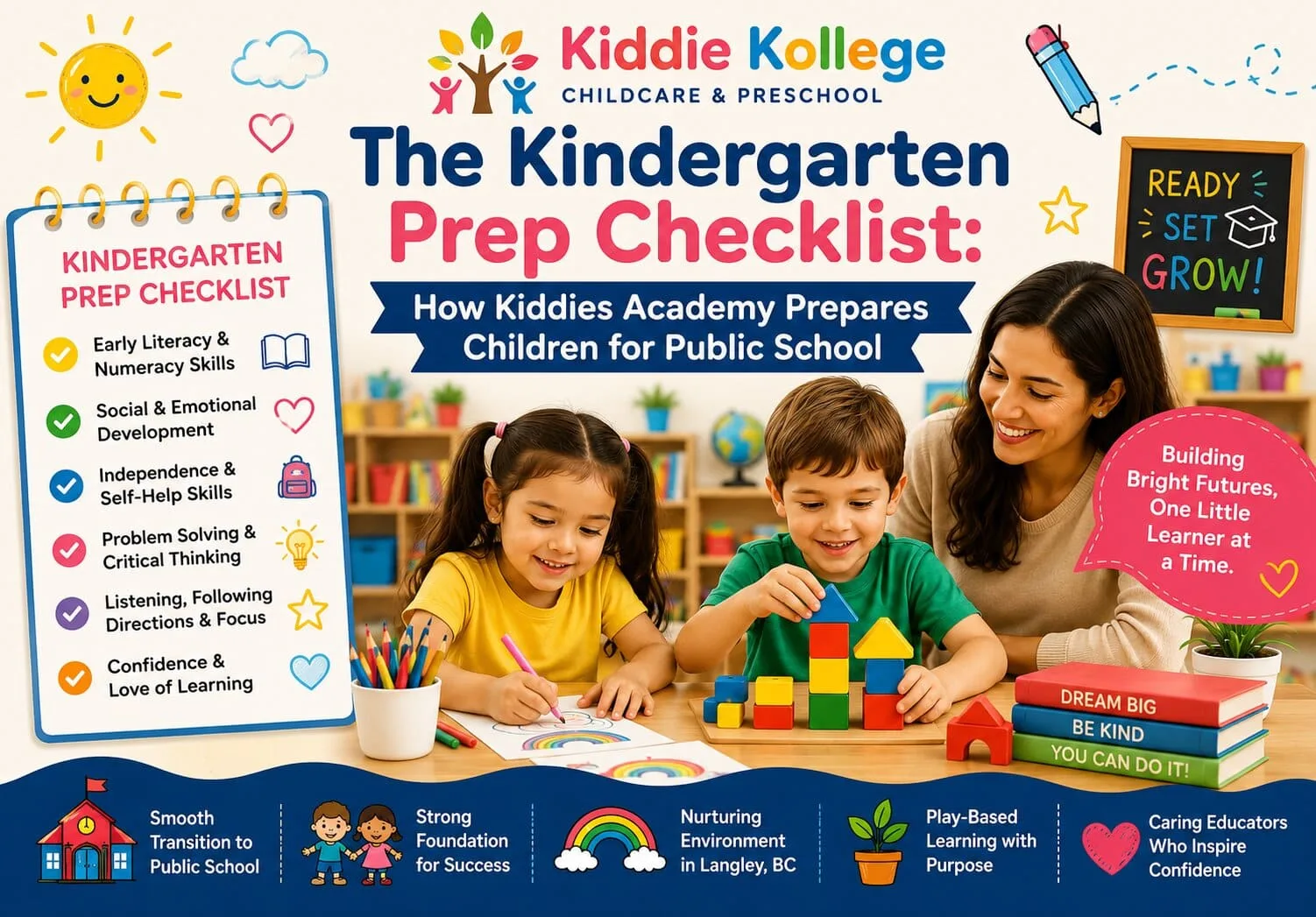
At KiddieKollege, located at 20103 53 Ave, Langley, BC V3A 3T8, Canada, we see firsthand how an intentional, research-based kiddies academy framework builds the necessary internal architecture for this milestone. By examining a comprehensive readiness checklist, families can better understand how play-based routines layer in the cognitive resilience, fine motor control, and independent habits required for lifelong school success.
The Shift Beyond Academics: Holistic Readiness Explained
Historically, the phrase “kindergarten readiness” conjured images of children flashcard-drilling numbers and writing uppercase letters in perfect rows. However, contemporary early childhood education research shows that excessive rote memorization without contextual application offers very little long-term benefit. Kindergarten teachers in the modern public school system consistently emphasize that academic concepts like phonics and addition are easily taught when a child enters the room with a well-regulated nervous system, strong focus, and high social competence.
Holistic school readiness is built upon a child’s executive function. This mental toolkit acts as the brain’s air traffic control system, allowing young minds to filter out distractions, prioritize tasks, follow multi-step adult directions, and demonstrate cognitive flexibility when routines change.
When an early childhood program prioritizes these deep psychological pillars, children do not just learn facts; they learn how to become successful students. They build the emotional stamina required to handle minor frustrations, the confidence to seek help from an educator, and the social vocabulary needed to resolve peer disagreements constructively.
1. Social-Emotional Mastery and Co-Regulation Strategies
The absolute cornerstone of the kindergarten prep checklist centers on social-emotional maturity. A public school classroom often contains upwards of twenty children with a single educator, making individual attention less frequent than in early care settings. A child must be able to operate as a cooperative member of a large group.
Managing Transitions and Big Feelings
In an authentic licensed childcare Langley BC classroom, educators do not shield children from normal peer conflicts or moments of frustration. Instead, they utilize these instances as safe, supervised opportunities for emotional coaching. When a child experiences a setback—such as a building tower collapsing or a long wait for a preferred toy—educators help them identify their feelings and utilize breathing techniques to settle their nervous systems. This practice of co-regulation helps children gradually internalize these tools, transforming them into self-regulating individuals who can maintain their emotional balance during a busy public school day.
Initiating and Sustaining Peer Friendships
Cooperative play requires a highly complex set of communication skills. Children must learn to read subtle peer body language, negotiate roles in imaginative games, share shared materials, and express their personal boundaries using clear language. Early childhood settings foster these skills by organizing structured small-group projects, collaborative storytelling sessions, and dramatic roleplay scenarios where turn-taking is naturally required.
2. Executive Function and Cognitive Stamina
Entering kindergarten introduces a rigorous schedule filled with structured learning blocks, scheduled assemblies, and group table work. Building the cognitive endurance required to thrive under these conditions is a gradual process that must begin long before the first day of school.
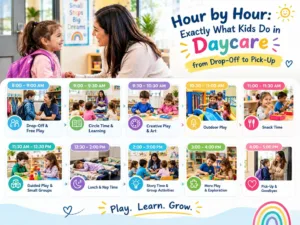
A high-quality preschools in langley framework addresses this by naturally increasing the complexity of daily group times. At the beginning of the preschool years, a group circle time might only last for five to ten minutes, focusing entirely on high-energy action songs.
As children mature, educators thoughtfully extend these blocks, introducing deeper collaborative discussions, interactive group storytelling, and complex multi-step daily projects. This gradual adaptation lengthens a child’s natural attention span, teaching them to listen actively and remain comfortably seated without experiencing physical or mental exhaustion.
Focus Evolution Progress
Year 1: 5-10 Minute High-Energy Circle Blocks (Active Music/Movement)
Year 2: 15-20 Minute Complex Multi-Step Inquiry Blocks (Interactive Group Stories)
Public K: Full-Day Collaborative Classroom Navigation (Sustained Focus)
Furthermore, early childhood classrooms encourage deep working memory by asking children to recall and execute multi-step instructions during everyday transitions. For instance, a child might be asked to put away their art materials, place their folder into their cubby, and wash their hands before sitting down at the lunch table. Practicing these sequences builds the operational memory pathways necessary to navigate a busy public school day independently.
3. Physical Independence and Self-Care Agency
A significant source of hidden stress for incoming kindergarten students is the sudden requirement for complete physical self-care. In a busy public elementary school classroom, children must be able to manage their personal belongings efficiently without relying constantly on adult assistance.
An intentional childcare langley environment builds these necessary independent habits into the flow of every single day. Children are encouraged to open and close their own lunchboxes, manage stubborn backpack zippers, hang up their outdoor gear on labeled hooks, and navigate bathroom routines completely independently.
Educators structure the environment so that sinks, soap dispensers, and storage cubbies sit at a natural child-friendly height, eliminating barriers to independence and helping children view themselves as fully capable individuals.
Fine motor coordination is equally vital. Before a child can comfortably hold a pencil to write their name, the small muscles in their fingers, hands, and wrists must develop significant strength and control.
Early learning classrooms build this strength through open-ended tactile activities rather than dry tracing sheets. Children pinch and roll clay, thread beads onto strings, use safety scissors to cut complex shapes, tear colored paper for mosaics, and manipulate small tweezers during sensory science experiments.
These playful, muscle-building activities lay the essential physical foundation for a proper pencil grasp and comfortable early writing skills.
4. Play-Based Inquiry and Language-Rich Classrooms
True academic preparation is seamlessly woven into the fabric of an intentional play-based preschool Langley curriculum. Rather than relying on static worksheets, math and literacy concepts are brought to life through hands-on exploration and meaningful dialogue.
When a group of children builds a complex wooden block structure, they are not simply passing the time; they are actively engaging with foundational principles of geometry, spatial awareness, balance, and physics.
An expert early childhood educator observes this play and asks open-ended questions: “How many long blocks do you think it will take to bridge that gap?” or “What do you notice happens to the stability when we place the heaviest block at the very top?” This interactive approach transforms a simple play session into a rich lesson in mathematical thinking.
Language development is similarly nurtured through expressive communication. High-quality early childhood preschool programs surround children with a vocabulary-rich environment. Educators read diverse children’s literature daily, engage in deep conversations during mealtimes, and encourage children to dictate their own stories to accompany their artwork.
This consistent exposure ensures that children enter kindergarten with a broad vocabulary, strong phonological awareness, and a genuine, lifelong love for reading and storytelling.
The Langley Context: Navigating Local School Board Expectations
For families living in the Fraser Valley, preparing for the transition also means understanding the specific expectations of the Langley School District (SD35). Local public schools place a high premium on children who can easily participate in outdoor learning, adapt to changing weather conditions, and function as collaborative members of a diverse community.
Early childhood centres in the region often mirror these expectations by implementing robust outdoor play philosophies. Children spend ample time exploring outdoor spaces in all weather conditions, learning to dress appropriately for the Pacific Northwest rain, and developing strong gross motor skills by navigating natural terrains.
This regular outdoor activity builds great physical stamina and resilience, ensuring that when children enter the public school system, they can fully enjoy recess, physical education classes, and outdoor learning opportunities with absolute ease and confidence.
Kindergarten Prep Assessment Checklist
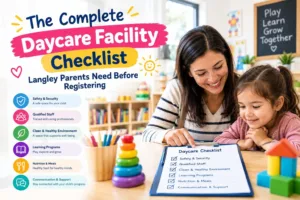
Parents can use this practical developmental reference checklist to track their child’s school readiness progress:
- Social-Emotional Control: Can your child comfortably share shared materials, wait patiently for their turn during activities, and use descriptive words to express their feelings when frustrated?
- Self-Care Independence: Is your child able to use the washroom independently, wash their hands thoroughly, open their personal lunch containers, and put on their outdoor coat and shoes?
- Communication and Language: Can your child listen attentively to a short story, follow a sequence of three related instructions, and express their thoughts clearly to both peers and adults?
- Fine Motor Strength: Does your child regularly use safety scissors with control, manipulate small items like beads or building blocks, and hold a crayon or marker using an efficient grasp?
- Cognitive Focus: Is your child capable of sustaining attention on a preferred group project or table activity for 15 to 20 consecutive minutes?
Frequently Asked Questions
How do early educators support children who display significant separation anxiety?
Educators work closely with families to establish highly predictable, warm morning drop-off routines. By creating clear visual schedules, assigning a comforting peer buddy, and providing immediate emotional reassurance, children quickly learn that the classroom is a secure environment and that their primary caregiver always returns at the end of the session.
What are the administrative communication timelines for waitlists and intake updates?
Our dedicated enrollment team respects that families must carefully coordinate their employment schedules, commutes, and transition timelines. All registration inquiries, campus tour bookings, and waitlist status updates are processed within a prompt 24 to 48 business hour window by our local administration office.
How does a play-based curriculum introduce formal math concepts without worksheets?
Mathematical concepts are introduced using tangible, concrete objects during everyday activities. Children count real loose parts during sensory play, sort blocks by attributes like shape, color, or size, and learn about patterns by stringing colored beads. This hands-on approach builds a deep, practical understanding of mathematical relationships before abstract numbers are introduced on paper.
Which specific geographic neighbourhoods do your early preparation cohorts accommodate?
Our centrally located campus serves as an accessible regional hub for families residing throughout the Fraser Valley. We regularly welcome children from prominent surrounding neighborhoods, including Willoughby, Walnut Grove, Brookswood, Murrayville, Aldergrove, and the entire Langley City core.
Conclusion / Final Thoughts
Preparing a young child for the transition into public school is a rewarding journey that flourishes when built upon a foundation of holistic development, physical self-care agency, and strong social-emotional resilience. By shifting the focus away from stressful academic drilling and prioritizing the growth of the whole child, parents can ensure that their little learner enters their first formal classroom filled with genuine curiosity, social confidence, and a deep love for discovery.
Finding the ideal preparatory setting within our community is entirely accessible when looking at the options among premier daycares centers near me. If you have been searching for a supportive, professional environment to give your child an exceptional educational launchpad, we invite you to connect with our team. At KiddieKollege, we are proud to serve our local community as an outstanding provider of an authentic kiddies academy curriculum. Contact our Langley admissions office today to arrange your private campus walkthrough, meet our certified early childhood educators, and learn how we can partner with your family to make the roadmap to kindergarten a wonderfully joyful, confidence-building milestone for your child.